- Fungi Including Lichens
- ›Basidiomycete Fungi
- ›Higher Basidiomycetes
- ›Mushrooms, Bracket Fungi, Puffballs, and Allies
- ›Agaricomycetidae
- ›Common Gilled Mushrooms and Allies
- ›Agaricineae
- ›Hymenogastraceae
- ›Psilocybe
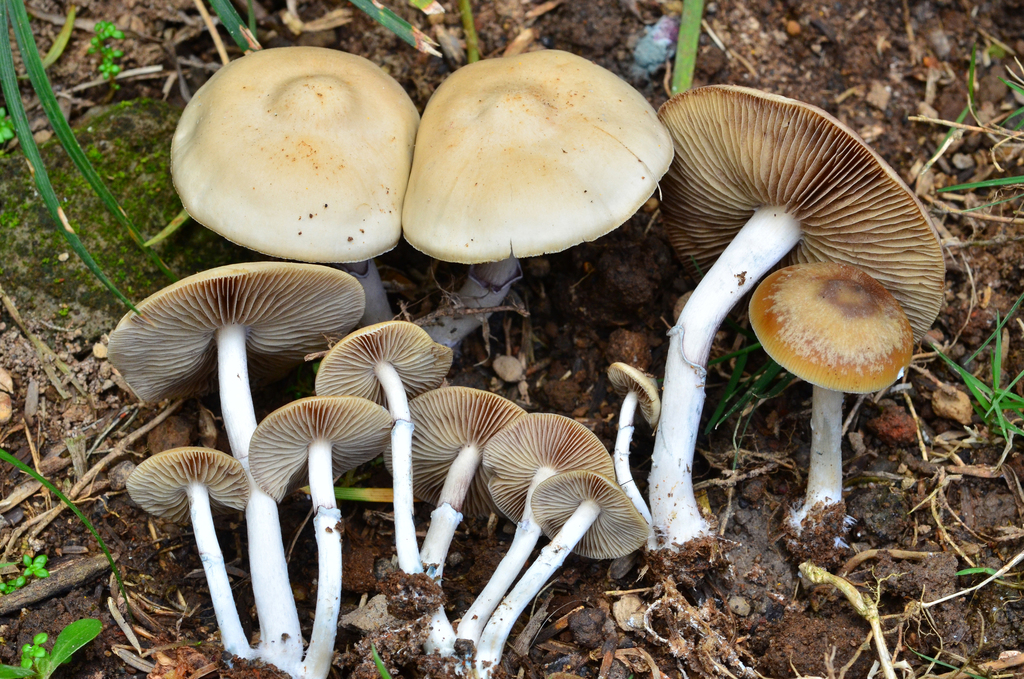
Psilocybe subaeruginascens
Psilocybe subaeruginascens is a psychedelic mushroom which has psilocybin and psilocin as main active compounds. This mushroom is closely related to Psilocybe subfimetaria and Psilocybe stuntzii.
From the article Psilocybe subaeruginascens on Wikipedia (CC BY-SA), quoted section by section
Description
The cap is 20–30 mm, and conical, to broadly campanulate (bell-shaped) or umbonate. It has a striated, ivory or pale-gray/brown colour, with a blue-green tinge and is hygrophanous. It does not change colour in reaction to KOH. The tough white stipe measures 40-65 x 2–3 mm. It is smooth to finely hairy though its base has conspicuous white rhizoids and mycelial strands attached to substrate. It has a fragile, fleeting, white ring left by its partial veil. It bruises blue-green where damaged. The flesh is tough, white, blues when touched and its odor is unpleasant. The gills are a pale brown, to yellowish brown color when young, becoming dark brown with white fringed edges in age. They have an adnate attachment, are crowded and somewhat forked. Its spore print is dark brown or black.
Microscopic Features. The spores measure 8-9.5x 5-6.5 x 4.5-5.5 μm, and are elliptical to subrhomboid in face view and almond-shaped in side view. They have thick-walls (1-1.3 μm in diameter), with distinct germ pore at its apex, and are smooth and opaque. The basidia are 24-30 x 6-8 μm in size, and are cylindrical. They have 4 spores each, and have sterigmata that are up to 7 μm long. The cheilocystidia measure 18-24 x 6-10 μm, and are spindle to urn-shaped, with a rounded or slightly swollen apex. The apex is sometimes covered in a thin, transparent crust. …
Range & habitat
Psilocybe subaeruginascens grows in gregariously and in cespitose clusters in wood chips, piles of leaves, and woody debris in urban areas and along trails and roads in deciduous forests and gardens. It is occasionally found in dung. It is found from April to July in southern Japan and subtropical Indonesia .
Wikipedia: “Distribution and habitat”
Where it lives
Recorded sightings
—
geo-referenced records in GBIF, from museums, herbaria and field observers.
Drag the globe to turn it. Dots are where records exist, not a range map; darker means more records.
In the stacks
Searching the stacks…
Every page naming Psilocybe subaeruginascens in the Biodiversity Heritage Library →
This page is assembled live from iNaturalist, GBIF, Wikipedia, the Source Library and the Internet Archive. It is not yet part of the hand-edited codex. iNaturalist taxon 499798.