- Fungi Including Lichens
- ›Basidiomycete Fungi
- ›Higher Basidiomycetes
- ›Mushrooms, Bracket Fungi, Puffballs, and Allies
- ›Thelephorales
- ›Boletopsidaceae
- ›Boletopsis
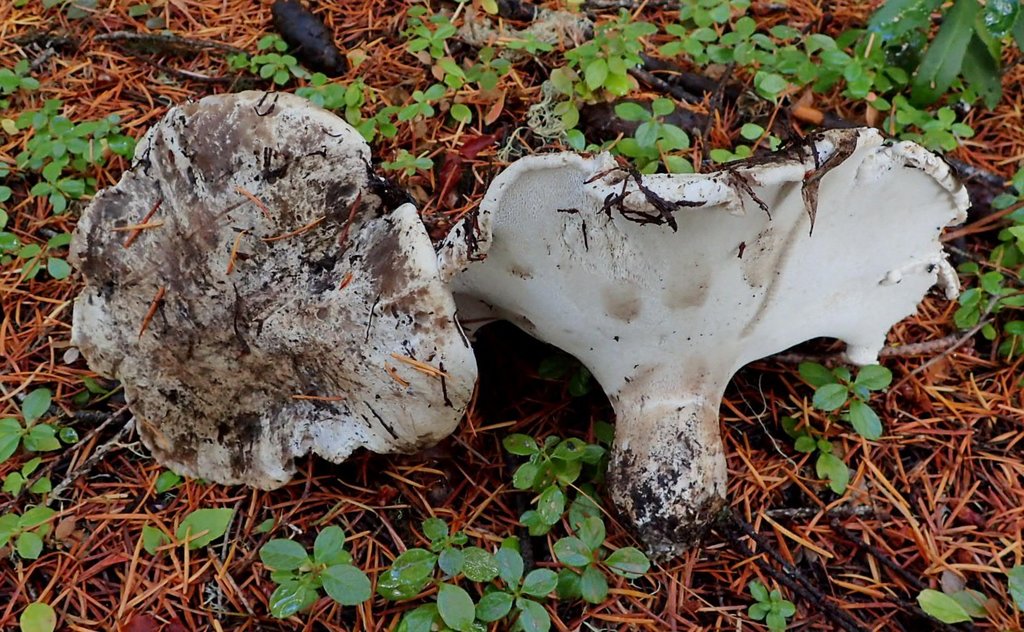
grey falsebolete
Boletopsis grisea
Boletopsis grisea is a species of fungus in the family Bankeraceae. The fruit bodies are gray, fleshy polypores that grow on the ground in a mycorrhizal association with Scots pine (Pinus sylvestris). It is found in Asia, North America, and Europe.
From the article Boletopsis grisea on Wikipedia (CC BY-SA), quoted section by section
Description
The fruit body is a fleshy polypore that grows from the ground. The gray cap is convex and irregular with a dry surface. The cap grows up to 15 centimetres (6 in) wide, the stem 3–10 cm (1+1⁄4–4 in). Underneath the cap are white pores. The stout stipe is the same colour as the cap. The flesh is whitish, discoloring gray to greenish. The smell is fragrant. The spore print is tan.
Similar species. It may resemble B. leucomelaena as well as Albatrellus ovinus and its close relatives.
Range & habitat
Boletopsis grisea is found in Europe, and in both Canada and the United States (August–October in the east and September–November in the west), growing on nutrient-poor acidic soils. It has a mycorrhizal association with Pinus sylvestris (Scots pine), as well as lichens and heath plants as understorey.
Wikipedia: “Distribution and habitat”
Where it lives
Recorded sightings
—
geo-referenced records in GBIF, from museums, herbaria and field observers.
Drag the globe to turn it. Dots are where records exist, not a range map; darker means more records.
In the stacks
Searching the stacks…
Every page naming Boletopsis grisea in the Biodiversity Heritage Library →
This page is assembled live from iNaturalist, GBIF, Wikipedia, the Source Library and the Internet Archive. It is not yet part of the hand-edited codex. iNaturalist taxon 499962.