- Plants
- ›Vascular Plants
- ›flowering plants
- ›Dicots
- ›proteas, lotuses, planes, and allies
- ›Protea family
- ›Paired Proteas
- ›Embothrieae
- ›Hakeinae
- ›Hakea
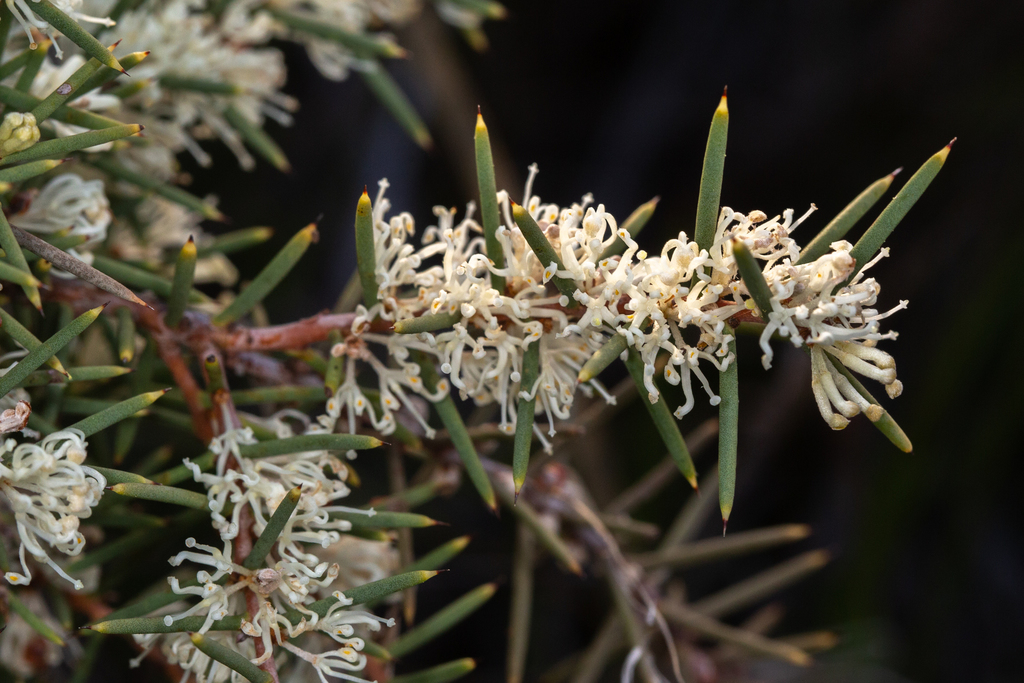
dwarf hakea
Hakea rugosa
Hakea rugosa, commonly known as wrinkled hakea or dwarf hakea, is a shrub of the family Proteaceae native to Australia. It has sharp needle-shaped leaves and white or cream fragrant flowers in profusion from August to October.
From the article Hakea rugosa on Wikipedia (CC BY-SA), quoted section by section
Description
Hakea rugosa is a wide-spreading shrub 0.7–2 m (2 ft 4 in – 6 ft 7 in) high with stiff, straight needle-shaped leaves 1.5–6 cm (0.59–2.36 in) long and 0.9–1.3 mm (0.035–0.051 in) wide. The new growth leaves and branches are covered in flattened, short, silky hairs. The inflorescence consists of densely clustered cream or white flowers in profusion in the leaf axils. The pedicel is 2.0–3.5 mm (0.079–0.138 in) long and covered with flattened silky hairs. The perianth 3–3.5 mm (0.12–0.14 in) long with silky hairs at the base, the pistil 4.5–6 mm (0.18–0.24 in) long and upright. The small, S-shaped fruit are more or less at right angle to the stalk, 1.5–2.2 cm (0.59–0.87 in) long and 0.7–1.6 cm (0.28–0.63 in) wide. The fruit are coarsely wrinkled, occasionally with fine dark warts and the 3–7 mm (0.12–0.28 in) long narrow beak is bent sharply back onto the fruit. Flowering occurs from August to October.
Range & habitat
Dwarf hakea grows on loam or sand in mallee scrub or coastal heath from Eyre Peninsula in South Australia to western Victoria.
== References ==
Wikipedia: “Distribution and habitat”
Where it lives
Recorded sightings
—
geo-referenced records in GBIF, from museums, herbaria and field observers.
Drag the globe to turn it. Dots are where records exist, not a range map; darker means more records.
In the stacks
Searching the stacks…
Every page naming Hakea rugosa in the Biodiversity Heritage Library →
This page is assembled live from iNaturalist, GBIF, Wikipedia, the Source Library and the Internet Archive. It is not yet part of the hand-edited codex. iNaturalist taxon 502255.