- Animals
- ›Molluscs
- ›Gastropods
- ›Heterobranchs
- ›Euthyneura
- ›Tectipleura
- ›Sea Hares and Akera Snails
- ›Aplysioidea
- ›Seahares
- ›Aplysia
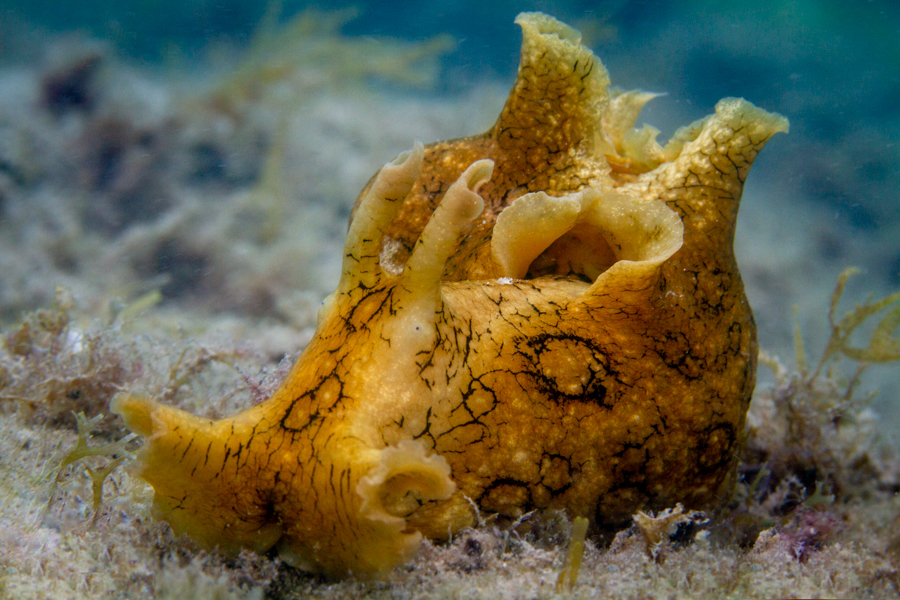
spotted seahare
Aplysia dactylomela
Aplysia dactylomela, common name the "spotted sea hare", is a species of large sea slug, a marine opisthobranch gastropod mollusc in the family Aplysiidae, the sea hares.
From the article Aplysia dactylomela on Wikipedia (CC BY-SA), quoted section by section
Description
The colour of the spotted sea hare is very variable, from pale gray to green, to dark brown. There are almost always large black rings on the mantle. The maximum recorded length is 410 mm. The shell is hatchet-shaped, solid, and pale straw in color, marked by distantly spaced concentric undulations. It is highly oblique and deeply convex, with a testaceous (shelly) interior. The apex is significantly elevated, strongly curved inward, and notably calloused. The upper margin is deeply excavated, broadly reflected, and acuminated (pointed) at its extremity. The outer lip is produced and rounded. The dorsal margin is rounded superiorly, then slopes towards the outer lip inferiorly, appearing arched and excavated.
Range & habitat
As traditionally defined, this species of sea hare was cosmopolitan, being found in almost all tropical and warm temperate seas, including the Mediterranean Sea where first seen in 2002 and likely self-established due to increasing temperatures. Based on genetic evidence, the population from the Indo-Pacific region is now recognized as a separate species, A. argus. This restricts the true A. dactylomela to the Atlantic Ocean region, including the Caribbean and Mediterranean. The appearance of the two species is very similar, although A. argus is more variable in colour and pattern.
Wikipedia: “Distribution and taxonomy”
What it does
The Aplysia dactylomela is capable of swimming and crawling. It accomplishes the former by creating a funnel using the parapodia folded forward and downwards; this action pulls in water. It then pushes the water out from behind the animal by pressing the anterior parts of the parapodia together, thus forward motion is achieved. The sea hare's usual mode of propulsion is crawling; it crawls by lifting the front end of the foot, stretching it forward then placing it on the ground in front, creating an arching pattern; the remainder of the body follows this arching pattern until the tail is reached.
Wikipedia: “Behaviour”
Where it lives
Recorded sightings
—
geo-referenced records in GBIF, from museums, herbaria and field observers.
Drag the globe to turn it. Dots are where records exist, not a range map; darker means more records.
In the stacks
Searching the stacks…
Every page naming Aplysia dactylomela in the Biodiversity Heritage Library →
This page is assembled live from iNaturalist, GBIF, Wikipedia, the Source Library and the Internet Archive. It is not yet part of the hand-edited codex. iNaturalist taxon 50543.