- Plants
- ›Vascular Plants
- ›flowering plants
- ›Dicots
- ›Mustards, Capers, and Allies
- ›papaya family
- ›Vasconcellea
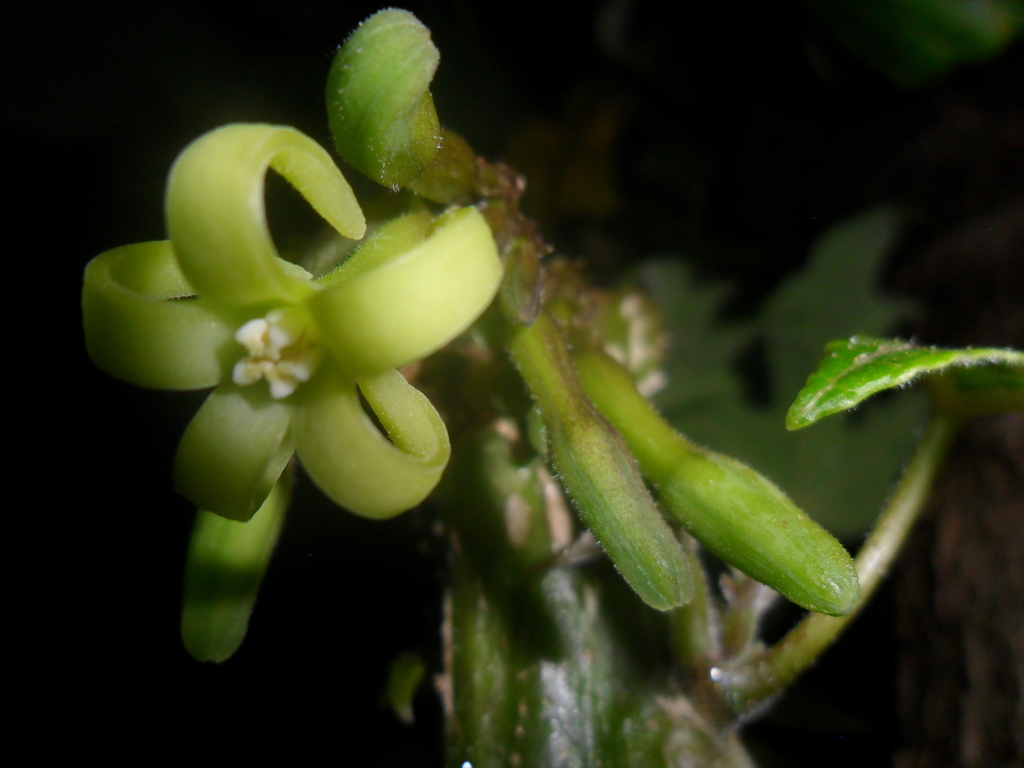
Mountain pawpaw
Vasconcellea pubescens
The mountain papaya (Vasconcellea pubescens) also known as mountain pawpaw, papayuelo, chamburo, or simply "papaya" is a species of the genus Vasconcellea, native to the Andes of northwestern South America from Colombia south to central Chile, typically growing at altitudes of 1,500–3,000 metres (4,900–9,800 ft).
It has also been known as Carica pubescens.
From the article Mountain papaya on Wikipedia (CC BY-SA), quoted section by section
Description
Vasconcellea pubescens is an evergreen pachycaul shrub or small tree with an average height of ca. 5 metres (16 ft) and can grow up to 10 metres (33 ft) tall. It has one central stem and palmate leaves of 5–7 lobes with thick pubescence on the underside of the leaf and petiole. The petioles are long and the top of the leaf has no pubescence. It has a fast growth rate which is one of the reasons it is considered invasive in some regions (see section Invasiveness) and it has an ecological preference for higher altitudes. This plant is mostly dioecious but can be found to be monoecious or even andromonoecious. The existence of flowers of different sexes appears to depend on the season. The fruits are arranged spirally along the trunk and a single tree can produce 50–60 fruits per year. The fruit is 6–15 centimetres (2.4–5.9 in) long and 3–8 centimetres (1.2–3.1 in) broad, with five broad longitudinal ribs from base to apex; it is green, maturing yellow to orange. The fruit pulp is edible, similar to papaya, and is usually cooked as a vegetable. It is also eaten raw.
At the table
The mountain papaya fruit is normally eaten cooked, although some people do eat it raw. Since it has a naturally sourish pulp, it is usually sweetened with sugar or used in preserves, jams, juices, and ice creams. It can also be added to soups and stews to add rich, fruity flavors. The aroma of the fruit is considered to be one of the most important attributes since it is very strong and fruity, due to the complex volatile compounds in the flesh. The papain enzyme present in the milky latex of immature fruits and leaves is often used in the culinary industry as a meat tenderizer since it is a digestive enzyme. Traditionally, the mountain papaya fruit is also prepared as an infused drink including passion fruit, apple, and other fruits and is often sold by street vendors.
Wikipedia: “Culinary uses”
In medicine
High concentrations of the milky latex containing papain (a digestive enzyme) has been reported to help some people with indigestion (dyspeptics); it contains a cysteine endopeptidase mixture especially present in immature fruits that is used commercially by the pharmaceutical and food industries. The latex proteinases from the milky sap have been effectively tested on rodents to treat gastric ulcers. They have also been reported to treat diabetic foot treatments and gastric ulcers in several wounded models as well as reducing melanoma and metastasis levels in animal tumors. Traditionally in the central highlands of Colombia an infusion is made to combat cold and flu diseases. Research has found promise in the use of proteolytic fractions from the unripe fruit in the treatment of wounds and ulcers.
Wikipedia: “Medicinal uses”
How it is grown
This plant grows in a temperature range of 10–28 °C (50–82 °F) but an average temperature of 17 °C (63 °F) is preferred. V. pubescens is sensitive to cold: the stem and leaves could be affected leading to complete plant death when temperatures fall below 2 °C (36 °F). However, it is more cold tolerant than the common papaya. The mountain papaya requires a well drained soil and well established plants can tolerate prolonged drought periods. However, younger/smaller plants are not tolerant to drought. The preferable soil pH range is 6.5–7, but can tolerate a pH range of 4.5–8.4.
Propagation. Growers usually produce their own planting material from their own orchards. The main reproductive mode is via seeds. They are sown in containers which receive only indirect light. Germination is best at a temperature around 24–30 °C (75–86 °F). In case of dioecious plants, both males and females are planted separately. Germination takes 2–6 weeks. When plants are about 2 weeks old, the plants are transferred to a sunny location. They are later planted out into permanent locations when the plants are deemed large enough.
Harvest and processing. The mountain papaya fruit is harvested when it is anywhere from 5–20 centimetres (2.0–7.9 in) long, 5–6 centimetres (2.0–2.4 in) in diameter, and an average weight of 200 grams (7.1 oz). …
Wikipedia: “Cultivation”
In human culture
The origins of the mountain papaya are not well known, but it probably originated in the Northern highlands of the Andes and may have been introduced in the North of Chile by migrations of pre-Columbian peoples. In Chilean mythology, mountain papayas are said to have originated in the middle 16th century when a Spaniard, Juan Cisternas, fell prisoner to indigenous peoples in Norte Chico. He fell in love with Chalalupanqui, the daughter of cacique Hualpi and became engaged with her, but was murdered by another member of the tribe in a fit of jealousy. Chalalupanqui then cried, and from her tears the first papaya formed, hence their golden tearlike shape. The cultivated surface of mountain papaya almost disappeared after the earthquake and tsunami of 2010 in the Maule Region of Chile, mainly because natural growing areas of the species were salinized and damaged by seawater.
Wikipedia: “History”
Where it lives
Recorded sightings
—
geo-referenced records in GBIF, from museums, herbaria and field observers.
Drag the globe to turn it. Dots are where records exist, not a range map; darker means more records.
In the stacks
Searching the stacks…
Every page naming Vasconcellea pubescens in the Biodiversity Heritage Library →
This page is assembled live from iNaturalist, GBIF, Wikipedia, the Source Library and the Internet Archive. It is not yet part of the hand-edited codex. iNaturalist taxon 508242.