- Plants
- ›Vascular Plants
- ›flowering plants
- ›monocots
- ›Agaves, Orchids, Irises, and Allies
- ›iris family
- ›Iridoideae
- ›Irideae
- ›Iris
- ›Iris
- ›Iris
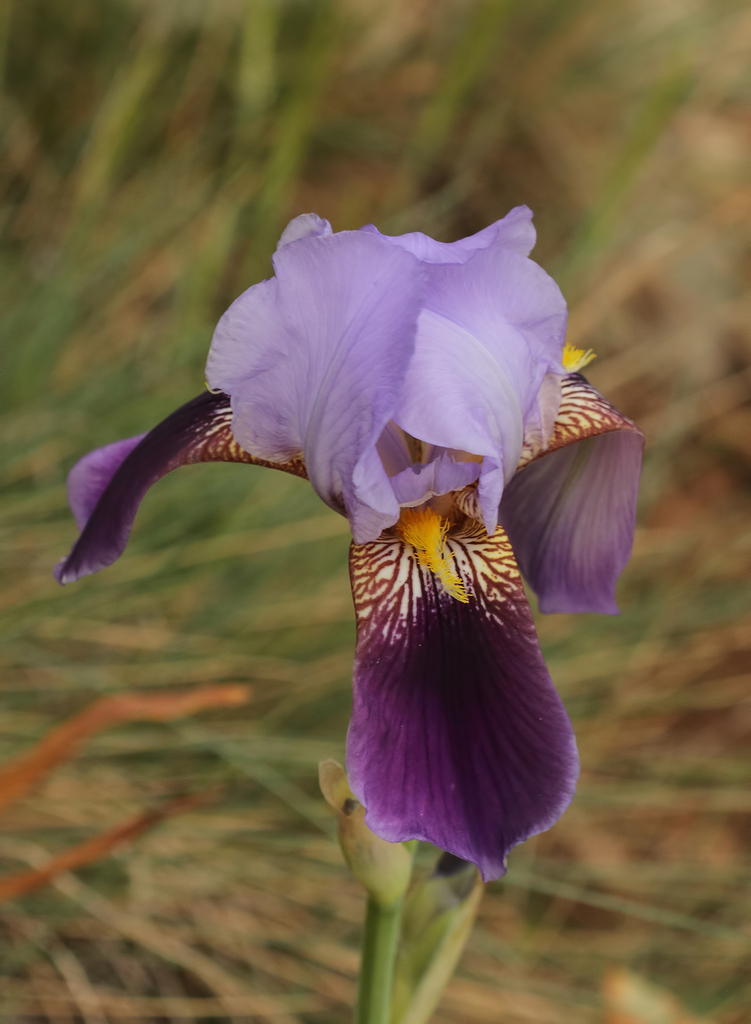
Iris junonia
Iris junonia is a plant species in the genus Iris and the subgenus Iris. It is a rhizomatous perennial, found in parts of Turkey. It has short, glaucous, and straight- or falcate-shaped leaves, tall stems with several branches, numerous or up to eight flowers in various colours from blue, blue-purple, lavender, pale blue, cream, white, to yellow, with brown veining and white tipped orange beards. It is cultivated as an ornamental plant in temperate regions. Its status is still unclear; it is unclear if it is a synonym of Iris germanica or a separate species.
From the article Iris junonia on Wikipedia (CC BY-SA), quoted section by section
Description
Iris junonia has short, broad rhizomes and a few long secondary roots that can form clumps of plants. It has a style branch that is 3–4 cm (1–2 in) long and 1.2–1.6 cm (0–1 in) wide. The iris has straight or slightly falcate (sickle-shaped), grey-green, glaucous, and sheathing leaves that can grow up to between 12 and 38 cm (5 and 15 in) long, and between 3 and 5 cm (1 and 2 in) wide. It is herbaceous—its leaves die in and remain dormant during the winter, before re-growing in the spring. In the Iris purpureobractea variety, the base of the leaves is purple violet. They can grow up to between 10–25 cm (4–10 in) long, and between 1.5 and 2.5 cm wide. Iris junonia is a tall growing species, with a slender and stiff stem, or peduncle, that can grow up to between 20 and 65 cm (8 and 26 in) tall. The stem has several (normally 2–4) lateral branches, or pedicels. The lower branches are 2–6 cm (1–2 in) long and the upper branches are sessile. The stem has obtuse or rounded, inflated, spathes (leaves of the flower bud), which are green, 2–7.6 cm (1–3 in) long, and scarious above. In the Iris purpureobractea variety, the spathes are very heavily stained purple; hence, the name Iris purpureobractea. The stem (and many branches) can hold up to 7 flowers, between May and June or (rarely) July. The flowers are chunky and 4–8 cm (2–3 in) in diameter. …
Range & habitat
Iris junonia is a rare plant, with only a few wild colonies. It is native to temperate areas of Asia minor. It is endemic to Turkey (especially in the north, northwest, west, and southwest, within the provinces of Sakararya, Usak, and Bolu). It has also been found in the Eastern Anatolia region (with Iris taochia and Iris schachtii), on Honaz Mountain in Denizli Province, in the Taurus Mountains in Cilicia, and in the Adana and Içel provinces of Turkey. It is endemic to Sicilian Taurus (a hill for which the city of Taormina was named).
Wikipedia: “Distribution”
How it is grown
Iris junonia is hardy to close to −15 °C (5 °F). It is hardy enough to grow in France, but not fully hardy in the United Kingdom. It prefers to grow in well-drained soils containing limestone, in dry locations, and in full sun. It can be grown in rock gardens, but can be damaged by slugs and aphids. It can also be prone to rhizome rot. William Rickatson Dykes recommends a planting time of between August and September. Irises can generally be propagated by division or seed growing. Iris junonia can be used in hybridization, used like Iris aphylla. It can be crossed with various other bearded irises, and can be crossed with other iris species (such as Iris pumila and Regelia section irises) to produce fertile offspring. Dykes believed that Iris junonia had potential in breeding programmes to create plants with tall stems and large flowers.
Wikipedia: “Cultivation”
In human culture
In 2002, Mozambique released a postage stamps showing an illustration of the iris as part of a set of stamps about flora. In 2013, a study was carried out on the cultural conditions of Iris species in Turkey.
Wikipedia: “Culture”
Where it lives
Recorded sightings
—
geo-referenced records in GBIF, from museums, herbaria and field observers.
Drag the globe to turn it. Dots are where records exist, not a range map; darker means more records.
In the stacks
Searching the stacks…
Every page naming Iris junonia in the Biodiversity Heritage Library →
This page is assembled live from iNaturalist, GBIF, Wikipedia, the Source Library and the Internet Archive. It is not yet part of the hand-edited codex. iNaturalist taxon 508315.