- Animals
- ›Chordates
- ›Vertebrates
- ›Birds
- ›Cranes, Rails, and Allies
- ›Rails, Gallinules, and Coots
- ›Mustelirallus
On eBird ↗
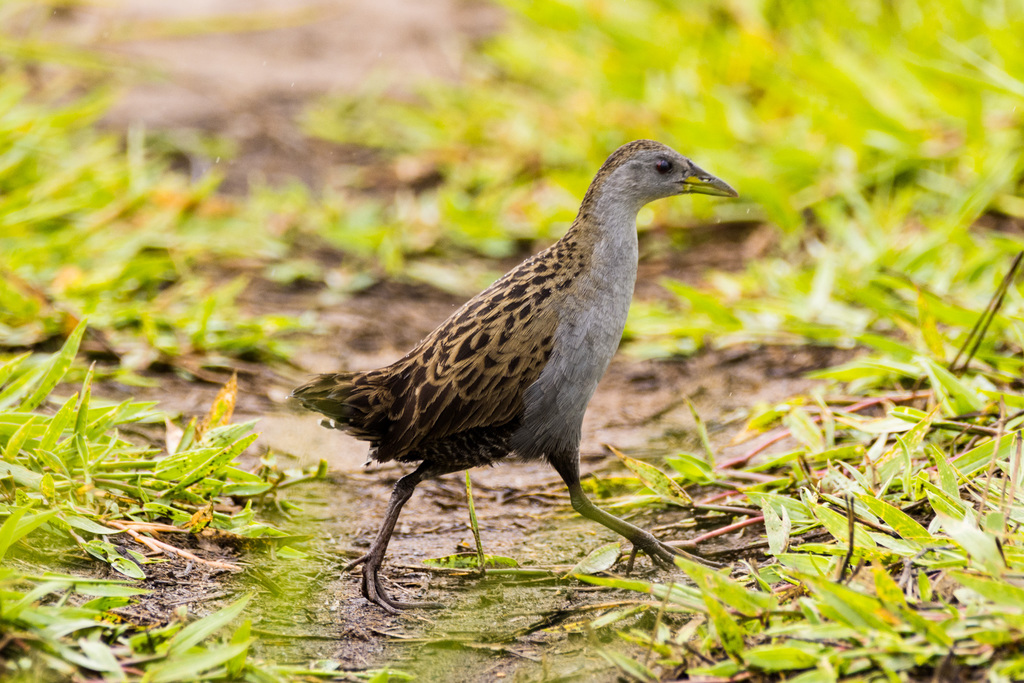
Ash-throated Crake
Live sightings near you, the range map, bar charts of when it is seen, and Macaulay Library photos and recordings.
Ash-throated Crake
Mustelirallus albicollis
The ash-throated crake (Mustelirallus albicollis) is a species of bird in the family Rallidae. It is found in Argentina, Bolivia, Brazil, Colombia, French Guiana, Guyana, Paraguay, Peru, Suriname, Trinidad and Tobago, and Venezuela. Its natural habitats are subtropical or tropical seasonally wet or flooded lowland grassland and swamps.
From the article Ash-throated crake on Wikipedia (CC BY-SA), quoted section by section
Description
The ash-throated crake is 21 to 24 cm (8.3 to 9.4 in) long and weighs 90 to 120 g (3.2 to 4.2 oz). The sexes have the same plumage. Adults of the nominate subspecies have black upperparts with brown edges to the feathers, a pale gray throat, breast, and belly, and black and white bars on the flanks and undertail coverts. They have a short greenish bill and purplish brown legs. Subspecies M. a. typhoeca is smaller and paler than the nominate.
Range & habitat
The ash-throated crake's subspecies have completely separate ranges. M. a. typhoeca is the more northerly. It is found from Colombia east through Venezuela, extreme northern Brazil, and the Guianas and south into far northeastern Ecuador. It previously occurred on Trinidad but has been extirpated from there. M. a. albicollis is found in eastern and southern Brazil, southeastern Peru, northern and eastern Bolivia, eastern Paraguay, extreme northern Argentina, and extreme northern Uruguay. The species inhabits a wide variety of damp to wet landscapes including freshwater marshes, moriche swamps, rice fields, savanna, and pastures, though it tends to be in the drier parts of marshes and swamps. In elevation it ranges from sea level to 1,200 m (3,900 ft).
Wikipedia: “Distribution and habitat”
What it does
The ash-throated crake usually forages out of sight in vegetation but sometimes emerges to the edges of it. Its diet is grass seeds and adults and larvae of insects such as Lepidoptera, Formicidae, and Coleoptera.
Wikipedia: “Feeding”
Listen
Looking for field recordings…
Where it lives
Recorded sightings
—
geo-referenced records in GBIF, from museums, herbaria and field observers.
Drag the globe to turn it. Dots are where records exist, not a range map; darker means more records.
In the stacks
Searching the stacks…
Every page naming Mustelirallus albicollis in the Biodiversity Heritage Library →
This page is assembled live from iNaturalist, GBIF, Wikipedia, the Source Library and the Internet Archive. It is not yet part of the hand-edited codex. iNaturalist taxon 508907.