- Plants
- ›Vascular Plants
- ›flowering plants
- ›Dicots
- ›saxifrages, stonecrops, and allies
- ›red thumb family
- ›Cynomorium
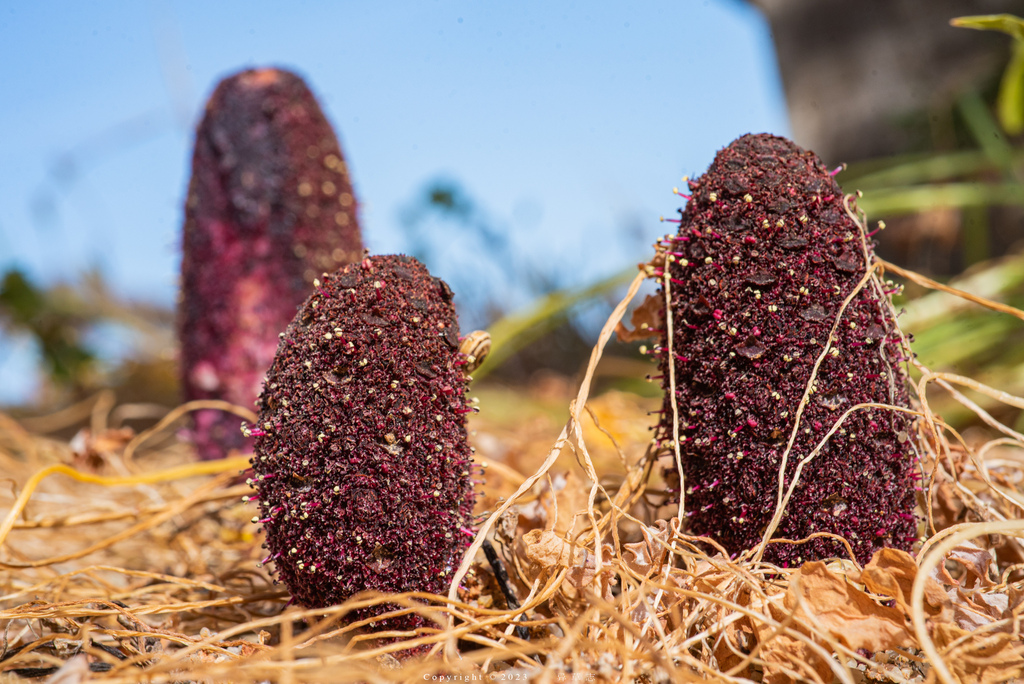
Red Thumb
Cynomorium coccineum
Cynomorium is a genus of parasitic perennial flowering plants in the family Cynomoriaceae. The genus consists of only one species, Cynomorium coccineum (although one of its subspecies is sometimes treated as a separate species). Its placement in the Saxifragales was resolved in 2016 with the help of nuclear, plastid, and mitochondrial sequences obtained from next-generation sequencing. Common names include the misleading Maltese fungus or Maltese mushroom; also desert thumb, red thumb, tarthuth (Bedouin) and suoyang (Chinese). A rare or local species, it grows in dry, rocky or sandy soils, often in salt marshes or other saline habitats close to the coast. It has had a wide variety of uses in European, Arabian and Chinese herbal medicine.
From the article Cynomorium on Wikipedia (CC BY-SA), quoted section by section
Description
This plant has no chlorophyll and is unable to photosynthesise. It is a geophyte, spending most of its life underground in the form of a rhizome, which is attached to the roots of its host plant; it is a holoparasite, i.e. totally dependent on its host. The low-growing inflorescence emerges (in spring, following winter rain), on a fleshy, unbranched stem (most of which is underground) with scale-like, membranous leaves. Dark-red or purplish, the inflorescence consists of a dense, erect, club-shaped mass, some 15–30 cm (5.9–11.8 in) long, of minute scarlet flowers, which may be male, female or hermaphrodite. It is pollinated by flies, attracted to the plant by its sweet, slightly cabbage-like odour. Once pollinated, the spike turns black. The fruit is a small, indehiscent nut. In the Mediterranean region, Cynomorium is a parasite of salt-tolerant plants in the Cistaceae (cistus family) or Amaranthaceae (amaranth family); elsewhere it parasitizes Amaranthaceae, Tamaricaceae (tamarisks) and, in China, Nitrariaceae, especially Nitraria sibirica. Other authorities suggest the host plants are saltbushes (Atriplex species, Amaranthaceae). DNA studies suggest that Cynomorium is not a member of the Balanophoraceae, as previously thought, but more probably belongs to the Saxifragales, possibly near Crassulaceae (stonecrop family). …
Range & habitat
Cynomorium coccineum var. coccineum is found from the Atlantic coastal desert in Mauritania and Western Sahara, through Morocco, the Canary Islands, southern Iberia (Portugal and Spain), the Balearic Islands, Algeria, Corsica, Sardinia, Sicily, southern Italy, Malta, Tunisia, Libya, Egypt, the Arabian Peninsula, Somalia, Iran and Afghanistan. Cynomorium coccineum var. songaricum is found in Central Asia and Mongolia, where it grows at high altitudes. Several authorities consider this to be a separate species, C. songaricum; it is called "suoyang" (Chinese: 鎖陽) in China, where it is extensively collected as a herbal remedy for illnesses including sexual worries and nocturnal emissions.
Wikipedia: “Distribution”
At the table
Sir David Attenborough suggests that, following the reasoning of the "Doctrine of signatures", the phallic shape of the inflorescence suggested to early herbalists that Cynomorium should be used as a cure for erectile dysfunction and other sexual problems. Its colour suggested that it would cure anaemia and other diseases of the blood. It has been used for similar purposes in the east and west of its range: crusaders carried dried spikes to help them recover from their wounds. Other traditional uses have included treatments for apoplexy, dysentery, sexually transmitted diseases, hypertension, vomiting and irregular menstruation. The city of Kuyu 苦峪 was also known as Suoyang City (the Chinese name for cynomorium), after the 7th-century general Xue Rengui and his army supposedly survived a siege there by eating the plant. Much later, it was "introduced" (or possibly imported) to China from Mongolia during the Yuan dynasty as a medicinal plant, and is first mentioned by Zhū Dānxī (朱丹溪) in his Supplement and Expansion of Materia Medica (Chinese: 本草衍義補遺; pinyin: Běncǎo Yǎnyì Bǔyí) in 1347. It was an ingredient in his recipe for hidden tiger pills (Chinese: 虎潛丸 or 虎潜丸; pinyin: hǔqián wán), used for impotence and weak legs. During the 16th century, the Knights of Malta greatly prized the plant and sent samples of it to European royalty. …
Wikipedia: “History and historical uses”
Where it lives
Recorded sightings
—
geo-referenced records in GBIF, from museums, herbaria and field observers.
Drag the globe to turn it. Dots are where records exist, not a range map; darker means more records.
In the stacks
Searching the stacks…
Every page naming Cynomorium coccineum in the Biodiversity Heritage Library →
This page is assembled live from iNaturalist, GBIF, Wikipedia, the Source Library and the Internet Archive. It is not yet part of the hand-edited codex. iNaturalist taxon 50902.