- Plants
- ›Vascular Plants
- ›flowering plants
- ›Dicots
- ›Buttercups, Poppies, and Allies
- ›buttercup family
- ›Columbines and Meadow-Rues
- ›Aquilegia
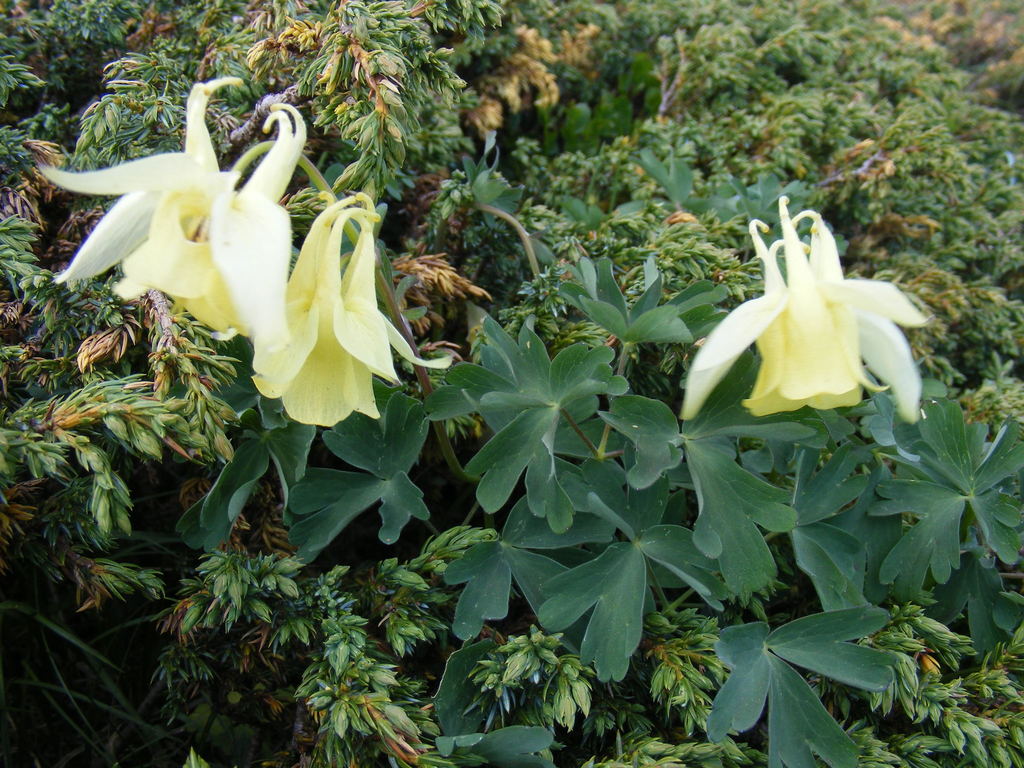
Aquilegia aurea
Aquilegia aurea is a perennial flowering plant in the family Ranunculaceae native to Bulgaria and small areas of North Macedonia and Greece.
From the article Aquilegia aurea on Wikipedia (CC BY-SA), quoted section by section
Description
Aquilegia aurea grows to 10–100 cm (4–39 in) with smooth or lightly hairy stems and large, nodding, light yellow or greenish-yellow flowers with a hooked nectar spur and protruding stamens. It forms a large underground mass to maintain stability among the loose rocks and scree of its environment.
Range & habitat
Aquilegia aurea is native to mountainous regions of western and southwestern Bulgaria, in Vitosha, Rila, Pirin and the western Rhodope Mountains, as well as the Belasica mountains (also known as Kerkini in Greece) in southeastern North Macedonia and northeastern Greece. It grows in rocky alpine meadows at altitudes of 1,800–2,300 m (5,900–7,500 ft).
Wikipedia: “Distribution and habitat”
What it does
Aquilegia aurea blooms in June and July. It is one of the diagnostic species for the high-altitude Aquilegio aureae-Doronicetum columnae plant community that occurs in almost all of the main Bulgarian mountain ranges. The leaf miner Phytomyza minuscula is known to attack the leaves, along with the fungus Erysiphe aquilegiae var. aquilegiae, which causes powdery mildew, and the smut fungus Urocystis aquilegiae, which creates pustules on the leaves.
Wikipedia: “Ecology”
In human culture
The specific epithet aurea means "golden" in Latin, referring to the colour of the flowers.
Wikipedia: “Etymology”
Where it lives
Recorded sightings
—
geo-referenced records in GBIF, from museums, herbaria and field observers.
Drag the globe to turn it. Dots are where records exist, not a range map; darker means more records.
In the stacks
Searching the stacks…
Every page naming Aquilegia aurea in the Biodiversity Heritage Library →
This page is assembled live from iNaturalist, GBIF, Wikipedia, the Source Library and the Internet Archive. It is not yet part of the hand-edited codex. iNaturalist taxon 509381.