- Plants
- ›Vascular Plants
- ›flowering plants
- ›Dicots
- ›Buttercups, Poppies, and Allies
- ›buttercup family
- ›Columbines and Meadow-Rues
- ›Aquilegia
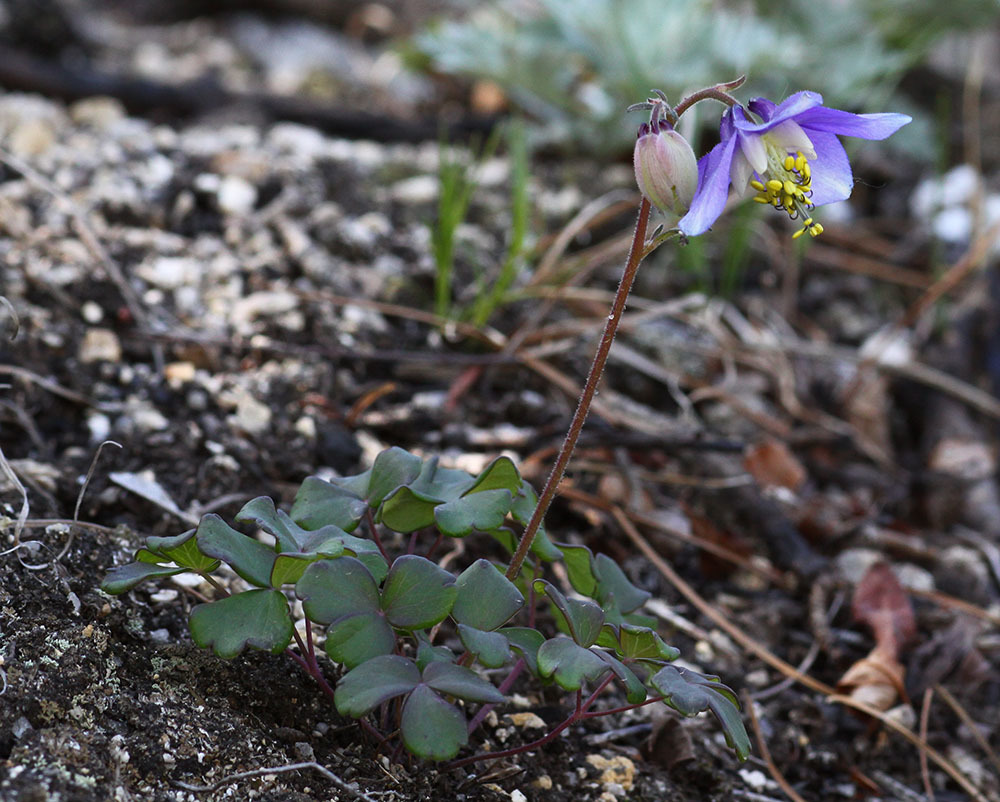
Aquilegia parviflora
Aquilegia parviflora is a species of flowering plant of the Aquilegia (columbine) genus in the family Ranunculaceae native to the Asian regions of Siberia, northern Mongolia, northern China, and Sakhalin.
Its comparatively small blue-purple flowers give the plant its name and make it less popular with gardeners than other columbines. The plant is well-suited to rock gardens.
From the article Aquilegia parviflora on Wikipedia (CC BY-SA), quoted section by section
Description
Aquilegia parviflora grows to roughly 40 centimetres (16 in) tall – with an observed range between 10 centimetres (3.9 in) and 80 centimetres (31 in) – with stems of between 1 millimetre (0.039 in) and 2 millimetres (0.079 in) thick. Plants can possess numerous stems, each of which are branched. The plant's stems are glabrous. The plant's few leaves are in a basal arrangement (growing from the base of the stems) and are leathery. Flowering lasts between two and three weeks during the mid-spring (June). The plants have numerous but small flowers which each measure between 2.5 centimetres (0.98 in) and 3.5 centimetres (1.4 in) across. The sepals are blue-purple and range between 15 millimetres (0.59 in) and 20 millimetres (0.79 in) long. The sepals spread and are ovate or oblong-ovate in shape. The petal blades can be blue-purple or white and are between 3 millimetres (0.12 in) and 5 millimetres (0.20 in) long. Stamens are between 8 millimetres (0.31 in) and 11 millimetres (0.43 in) long. Nectar spurs are short compared to other Aquilegia and heavily curved, extending only between 3 millimetres (0.12 in) and 5 millimetres (0.20 in) in length. Spurless instances of A. parviflora have been observed. Fruiting occurs a month following flowering. Seeds are 2 millimetres (0.079 in) long.
Range & habitat
The species is native to the Asian regions of Siberia, northern Mongolia, and northern China. In Russia, its presence has been documented in Amur Oblast, the former Chita Oblast (now part of Zabaykalsky Krai), Irkutsk Oblast, Khabarovsk Krai, Krasnoyarsk Krai, Magadan Oblast, Primorsky Krai, Sakha Republic, and the island of Sakhalin. In China, it is found in Inner Mongolia and Manchuria. It favors the woodlands and slopes of its range. The plant favors forest clearings and meadows. The plant is found in this range at elevations of between 2,500 metres (8,200 ft) and 3,500 metres (11,500 ft). In 1901, botanist and later Prime Minister of Finland A. K. Cajander traveled to along the lower portion of the Lena River in Siberia. Among the vascular plant species he gathered examples of was A. pavriflora, retaining four specimens. His notes indicate the plant's presence from the mouth of the Vilyuy (a tributary of the Lena) into subalpine zones, with occurrence of the species being "[f]airly frequent to very frequent". He recorded that its frequency decreased north of the Vilyuy's mouth until it ceased "halfway between the Vilyuy and Agrafena". He located examples in larch forests and on the margins of forests, saying the plant preferred "half-open places". Cajander said A. …
Wikipedia: “Distribution”
How it is grown
Gardeners, who often favor columbine plants with larger flowers, tend to avoid acquiring the species. Cultivation of A. parviflora is generally reserved to collectors. In 1946, botanist Philip A. Munz noted that the flower did not appear to be cultivated in the United States. Cultivation requires planting in sunny or semi-shaded positions. Russian botanist Tatyana Shulkina noted that the plant was well-suited for rock gardens.
Wikipedia: “Cultivation”
In human culture
The word columbine derives from the Latin word columbinus, meaning "dove", a reference to the flowers' appearance of a group of doves. The genus name Aquilegia may come from the Latin word for "eagle", aquila, in reference to the petals' resemblance to eagle talons. Aquilegia may also derive from aquam legere, which is Latin for "to collect water", or aquilegium, a Latin word for a container of water. The name parviflora means "small-flowered".
Wikipedia: “Etymology”
Where it lives
Recorded sightings
—
geo-referenced records in GBIF, from museums, herbaria and field observers.
Drag the globe to turn it. Dots are where records exist, not a range map; darker means more records.
In the stacks
Searching the stacks…
Every page naming Aquilegia parviflora in the Biodiversity Heritage Library →
This page is assembled live from iNaturalist, GBIF, Wikipedia, the Source Library and the Internet Archive. It is not yet part of the hand-edited codex. iNaturalist taxon 509407.