- Plants
- ›Vascular Plants
- ›flowering plants
- ›monocots
- ›Agaves, Orchids, Irises, and Allies
- ›agave and allies
- ›cabbage tree subfamily
- ›Thysanotus
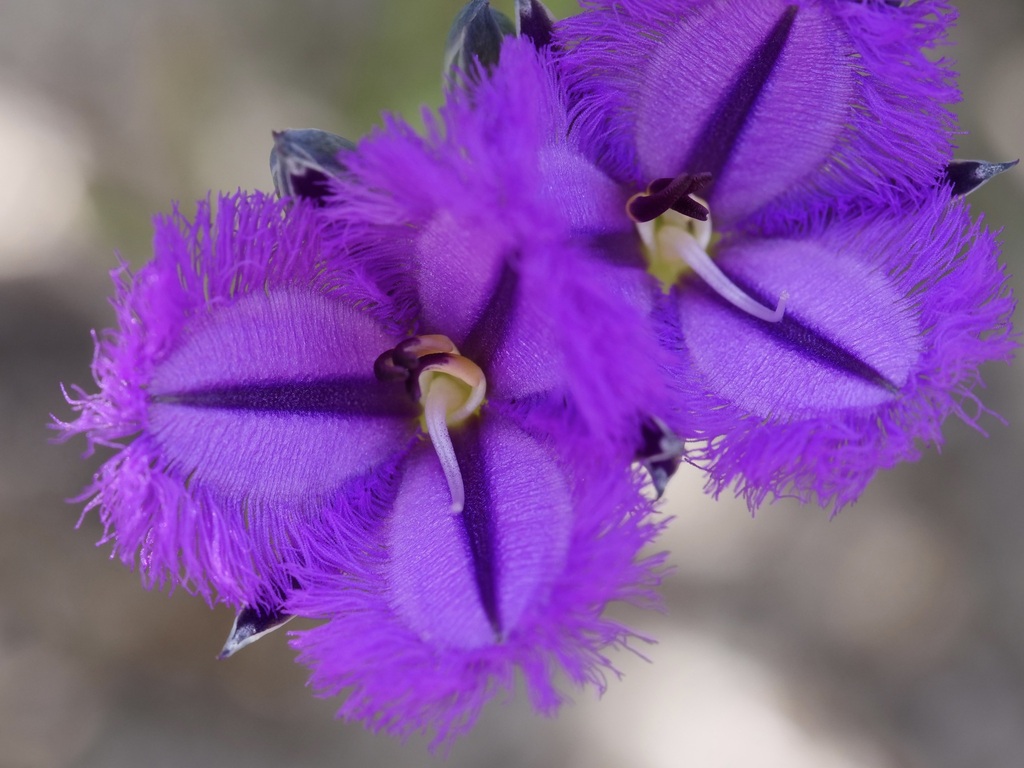
Thysanotus triandrus
Thysanotus triandrus, commonly known as three-stamened fringe lily is a species of flowering plant in the Asparagaceae family, and is endemic to the south-west of Western Australia. It is a tufted perennial herb with a small rootstock, fibrous roots, narrowly lance-shaped to more or less linear, perennial leaves and an umbels of four to fifty purple flowers with lance-shaped sepals, elliptic fringed petals and three stamens with equal anthers.
From the article Thysanotus triandrus on Wikipedia (CC BY-SA), quoted section by section
Description
Thysanotus triandrus is a tufted perennial herb with a small rootstock and fibrous roots. It has about 5 to 42 narrowly lance-shaped to more or less linear and flat or channelled leaves that are more or less terete on the upper surface and ridged below, 50–430 mm (2.0–16.9 in) long and 1.5–3 mm (0.059–0.118 in) wide. The flowers are borne in an umbel with four to fifty flowers, each on a pedicel 5–35 mm (0.20–1.38 in) long. The perianth segments are 9–15 mm (0.35–0.59 in) long, the sepals lance-shaped, about 3 mm (0.12 in) wide, and the petals elliptic, 6–7 mm (0.24–0.28 in) wide, with a fringe about 3 mm (0.12 in) long. There are three stamens, the anthers about 5 mm (0.20 in) long, slightly curved and twisted, the style curved, about 6 mm (0.24 in) long. Flowering occurs from September to December, and the seeds are cylindrical about 2 mm (0.079 in) long and 1 mm (0.039 in) in diameter with a stalked, yellow aril.
Range & habitat
Thysanotus triandrus grows in low Banksia forest on inland sandplain vegetation in deep white sand, sometimes with Eucalyptus staeri in dark, humus-rich sand. It occurs from Cockleshell Gully to Esperance and Israelite Bay, in the Avon Wheatbelt, Esperance Plains, Geraldton Sandplains, Jarrah Forest, Mallee, Swan Coastal Plain and Warren bioregions of south-western Western Australia.
Wikipedia: “Distribution and habitat”
Where it lives
Recorded sightings
—
geo-referenced records in GBIF, from museums, herbaria and field observers.
Drag the globe to turn it. Dots are where records exist, not a range map; darker means more records.
In the stacks
Searching the stacks…
Every page naming Thysanotus triandrus in the Biodiversity Heritage Library →
This page is assembled live from iNaturalist, GBIF, Wikipedia, the Source Library and the Internet Archive. It is not yet part of the hand-edited codex. iNaturalist taxon 511232.