- Plants
- ›Vascular Plants
- ›flowering plants
- ›Dicots
- ›beeches, oaks, walnuts, and allies
- ›Sheoaks
- ›Allocasuarina
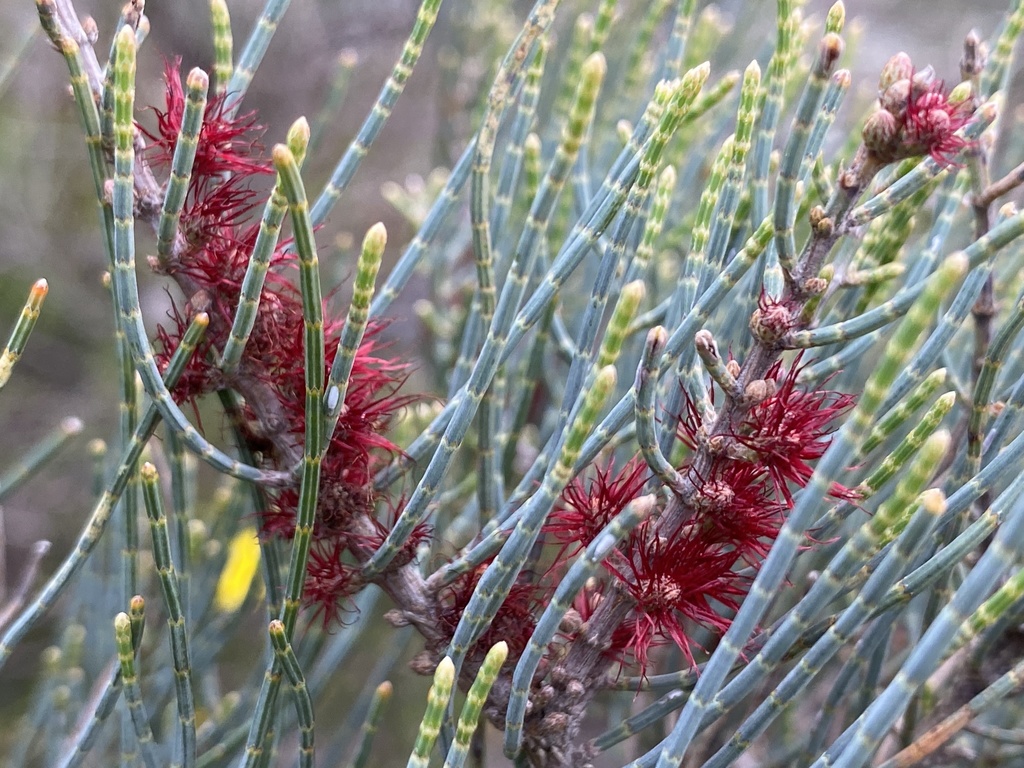
dwarf sheoak
Allocasuarina humilis
Allocasuarina humilis, commonly known as dwarf sheoak, is a species of flowering plant in the family Casuarinaceae and is endemic to the south-west of Western Australia. It is an erect or spreading dioecious or monoecious shrub that has its leaves reduced to scales in whorls of five to seven, the mature fruiting cones 12–22 mm (0.47–0.87 in) long containing winged seeds (samaras) 5–6 mm (0.20–0.24 in) long.
From the article Allocasuarina humilis on Wikipedia (CC BY-SA), quoted section by section
Description
Allocasuarina humilis is an erect or spreading, dioecious or monoecious shrub that typically grows to a height of 0.2–2 m (7.9 in – 6 ft 6.7 in). Its needle-like branchlets are more or less erect, up to 120 mm (4.7 in) long, the leaves reduced to scale-like teeth 0.4–0.5 mm (0.016–0.020 in) long, arranged in whorls of five to seven around the branchlets. The branchlets are smooth and sometimes waxy. The sections of branchlet between the leaf whorls (the "articles") are mostly 3–6 mm (0.12–0.24 in) long and 0.8–1.2 mm (0.031–0.047 in) wide. Male flowers are arranged in spikes 6–18 mm (0.24–0.71 in) long, in whorls of 12 to 16 per centimetre (per 0.39 in.), the anthers 0.7–0.8 mm (0.028–0.031 in) long. Flowering occurs from May to November, and the mature cones are sessile, 12–22 mm (0.47–0.87 in) long and 10–17 mm (0.39–0.67 in) in diameter containing samaras 5–6 mm (0.20–0.24 in) long with a short wing.
Range & habitat
Allocasuarina humilis is found across southwest Western Australia, from the Murchison River in the north, to the south coast, where it extends eastwards to Israelite Bay. It grows on sand, sand over laterite, gravel, or clay.
Wikipedia: “Distribution and habitat”
How it is grown
Allocasuarina humilis adapts readily to cultivation. Versatile, it tolerates a wide range of soils, including those with some alkalinity, and prefers a sunny aspect. Tolerant of some exposure to coastal conditions, it is also planted for erosion control and as a windbreak. Unlike many Australian native plants, it is relatively tolerant of phosphates to some degree in cultivation.
== References ==
Wikipedia: “Use in horticulture”
Where it lives
Recorded sightings
—
geo-referenced records in GBIF, from museums, herbaria and field observers.
Drag the globe to turn it. Dots are where records exist, not a range map; darker means more records.
In the stacks
Searching the stacks…
Every page naming Allocasuarina humilis in the Biodiversity Heritage Library →
This page is assembled live from iNaturalist, GBIF, Wikipedia, the Source Library and the Internet Archive. It is not yet part of the hand-edited codex. iNaturalist taxon 511289.