- Animals
- ›Arthropods
- ›Crustaceans
- ›Typical Crustaceans
- ›Malacostracans
- ›Decapods, Isopods, and allies
- ›Decapods and Krill
- ›Decapods
- ›Crabs, Lobsters, Shrimps, and Allies
- ›True Crabs
- ›Eubrachyuran Crabs
- ›Heterotrematan Crabs
- ›Xanthoid Crabs
- ›Round Crabs
- ›Polydectinae
- ›Lybia
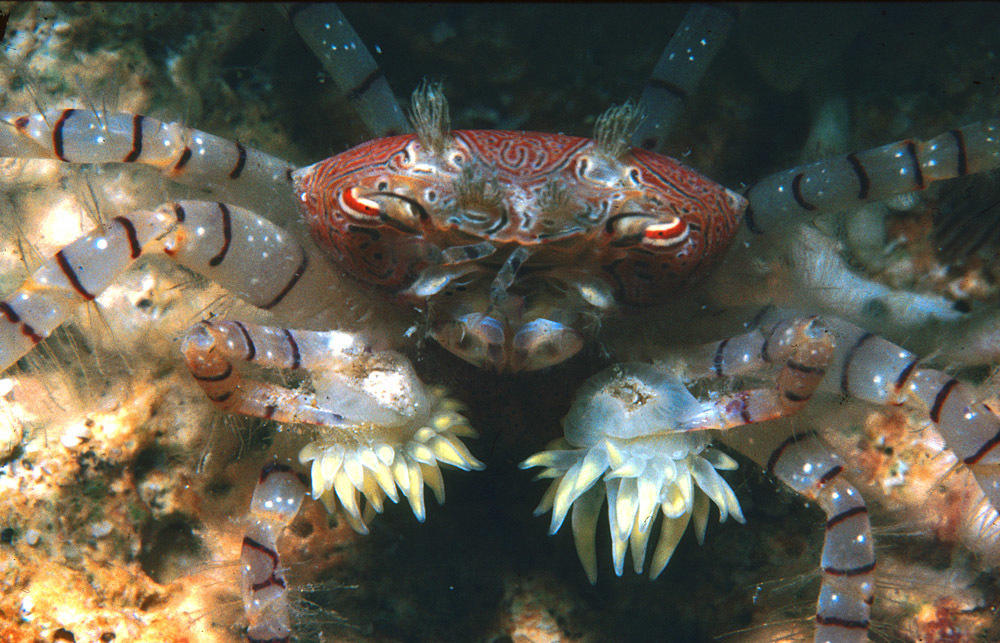
Hawaiian Pom-pom Crab
Lybia edmondsoni
Lybia edmondsoni is a species of small crab in the family Xanthidae and is endemic to the Hawaiian Islands. Like other members of the genus Lybia, it is commonly known as the pom-pom crab or boxer crab because of its habit of carrying a sea anemone around in each of its claws, these resembling pom-poms or boxing gloves. Its Hawaiian name is kūmimi pua, meaning "inedible flower crab". In ancient times, this animal was used by men claiming to be sorcerers.
From the article Lybia edmondsoni on Wikipedia (CC BY-SA), quoted section by section
Description
The carapace of L. edmondsoni can reach 0.5 inches (13 mm) in width. It sports unusual polygonal patterns in pink, brown or yellow. The chelipeds are not heavily armoured as in most crab species but are fine and delicate, the propodal-carpal joint being very flexible, and there are several backward-pointing spines. The walking legs are banded in dark purple. On its favorite substrates, such as thin sand or rubble, the crab is almost invisible. The common name "pom-pom crab" comes from its symbiotic practice of brandishing a stinging sea anemone (usually Triactis producta) in each claw to defend against predators and possibly to stun prey. Its alternative common name, "boxer crab", comes from its pugnacious response to threats.
Range & habitat
Lybia edmondsoni is endemic to Hawaii but is very similar in its size and behavior to its sister species, L. tessellata, which is much more widespread in the tropical Indo-Pacific. L. edmondsoni is found in shallow water, down to a depth of about 20 m (66 ft), and hides under rocks or among coral debris. It is also found on sandy and gravelly flats, where it is well camouflaged, and on live corals where it clings with its long, slender legs.
Wikipedia: “Distribution and habitat”
What it does
In 1905, James Edwin Duerden made a study of the relationships between boxer crabs and their associated sea anemones, what species of anemone were selected, how they were acquired, how they were used and the feeding behavior of both anemones and crabs. His work remains the most comprehensive study of mutualism between crabs and sea anemones. Research undertaken in 1997 by I. Karplus and others investigated how these aggressive crabs responded to other crabs of the same species in their vicinity, and whether their anemones were used as weapons in these encounters. Of the 50 crabs used in the study, 48 had two anemones each when first caught while the remaining two had just one. It was found that when two well-matched crabs met on neutral ground, much of the agonistic activity took place when the crabs were still some distance from each other, and involved threateningly extending a leg holding an anemone in the direction of the other crab. Some crabs retired from the fray at this stage but if the encounter proceeded to contact between the protagonists, the grapple was between the hindmost walking legs and the anemones were held out to the rear, well away from the contact zone. As well as aggressive moves, certain maintenance activities also took place while the crabs were close to one another. …
Wikipedia: “Behavior”
Where it lives
Recorded sightings
—
geo-referenced records in GBIF, from museums, herbaria and field observers.
Drag the globe to turn it. Dots are where records exist, not a range map; darker means more records.
In the stacks
Searching the stacks…
Every page naming Lybia edmondsoni in the Biodiversity Heritage Library →
This page is assembled live from iNaturalist, GBIF, Wikipedia, the Source Library and the Internet Archive. It is not yet part of the hand-edited codex. iNaturalist taxon 51201.