- Plants
- ›Vascular Plants
- ›flowering plants
- ›Dicots
- ›Sunflowers, Bellflowers, Fanflowers, and Allies
- ›Sunflowers, Daisies, Asters, and Allies
- ›chicories, dandelions, and allies
- ›Lettuce, Chicory, Dandelion and Salsify Tribe
- ›Scolyminae
- ›Hymenonema
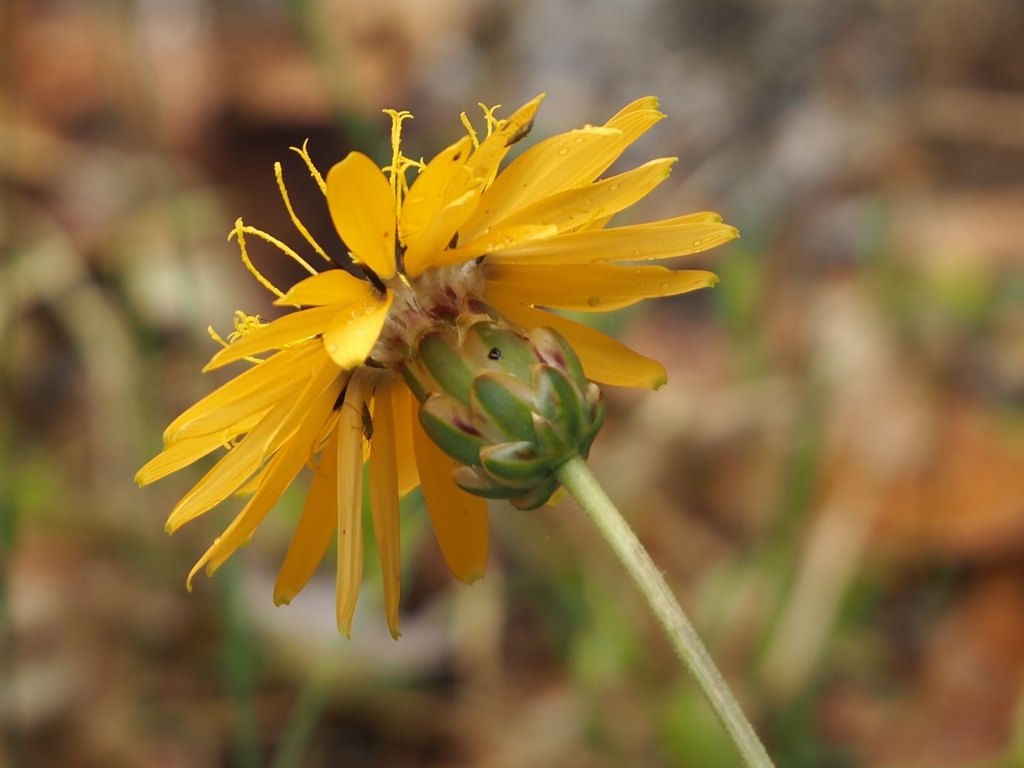
Hymenonema laconicum
Hymenonema laconicum is a species of herbaceous perennial plant in the Asteraceae family. It is small to average height, with a rosette of greyish pinnately segmented leaves, and little branching solid stems carrying one to three heads of orange or yolk yellow ray-flowers, with a purple anther tube, and scaly pappus. The species is an endemic of the central and south-eastern Peloponnesos, and flowers in May and June.
From the article Hymenonema laconicum on Wikipedia (CC BY-SA), quoted section by section
Description
Hymenonema laconium is a perennial herbaceous plant of 20–70 cm (7.9–27.6 in) high, with minute pale glandular hairs and longer hairs without glands. The number chromosomes is twenty (2n = 20). Both surfaces of the leaves are densely set with rigid hairs pressed to their surface. The leaves in the basal roset are 7–25 cm (2.8–9.8 in) long and pinnately segmented, sometimes with teeth at the margin. The top segment is larger than the lateral segments, and 1½-3 cm wide, or sometimes a little as 1 cm. Between one and six smaller leaves are distanced along the stem, the lowest pinnately segmented, the higher increasingly simple, small and narrow. Each stem carries between one and three flowerheads. The involucre is 1.5–2.5 cm (0.6–1.0 in) high and 1.5–2.25 cm (0.59–0.89 in) wide, with the individual bracts without hair, ovate to oblong-ovate in shape, with a rounded tip and an entire or dentate margin. The pits in the common base of the florets (called the receptacle) are each circled by a row of long hairs. The fruits (or cypselas) are 4–5 mm high and topped by the changed calyx called pappus. On the outer cypselas the pappus takes the shape of trifid scales, the middle branch of which is prolonged as a rigid hair. On the inner cypselas, there is a row of rigid hairs encircling a row of lanceolate scales that change at the tip into a rigid hair.
Differences with related species. …
Range & habitat
Hymenonema laconicum is limited to the central and south-eastern Peloponnesos, in particular the Mainalo, Parnon and Taygetos mountains and the surrounding lowlands. It grows at altitudes of 5–1,300 m (16–4,265 ft) in shrubland on stony soils, field margins and meadows.
== References ==
Wikipedia: “Distribution and habitat”
Where it lives
Recorded sightings
—
geo-referenced records in GBIF, from museums, herbaria and field observers.
Drag the globe to turn it. Dots are where records exist, not a range map; darker means more records.
In the stacks
Searching the stacks…
Every page naming Hymenonema laconicum in the Biodiversity Heritage Library →
This page is assembled live from iNaturalist, GBIF, Wikipedia, the Source Library and the Internet Archive. It is not yet part of the hand-edited codex. iNaturalist taxon 513616.