- Plants
- ›Vascular Plants
- ›flowering plants
- ›Dicots
- ›pinks, cactuses, and allies
- ›Amaranth family
- ›Salsoloideae
- ›Salsoleae
- ›Salsola
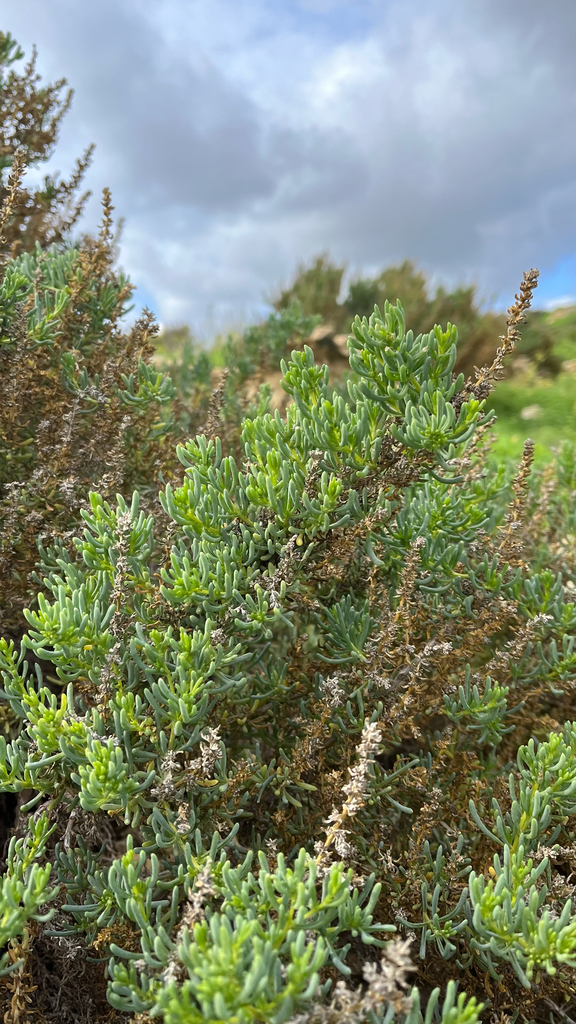
Maltese Salt-tree
Salsola melitensis
Salsola melitensis is an endemic vascular plant of the Maltese archipelago. Its generic name is derived from the Latin word “salsus” which means salty, attributing to the salt tolerant nature of the species within this genus. The genus name was published in 1753 in the Species Plantarum composed by Carl Linnaeus but was reclassified again by Akhani et al. in 2007.
From the article Salsola melitensis on Wikipedia (CC BY-SA), quoted section by section
Description
Salsola melitensis is a perennial woody shrub with thin succulent leaves. Its stem trails on the ground or sometimes with the extremity tending to ascend. The trunk elevates the canopy to a height of up to 2.5 m. The leaves may be either filiform or semicylindrical and occur mainly in alternate fashion or occasionally be opposite. The flowers occur axillarily and are complete; they are also hermaphrodite or polygamous (i.e. with male or female sexual parts or both), bearing two small leafy structures (bracteoles) directly beneath the flower stalk. The summer-blooming flowers are composed of five membranous flower segments that are intermediate between petals and sepals: two inner ones and three outer ones, bearing five stamens on a glandular ring and a single style with two stigmas. The fruit is an utricle, which may be either depressed or spherical, as well as papery or fleshy; the horizontal five-winged seed holds a spiral embryo with a simple testa but no surrounding nutritive tissue. The seeds are normally orthodox, meaning that they can withstand severe drying and freezing for their long-term conservation.
Range & habitat
Given that its seeds are winged, minuscule and therefore easily transported by wind, S. melitensis is known to colonise sea-side cliffs where it can avoid anthropogenic pressure; the plant is historically reported to also grow on slanting walls in fortifications in many parts of Malta, Gozo and Comino, and is reported to grow in the fortifications of the Citadel and Xagħra. In 1927, Borg reported S. melitensis (under the name of S. vermiculata) as being rare in Malta and occurring in Marsaxlokk, Birżebbuġa, and seaside cliffs in Dingli and Baħrija. In 2020, Brullo et al. reported that S. melitensis (= D. melitensis) occurs in so-called permasigmeta and geopermasigmeta habitats composing Suaedo verae-Darnellio melitensis communities on dry marly-clayey outcrops near the sea that allow for salty/nitrophilous environments. The plant is reported as being very resilient to harsh abiotic conditions, including lack of water, strong winds, sea spray and very little soil. Brullo et al. report the plant occurring in various locations providing comprehensive coverage in their account, including Baħrija valley, Għar Lapsi, Mġarr ix-Xini, Xlendi valley, Babu valley, Dikkiena cliffs, Tal-Bardan cliffs, Ta’ Ċenċ, Dwejra, Dingli, Comino, and some others. According to Mifsud et al. the species does not occur in Selmunett despite having been historically reported to occur there.
Wikipedia: “Distribution and habitat”
At the table
The Maltese salt tree is a rather unknown plant outside of Malta, and virtually no research on its biology or biochemistry has been done on it internationally. It is not within the inventory of plants of the Seed Information Database of the KEW Royal Botanical Gardens, nor is it listed in the GENESYS-PGR accession browser of the Global Crop Diversity Trust, the ENSCONET accession browser of the International Centre for Advanced Mediterranean Agronomic Studies, or the World Information and Early Warning System (WIEWS) accession browser of the United Nations. Nevertheless, the plant was used in olden days as a source of potash, possibly as a cleaning agent as it may have been used in conjunction with olive oil for the creation of rudimentary soap. Salsola soda is consumed as a vegetable in various parts of Italy (known as “barba del frate,” “agretti,” “rospici,” “liscari,” etc.) and Spain (known as “barilla.”) The herbaceous plantlet, like the herbaceous forms of Salsola spp. have high fodder value particularly in arid environments, given their high tolerance to extreme climatic conditions such as high temperatures and prolonged drought. Some studies report that foliage of S. vermiculata has up to 13.1% of protein content, 9% of which is digestible. …
Wikipedia: “Uses”
Where it lives
Recorded sightings
—
geo-referenced records in GBIF, from museums, herbaria and field observers.
Drag the globe to turn it. Dots are where records exist, not a range map; darker means more records.
In the stacks
Searching the stacks…
Every page naming Salsola melitensis in the Biodiversity Heritage Library →
This page is assembled live from iNaturalist, GBIF, Wikipedia, the Source Library and the Internet Archive. It is not yet part of the hand-edited codex. iNaturalist taxon 514170.