- Plants
- ›Vascular Plants
- ›flowering plants
- ›Dicots
- ›borages
- ›borage family
- ›Cynoglossoideae
- ›Myosotideae
- ›Myosotis
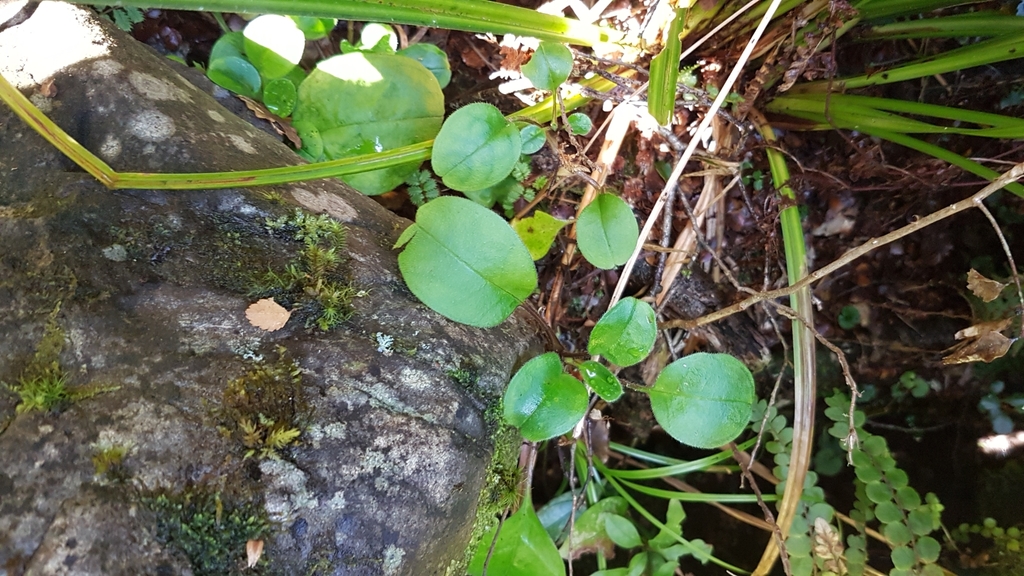
Myosotis pottsiana
Myosotis pottsiana is a species of flowering plant in the family Boraginaceae, endemic to the North Island of New Zealand. Lucy Moore described Myosotis petiolata var. pottsiana in 1961. Plants of this species of forget-me-not are perennial rosettes with ebracteate inflorescences and white corollas with exserted stamens.
From the article Myosotis pottsiana on Wikipedia (CC BY-SA), quoted section by section
Description
Myosotis pottsiana plants are rosettes. The rosette leaves have petioles that are 14–57 mm long. The rosette leaf blades are 7–51 mm long by 5–32 mm wide (length: width ratio 1.2–2.0: 1), usually narrowly obovate, obovate, broadly obovate, widest at or above the middle, with an obtuse and mucronate apex. Both surfaces of the leaf are uniformly and densely covered in straight, appressed, antrorse (forward-facing) hairs. Each rosette has multiple ascending, branched ebracteate (or sometimes partially bracteate) inflorescences that are up to 430 mm long. The cauline leaves are similar to the rosette leaves, but become smaller. The flowers are 6–73 per inflorescence, and each is borne on a short pedicel without a bract (or sometimes lowest flowers with a bract). The calyx is 2–4 mm long at flowering and 3–5 mm long at fruiting, lobed to half to three-quarters of its length, and densely covered in straight to curved, appressed to patent, antrorse hairs. The corolla is white and 7–15 mm in diameter, with a cylindrical tube, petals that are narrowly ovate, ovate, obovate or broadly obovate, and small yellow scales alternating with the petals. The anthers are fully exserted. The four smooth, shiny, usually medium to dark brown nutlets are 1.3–1.8 mm long by 0.9–1.2 mm wide and ovoid to broadly ovoid in shape. The pollen of Myosotis pottsiana is unknown. The chromosome number of M. …
Range & habitat
Although once thought to be extinct, Myosotis pottsiana is known from a handful of populations in Bay of Plenty, North Island, New Zealand from 40 to 300 m ASL, on vertical rock walls, steep river banks and forest bluffs.
Wikipedia: “Distribution and habitat”
In human culture
Myosotis pottsiana (L.B.Moore) Meudt, Prebble, R.J.Stanley & Thorsen is in the plant family Boraginaceae. The species was originally described by Lucy Moore as a variety of M. pansa, Myosotis petiolata var. pottsiana in 1961. It was raised to species rank by Heidi Meudt, Jessica Prebble, Rebecca Stanley, and Michael Thorsen in 2013. The lectotype specimen of Myosotis petiolata var. pottsiana was collected by Anthony Druce in 1956, and the holotype is lodged at the Allan Herbarium of Manaaki Whenua - Landcare Research (CHR 87624). Myosotis pottsiana was discovered by Norman Potts and Marc Heginbotham around 1952, and the variety and now species epithet honours Potts, who also collected and cultivated it. Myosotis pottsiana is morphologically and genetically most similar to M. pansa and M. petiolata. These three species are allopatric in their geographic distributions, and can be distinguished from one another by a suite of characters that includes corolla diameter (M. pottsiana: 5.3–9.8 mm; M. petiolata: 4.2–10.5 mm; and M. pansa: 7.6–14.3 mm).
Wikipedia: “Taxonomy and etymology”
Where it lives
Recorded sightings
—
geo-referenced records in GBIF, from museums, herbaria and field observers.
Drag the globe to turn it. Dots are where records exist, not a range map; darker means more records.
In the stacks
Searching the stacks…
Every page naming Myosotis pottsiana in the Biodiversity Heritage Library →
This page is assembled live from iNaturalist, GBIF, Wikipedia, the Source Library and the Internet Archive. It is not yet part of the hand-edited codex. iNaturalist taxon 515777.