- Plants
- ›Vascular Plants
- ›flowering plants
- ›Dicots
- ›proteas, lotuses, planes, and allies
- ›Protea family
- ›Singlet Proteas
- ›Hairiseed Proteoid Clade
- ›Protea
- ›Leiocephalae
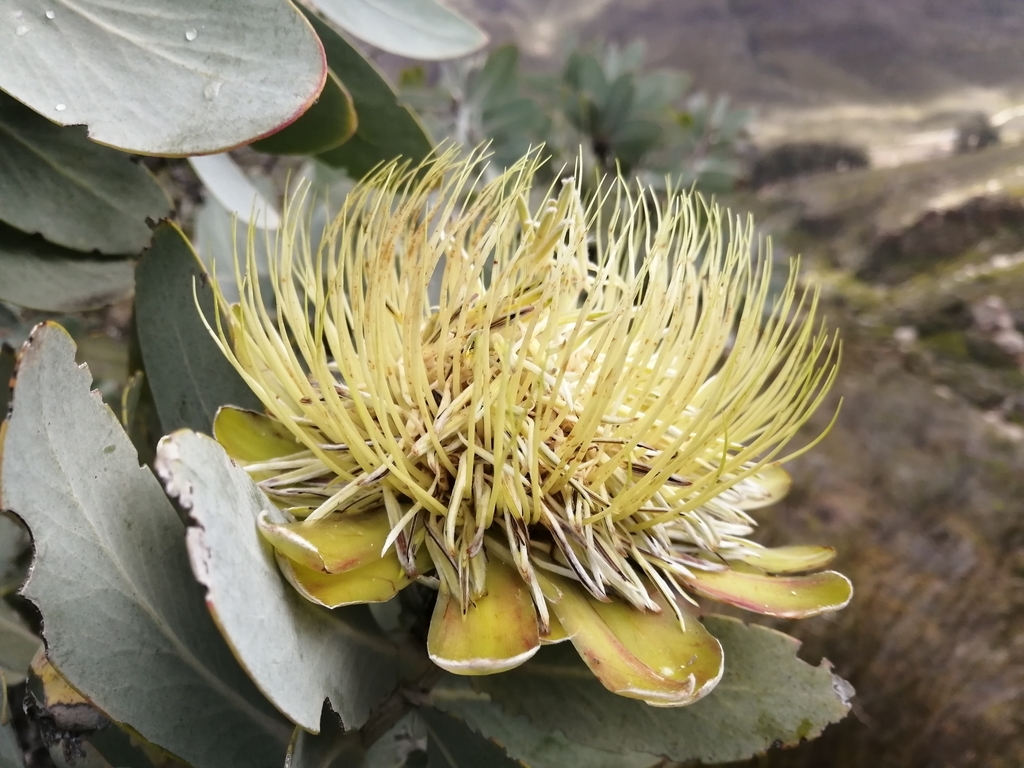
Wagon Tree
Protea nitida
Protea nitida, commonly called wagon tree, waboom or blousuikerbos, is a large, slow-growing Protea endemic to South Africa. It is one of the few Protea species that grows into trees, and the only one that has usable timber.
From the article Protea nitida on Wikipedia (CC BY-SA), quoted section by section
Description
Protea nitida is a slow-growing tree, with very thick white-grey bark, that varies considerably in height. It is normally about 5 meters tall, but in good conditions it may reach a height of up to 10 meters, with a trunk diameter of 1 meter. The young leaves are crimson, but they become a bluish, sea-green colour in later life. These leaves are described as "oblong to elliptic", "hairless" and "leathery". Large, bisexual flower heads appear all through the year, especially in winter, and bear sweet nectar. Small nuts are released about a year after flowering. Throughout their distribution, a dwarf, multi-stemmed form with narrow green leaves also occurs—at one point regarded as a distinct species, Protea reticulata.
Wikipedia: “Appearance”
Range & habitat
The natural range of Protea nitida is from the Cape Peninsula, all the way to the Bokkeveld escarpment and into the Eastern Cape. It grows on mountain slopes of all elevations and in the right conditions, they can form large open woodlands. Though they are not threatened, in many areas they have been cleared for timber, often to be replaced by commercial pine plantations.
Wikipedia: “Distribution”
Where it lives
Recorded sightings
—
geo-referenced records in GBIF, from museums, herbaria and field observers.
Drag the globe to turn it. Dots are where records exist, not a range map; darker means more records.
In the stacks
Searching the stacks…
Every page naming Protea nitida in the Biodiversity Heritage Library →
This page is assembled live from iNaturalist, GBIF, Wikipedia, the Source Library and the Internet Archive. It is not yet part of the hand-edited codex. iNaturalist taxon 515952.