- Plants
- ›Vascular Plants
- ›flowering plants
- ›Dicots
- ›Mints, Plantains, Olives, and Allies
- ›Plantain Family
- ›Veroniceae
- ›Veronica
- ›Chamaedrys
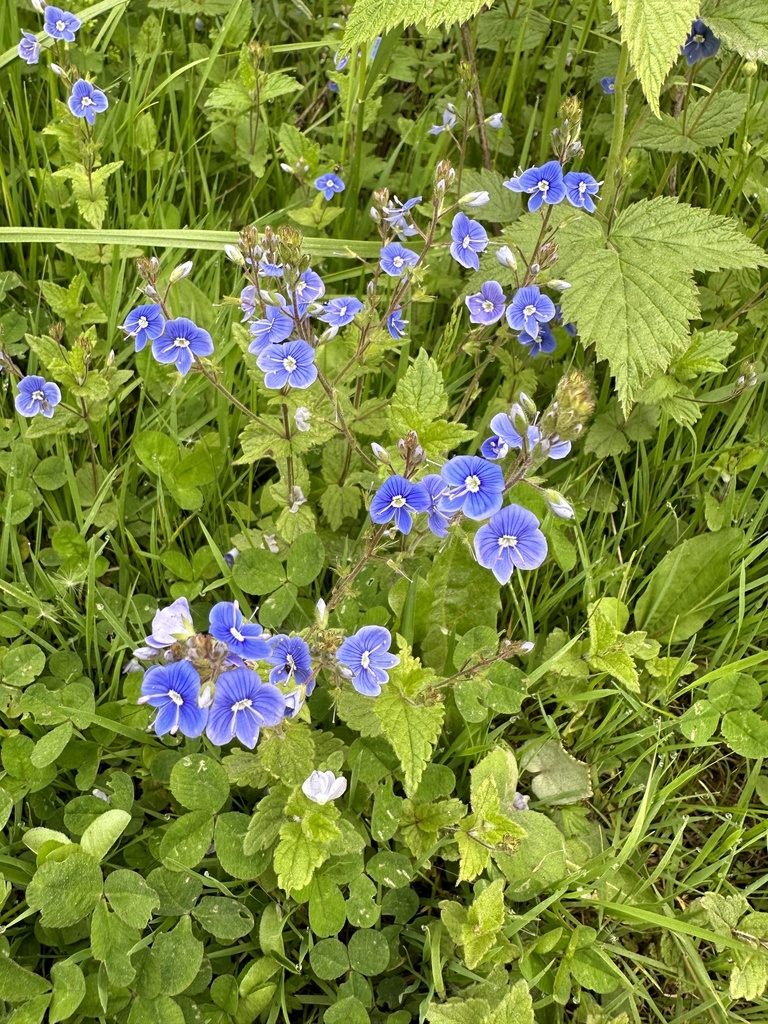
Germander Speedwell
Veronica chamaedrys
Veronica chamaedrys, the germander speedwell, bird's-eye speedwell, or cat's eyes, is a herbaceous perennial species of flowering plant in the plantain family Plantaginaceae.
From the article Veronica chamaedrys on Wikipedia (CC BY-SA), quoted section by section
Description
Veronica chamaedrys can grow to 20 cm (7.9 in) tall, but is frequently shorter, with stems that are hairy only along two opposite sides. The leaves are in opposite pairs, triangular and crenate, sessile or with short petioles. The flowers are deep blue with a zygomorphic (bilaterally symmetrical) four-lobed corolla, 8–12 mm (0.3–0.5 in) wide. The capsules are wider than they are long.
The blossoms of this plant wilt very quickly upon picking, which has given it the ironic name "Männertreu", or "men's faithfulness" in German. Veronica chamaedrys is a common, hardy turf so-called weed when it invades turf and lawns. It creeps along the ground, spreading by sending down roots at the stem nodes. It is propagated both by seed and stem fragments. Leaves may defoliate in the summer and winter but the stems will grow again next season. Unlike at least five other common speedwell species, such as corn speedwell (Veronica arvensis), the leaves are opposite on both the upper and lower parts of the plant. See Veronica for special weed control considerations. The specific name chamaedrys is a combining form meaning "low" or "on the ground" derived from ancient Greek.
Range & habitat
This species is native to Europe. It is found on other continents as an introduced species.
Wikipedia: “Distribution”
At the table
Veronica chamaedrys has been used in traditional Austrian herbal medicine internally (as tea) for disorders of the nervous system, respiratory tract, cardiovascular system, and metabolism. In 18th century Britain, the plant had the reputation of being a cure for gout as well as being popular for making tea, the latter being so prevalent that the plant was nearly eradicated from London during the 18th century.
Wikipedia: “Uses”
Where it lives
Recorded sightings
—
geo-referenced records in GBIF, from museums, herbaria and field observers.
Drag the globe to turn it. Dots are where records exist, not a range map; darker means more records.
In the stacks
Searching the stacks…
Every page naming Veronica chamaedrys in the Biodiversity Heritage Library →
This page is assembled live from iNaturalist, GBIF, Wikipedia, the Source Library and the Internet Archive. It is not yet part of the hand-edited codex. iNaturalist taxon 51610.