- Plants
- ›Vascular Plants
- ›flowering plants
- ›monocots
- ›grasses, sedges, cattails, and allies
- ›grasses
- ›Panicums, Bluestems, Paspalums, and Allies
- ›bristle, rosette, and barnyard grasses, and allies
- ›Anthephorinae
- ›Digitaria
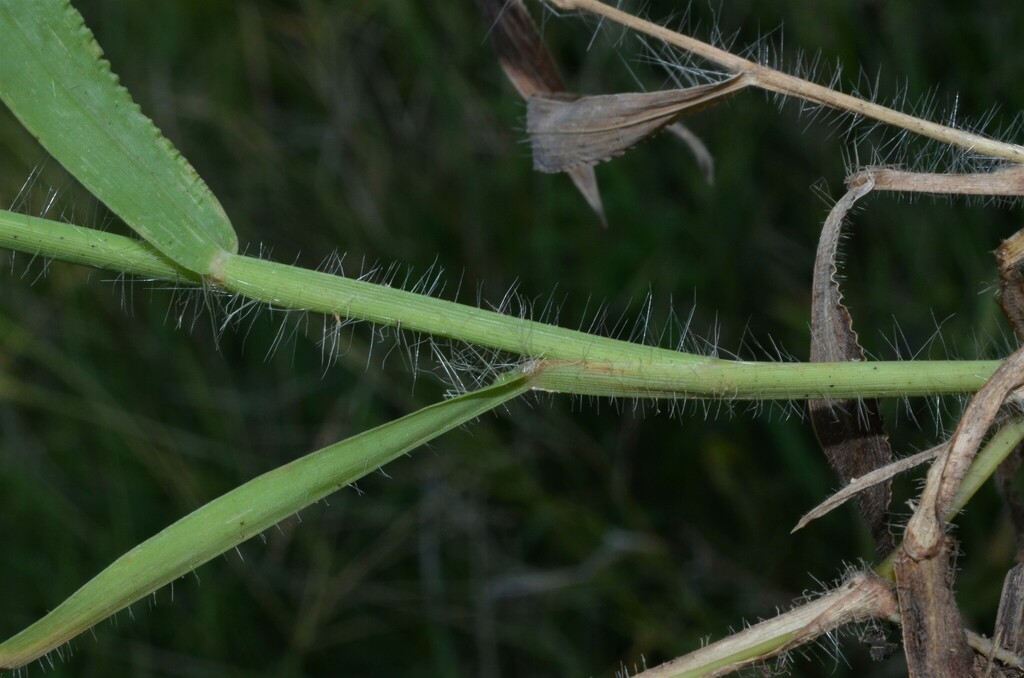
Hairy Crabgrass
Digitaria sanguinalis
Digitaria sanguinalis is a species of grass known by several common names, including hairy crabgrass, hairy finger-grass, large crabgrass, crab finger grass, purple crabgrass. It is one of the better-known species of the genus Digitaria, and one that is known nearly worldwide as a common weed. It is used as animal fodder, and the seeds are edible and have been used as a grain in Germany and especially Poland, where it is sometimes cultivated. This has earned it the name Polish millet.
From the article Digitaria sanguinalis on Wikipedia (CC BY-SA), quoted section by section
Description
It is an annual grass with an inflorescence of up to nine very long, very thin, radiating branches atop its stems. Each branch is lined with pairs of very tiny spikelets. The inflorescences may be reddish or purplish.
At the table
During the European Middle Ages, Digitaria sanguinalis was cultivated by Slavic peoples in Eastern Europe, where it was cooked in soups and porridges. The plant was brought to the United States by immigrants to serve as hand-foraged grain. The grass is also highly nutritious, especially before the plant exhausts itself producing seed. It is frequently sown in fields to provide graze for animals, or clipped and bundled as hay. Compared to other grasses, it has a relatively high protein percentage. Farmers will sometimes till patches in their pastures in the late spring, with the intent of encouraging crabgrass seed. For human consumption, crabgrass necessarily must be harvested by hand, because it produces grain throughout summer, rather than simultaneously. Machine harvesting would require monthly passes, and even then much of the seed would go to waste. Crabgrass produces an exceptionally high amount of grain, it smothers other weeds, it acts as its own mulch, and it can survive both heat and drought. Its adaptability makes it a candidate for environmental small-farming.
Wikipedia: “Uses”
Where it lives
Recorded sightings
—
geo-referenced records in GBIF, from museums, herbaria and field observers.
Drag the globe to turn it. Dots are where records exist, not a range map; darker means more records.
In the stacks
Searching the stacks…
Every page naming Digitaria sanguinalis in the Biodiversity Heritage Library →
This page is assembled live from iNaturalist, GBIF, Wikipedia, the Source Library and the Internet Archive. It is not yet part of the hand-edited codex. iNaturalist taxon 51633.