- Plants
- ›Vascular Plants
- ›flowering plants
- ›Dicots
- ›beeches, oaks, walnuts, and allies
- ›wax trees and shrubs
- ›Morella
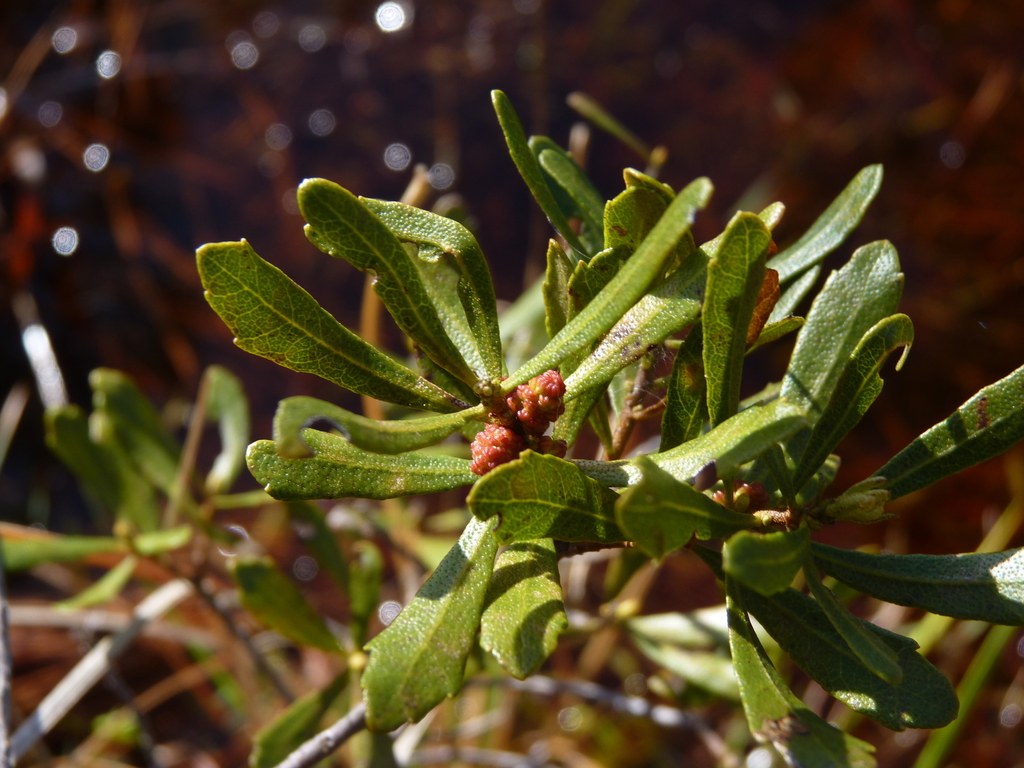
dwarf bayberry
Morella pumila
Myrica cerifera is a small evergreen tree or large shrub native to North and Central America and the Caribbean. Its common names include southern wax myrtle, southern bayberry, candleberry, bayberry tree, and tallow shrub. It has uses in the garden and for candlemaking, as well as a medicinal plant.
From the article Myrica cerifera on Wikipedia (CC BY-SA), quoted section by section
Description
Myrica cerifera is a small tree or large shrub, reaching up to 14 metres (46 ft) tall. It is adaptable to many habitats, growing naturally in wetlands, near rivers and streams, sand dunes, fields, hillsides, pine barrens, and in both coniferous and mixed-broadleaf forests. M. cerifera can weather coastal storms, long droughts, and tropical high temperatures. In nature, it ranges from Central America, northward into the southeastern United States. Wax Myrtle can be successfully cultivated as far north as the New York City area and southern Ohio Valley. It also grows in Bermuda and the Caribbean. In terms of succession, M. cerifera is often one of the first plants to colonize an area.
M. cerifera is an evergreen. The glandular leaves are long, have a leathery texture and serrated edges, and contain aromatic compounds. The plant is dioecious, with male and female flowers borne in catkins on separate plants. Male flowers have three or four stamens, and are surrounded by short bracts. The female flowers develop into fruit, which are globular and surrounded by a natural wax-like coating. The species flowers from late winter to spring, and bear fruit in late summer or fall. No endosperm is present in the seeds. M. cerifera can also reproduce clonally through runners. This species occurs in two forms, but there is no clear dividing line between them, many intermediate forms occurring. …
What it does
The fruit is a source of food for many bird species, such as the wild turkey and the northern bobwhite quail. In winter, the seeds are important foods for the myrtle warbler and tree swallow. To a point, M. cerifera will also provide habitat for the northern bobwhite quail. Birds' digestive systems remove the wax from the fruit, a prerequisite for germination.
This plant's roots possess root nodules harboring members of a symbiotic genus of actinorhizal bacteria, Frankia, which allow the plant to fix nitrogen gas at a faster rate than do legumes. The above-ground growth of M. cerifera is often killed by wildfires unless the fire is very small or transient. In the latter situation, only the most recent primary growth may be incinerated. Because the leaves, stem, and branches contain flammable aromatic compounds, a specimen of M. cerifera is in fact a fire hazard. In contrast to the flammability of its top growth, M. cerifera's root system is fire-resistant. By 1991, no known fire had killed this plant's roots. However, this plant will not survive repeated destruction of its top growth indefinitely. Three consecutive years of burning may kill all plants affected. After less damaging fires, new shoots will regrow from below ground. This regrowth is most rapid in the first season after a fire. M. cerifera has exhibited aggressive behavior in both native and non-native habitat. …
Wikipedia: “Ecology”
At the table
The leaves can be washed, dried, and used to season stews or cooking sauces. The berries can also be used as seasoning.
Wikipedia: “Food”
In medicine
Bayberry root bark has a history of use in herbalism. The plant contains several organic compounds, including: triterpenes such as myricadiol, taraxerol, and taraxerone, as well as chemicals such as different flavonoids, tannins, resins, gums, and phenols. Myricadiol has a slight impact on levels of potassium and sodium, while a substance called myricitrin has antibiotic properties. The Choctaw boiled bayberry and used the result as a treatment for fevers. In 1722, it was reported that colonists in Louisiana drank a mixture of wax and hot water to treat severe dysentery. Bayberry was reported in an account from 1737 as being used to treat convulsions, colic, palsy, and seizures. Starting in the early 19th century, the herbalist Samuel Thomson recommended this plant for producing "heat" within the body and as a treatment for infectious diseases and diarrhea. That use of bayberry waned later in the 19th century, in favor of using it for a variety of ailments, including a topical use for bleeding gums. For twenty years starting in 1916, bayberry root bark was listed in the American National Formulary. Use of bayberry in herbalism has declined since its peak in popularity in the 19th century. The plant is still used today in the treatment of fever, diarrhea, and a few other ailments. The chemical myricitrin has anti-fever properties. …
Wikipedia: “Herbalism”
Where it lives
Recorded sightings
—
geo-referenced records in GBIF, from museums, herbaria and field observers.
Drag the globe to turn it. Dots are where records exist, not a range map; darker means more records.
In the stacks
Searching the stacks…
Every page naming Morella pumila in the Biodiversity Heritage Library →
This page is assembled live from iNaturalist, GBIF, Wikipedia, the Source Library and the Internet Archive. It is not yet part of the hand-edited codex. iNaturalist taxon 516701.