- Fungi Including Lichens
- ›Ascomycete Fungi
- ›Sac Fungi and Lichens
- ›Dothideomycetes
- ›Botryosphaeriales
- ›Phyllostictaceae
- ›Phyllosticta
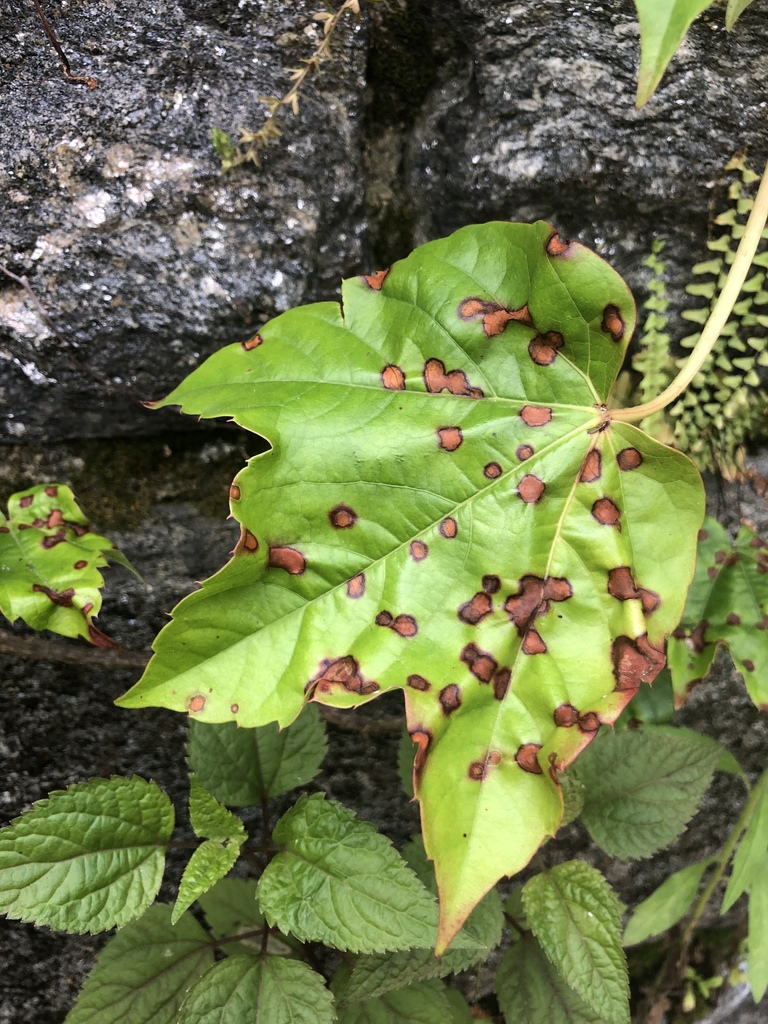
Black Rot
Phyllosticta ampelicida
Grape black rot is a fungal disease caused by an ascomycetous fungus, Guignardia bidwellii, that attacks grape vines during hot and humid weather. The disease "originated in eastern North America, but now occurs in portions of Europe, South America, and Asia. It can cause complete crop loss in warm, humid climates, but is virtually unknown in regions with arid summers." The name comes from the black fringe that borders growing brown patches on the leaves. The disease also attacks other parts of the plant, "all green parts of the vine: the shoots, leaf and fruit stems, tendrils, and fruit. The most damaging effect is to the fruit".
Grape black rot affects many grape growers throughout the World, therefore, it is important to understand the disease life cycle and environmental conditions to best manage the disease. Once infection takes place, different methods are available to control the disease.
From the article Black rot (grape disease) on Wikipedia (CC BY-SA), quoted section by section
In human culture
Cultural control consists of the management of the fields and sanitation methods to optimally grow grape crops. Many universities and professors suggest the following cultural control practices: The first cultural control method is to choose the right grape cultivar for the region that the grape will be grown in. Grape cultivars differ in their susceptibility to diseases, including differences in the disease black rot. Some varieties are less susceptible, while others are more prone to the disease when the right environmental conditions occur. Through research, many lists of grapes varieties will show the amount of resistance a variety has to disease and how the variety should be grown. A list of grape varieties is a good place to start for selecting the right grape variety. Proper grape management in the field is important to control black rot disease. The placement of the grape plants is important to provide for proper aeration and lighting, "where the vines will be exposed to full sun and good air circulation." Proper training of grape vines should be practiced. Many people use trellising to keep the vines off the ground. Trellising is a form of plant training, which is the arrangement of plant parts spatially to optimize productivity. Having the grape vines off the ground "reduces the time that vines remain wet from dew and rain and thus limits the amount of infection". …
Wikipedia: “Cultural control”
Where it lives
Recorded sightings
—
geo-referenced records in GBIF, from museums, herbaria and field observers.
Drag the globe to turn it. Dots are where records exist, not a range map; darker means more records.
In the stacks
Searching the stacks…
Every page naming Phyllosticta ampelicida in the Biodiversity Heritage Library →
This page is assembled live from iNaturalist, GBIF, Wikipedia, the Source Library and the Internet Archive. It is not yet part of the hand-edited codex. iNaturalist taxon 517494.