- Plants
- ›Vascular Plants
- ›flowering plants
- ›Dicots
- ›proteas, lotuses, planes, and allies
- ›Protea family
- ›Paired Proteas
- ›Banksieae
- ›Banksiinae
- ›Banksia
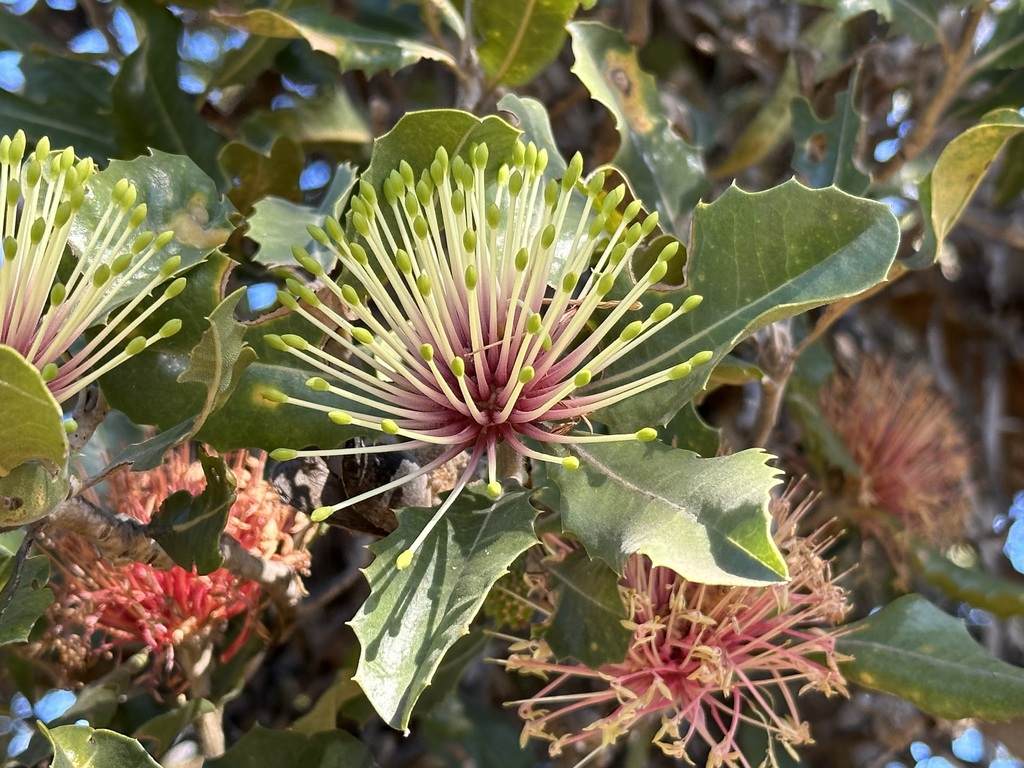
Holly-Leaved Banksia
Banksia ilicifolia
Banksia ilicifolia, commonly known as holly-leaved banksia, is a tree in the family Proteaceae. Endemic to southwest Western Australia, it belongs to Banksia subg. Isostylis, a subgenus of three closely related Banksia species with inflorescences that are dome-shaped heads rather than characteristic Banksia flower spikes. It is generally a tree up to 10 metres (33 ft) tall with a columnar or irregular habit. Both the scientific and common names arise from the similarity of its foliage to that of the English holly Ilex aquifolium; the glossy green leaves generally have very prickly serrated margins, although some plants lack toothed leaves. The inflorescences are initially yellow but become red-tinged with maturity; this acts as a signal to alert birds that the flowers have opened and nectar is available.
Robert Brown described Banksia ilicifolia in 1810. Although Banksia ilicifolia is variable in growth form, with low coastal shrubby forms on the south coast near Albany, there are no recognised varieties as such. Distributed broadly, the species is restricted to sandy soils. Unlike its close relatives which are killed by fire and repopulate from seed, Banksia ilicifolia regenerates after bushfire by regrowing from epicormic buds under its bark. It is rarely cultivated.
From the article Banksia ilicifolia on Wikipedia (CC BY-SA), quoted section by section
Description
Banksia ilicifolia is a variable species. It usually grows as an erect tree up to 10 metres (33 ft) in height, but some populations along the south coast consist of small trees or even spreading shrubs. It is generally 5 metres (16 ft) high small tree in the Margaret River region. The leaves arising from many short branchlets make a dense foliage close to the trunk and branches. Banksia ilicifolia has a stout trunk up to 50 cm (19.5 in) in diameter, and rough, fibrous, grey bark which is up to 2 cm (1 in) thick. New growth takes place mainly in summer. Young branchlets are covered in hair which they lose after two or three years. Leaves grow on stems less than two years of age, and are arranged in a scattered pattern along the stems although crowded at the apices (branchlet tips). Resembling those of holly, its leaves are a dark shiny green colour, and variously obovate (egg-shaped), elliptic, truncate or undulate (wavy) in shape, and 3–10 cm (1.2–3.9 in) long. Generally serrated, the leaf edges have up to 14 prickly "teeth" separated by broad v- to u-shaped sinuses along each side, although some leaves have margins lacking teeth. The leaves sit atop petioles 0.3–1 cm (0.1–0.4 in) in length. The upper and undersurface of the leaves are initially covered in fine hairs but become smooth with maturity. Flowering takes place from late winter to early summer. …
Range & habitat
A relatively common species, the holly-leaved banksia is widely distributed within southwest Western Australia. It occurs within 70 km (43 mi) of the coast, from Mount Lesueur to Augusta, and then east to the Cordinup River east of Albany. In the Margaret River region, it grows on yellow sand plains behind the Leeuwin-Naturaliste Ridge. Almost all occurrences are to the west (seaward) side of the Darling Scarp, although there are two outlying populations – one near Collie east of Bunbury and the other in the Tonbridge-Lake Muir area near Manjimup. Along the south coast, there is one inland population at Sheepwash Nature Reserve near Narrikup northwest of Albany. The annual rainfall over its distribution ranges from 600 to 1,100 mm (24 to 43 in). Banksia ilicifolia grows exclusively on sandy soils; its range ends where heavy soils are evident. It especially favours low-lying areas. It generally grows in open woodland alongside such trees as jarrah (Eucalyptus marginata), candlestick banksia (Banksia attenuata), firewood banksia (B. menziesii) and Western Australian Christmas tree (Nuytsia floribunda). Along the south coast, it grows in heath, sometimes forming stands with bull banksia (B. …
Wikipedia: “Distribution and habitat”
What it does
Banksia ilicifolia has been recorded as a source of nectar for the honey possum (Tarsipes rostratus) in winter to early summer (May to December), from field studies in the Scott National Park, replaced by Adenanthos meisneri in the summer. Several honeyeater species visit and pollinate Banksia ilicifolia. The western spinebill (Acanthorhynchus superciliosus) in particular prefers this species over other banksias.
A field study carried out at Jandakot Airport south of Perth and published in 1988 found that birds and insects overwhelmingly preferred visiting yellow-coloured flowerheads. The species recorded include several species of honeyeater, including the red wattlebird (Anthochaera carunculata), western wattlebird (A. lunulata), western spinebill, brown honeyeater (Lichmera indistincta), New Holland honeyeater (Phylidonyris novaehollandiae), white-cheeked honeyeater (P. nigra), singing honeyeater, (Gavicalis virescens), as well as the twenty-eight parrot (Barnardius zonarius semitorquatus), two species of native bee of the genus Leioproctus, a beetle of the genus Liparetrus, and ant species Iridomyrmex conifer. …
Wikipedia: “Ecology”
How it is grown
Rarely cultivated, Banksia ilicifolia requires a sunny position and sandy well-drained soil to do well. A slow-growing plant, it takes up to ten years to flower from seed. The glossy green foliage and long flowering period, combined with prominently displayed flowers give it horticultural potential, although its prickly foliage makes fallen leaves a problem if planted near lawns or walkways. Seeds do not require any treatment, and take 22 to 41 days to germinate. Difficulties in collection and low seed set make seed relatively expensive. Seeds are often eaten by insects before they can be collected.
Wikipedia: “Cultivation”
Where it lives
Recorded sightings
—
geo-referenced records in GBIF, from museums, herbaria and field observers.
Drag the globe to turn it. Dots are where records exist, not a range map; darker means more records.
In the stacks
Searching the stacks…
Every page naming Banksia ilicifolia in the Biodiversity Heritage Library →
This page is assembled live from iNaturalist, GBIF, Wikipedia, the Source Library and the Internet Archive. It is not yet part of the hand-edited codex. iNaturalist taxon 518359.