- Animals
- ›Arthropods
- ›Hexapods
- ›Insects
- ›Winged and Once-winged Insects
- ›Beetles
- ›Water, Rove, Scarab, Long-horned, Leaf, and Snout Beetles
- ›Cucujiform Beetles
- ›Longhorn Beetles and Allies
- ›Longhorn Beetles
- ›Round-necked Longhorn Beetles
- ›Compsocerini
- ›Rosalia
- ›Rosalia
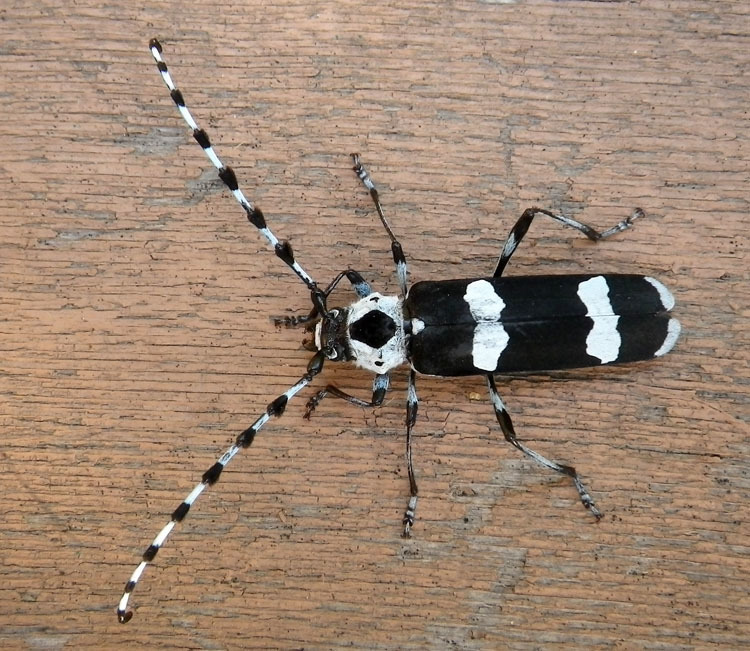
Banded Alder Borer
Rosalia funebris
The banded alder borer, Rosalia funebris, is a member of the very diverse family of longhorn beetles.
From the article Rosalia funebris on Wikipedia (CC BY-SA), quoted section by section
Description
Like many other species in the family Cerambycidae, R. funebris has strikingly colored wing covers (elytra). The elytra are dark with three white bands. The thorax (pronotum) is white with a large black spot. The alder borer's antennae are banded white and black. The male's antennae are longer than the body; the female's are shorter. Long and narrow, the body of R. funebris may grow to be 38 millimetres (1.5 in).
Wikipedia: “Appearance”
Range & habitat
They are found in western North America, from Alaska through California, and in New Mexico. The banded alder borer may be found in the spring and summer on the bark of alder trees. The exact reason is unknown, but R. funebris is drawn to recently painted buildings and may be found, in multitudes, resting on the paint.
Wikipedia: “Distribution”
At the table
Most mature Cerambycidae feed on flowers. The larvae consume wood. Rosalia funebris generally lays its eggs on downed trees rather than living trees, so it is not considered a significant pest.
Wikipedia: “Food”
Listen
Looking for field recordings…
Where it lives
Recorded sightings
—
geo-referenced records in GBIF, from museums, herbaria and field observers.
Drag the globe to turn it. Dots are where records exist, not a range map; darker means more records.
In the stacks
Searching the stacks…
Every page naming Rosalia funebris in the Biodiversity Heritage Library →
This page is assembled live from iNaturalist, GBIF, Wikipedia, the Source Library and the Internet Archive. It is not yet part of the hand-edited codex. iNaturalist taxon 51866.