- Fungi Including Lichens
- ›Basidiomycete Fungi
- ›Higher Basidiomycetes
- ›Mushrooms, Bracket Fungi, Puffballs, and Allies
- ›Agaricomycetidae
- ›boletes and allies
- ›boletes
- ›Suillelloideae
- ›Sutorius
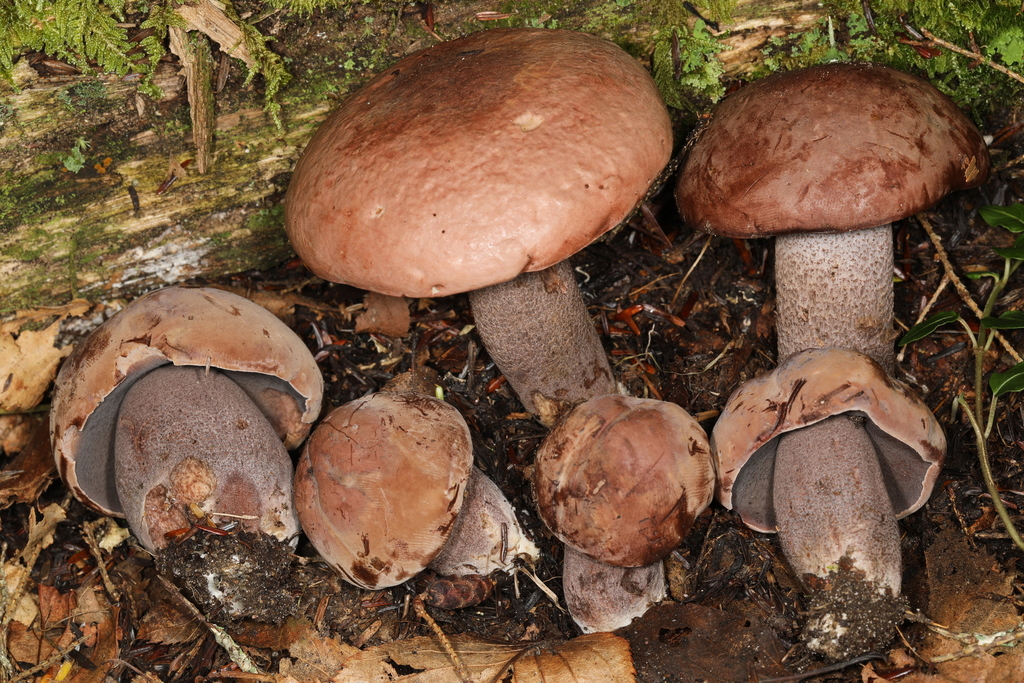
Lilac-brown bolete
Sutorius eximius
Sutorius eximius, commonly known as the lilac-brown bolete, is a species of fungus in the family Boletaceae. Originally described in 1874 as a species of Boletus, the fungus has also been classified in the genus Leccinum because of the scabers on the stipe, or in Tylopilus because of the color of the spore print. Molecular genetic analysis revealed that the lilac-brown bolete was separate from both of these genera, and merited placement in a new genus. Sutorius was created to contain this bolete and the closely related Australian species S. australiensis.
This bolete produces fruit bodies that are dark purple to chocolate brown in color with a smooth cap, a finely scaly stipe, and a reddish-brown spore print. The tiny pores on the cap underside are chocolate to violet brown. It is widely distributed, having been recorded on North America, South America, and Asia, where it grows in a mycorrhizal relationship with both coniferous and deciduous trees.
From the article Sutorius eximius on Wikipedia (CC BY-SA), quoted section by section
Description
Fruit bodies have caps that are initially convex, later becoming broadly convex to more or less flat, with a diameter of 5–12 cm (2.0–4.7 in). The cap surface is dry to slightly sticky, with a texture ranging from smooth to somewhat felt-like. Its color is purplish brown to grayish brown to reddish brown; young specimens are often covered with a fine whitish bloom (a delicate, powdery coating). The flesh is whitish, and slowly stains gray-brown when it is cut or injured. It has no distinctive odor, and a mild to slightly bitter taste. On the cap underside, the pore surface is dark chocolate brown to purple brown, and stains dark brown where bruised. The nearly circular pores number up to 3 per millimeter, and the tubes are 0.9–2.2 cm (0.4–0.9 in) deep. The solid stipe measures 4.5–9 cm (1.8–3.5 in) long by 1–4 cm (0.4–1.6 in) thick. Its color is similar to that of the cap, and it has a scurfy surface from a dense coating of purplish to purple-brown scabers. The lilac-brown bolete produces a pinkish to reddish-brown to amber-brown spore print. The smooth, translucent spores are narrowly spindle shaped and measure 11–17 by 3.5–5 μm. Collections made in Costa Rica have shorter spores (10.5–13.3 μm) and smaller fruitbodies than eastern North American material; Guyanese material also has smaller spores, measuring 9.7–12 μm. These differences are attributed to clinal variation. …
Range & habitat
Fruit bodies of Sutorius eximius grow in the soil singly or scattered among leaf litter. A mycorrhizal species, the bolete has been recorded growing in association with plants from various genera, including Dicymbe, Dipterocarpus, Fagus, Hopea, Quercus, Shorea, and Tsuga. The species has been recorded from North America (in the east from June to September), Costa Rica, and Indonesia. In Costa Rica, where it usually associates with the endemic oaks Quercus seemannii and Q. copeyensis, the lilac-brown bolete can be locally abundant in the Cordillera Central and the Cordillera de Talamanca. Additional locations with collections that have not been confirmed by DNA analysis include Guyana, Japan, China. Although S. eximius has been reported from Thailand, molecular analysis of Thai collections suggests that they represent a distinct, as-yet unnamed species.
Wikipedia: “Habitat and distribution”
At the table
Sutorius eximius is typically considered an edible mushroom, and listed as so in several North American field guides. Charles McIlvaine and Louis Krieger both wrote favorably of the bolete, but a series of gastroenteritis-like poisonings reported from both Canada and New England have cast doubt on potential edibility. According to Greg Marley, author Roger Phillips was the first to include a toxicity warning in his 1991 book Mushrooms of North America. Despite this, the lilac-brown bolete remains one of the most common mushrooms eaten by people living in the Hengduan Mountains region of southwestern China.
Wikipedia: “Edibility”
Where it lives
Recorded sightings
—
geo-referenced records in GBIF, from museums, herbaria and field observers.
Drag the globe to turn it. Dots are where records exist, not a range map; darker means more records.
In the stacks
Searching the stacks…
Every page naming Sutorius eximius in the Biodiversity Heritage Library →
This page is assembled live from iNaturalist, GBIF, Wikipedia, the Source Library and the Internet Archive. It is not yet part of the hand-edited codex. iNaturalist taxon 518723.