- Plants
- ›Vascular Plants
- ›flowering plants
- ›Dicots
- ›saxifrages, stonecrops, and allies
- ›witch-hazel family
- ›Hamamelis
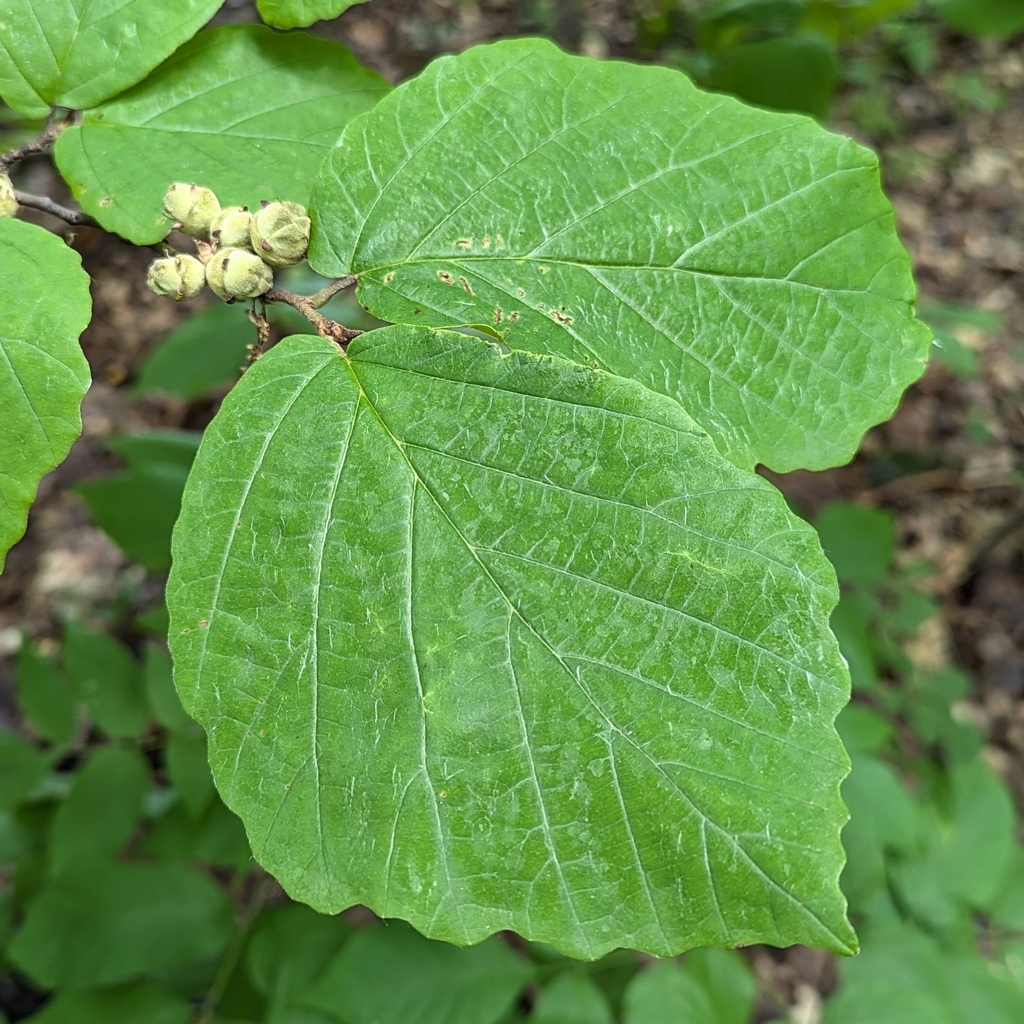
american witch-hazel
Hamamelis virginiana
Hamamelis virginiana, known as witch-hazel, common witch-hazel, American witch-hazel and beadwood, is a species of flowering shrub native to eastern North America, from Nova Scotia west to Minnesota, and south to central Florida to eastern Texas.
From the article Hamamelis virginiana on Wikipedia (CC BY-SA), quoted section by section
Description
Hamamelis virginiana is a small, deciduous tree or shrub growing up to 6 metres (20 ft), rarely to 10 m (33 ft) tall, often with a dense cluster of stems from its base. The bark is light brown, smooth, scaly, inner bark reddish purple. The branchlets are pubescent at first, later smooth, light orange brown, marked with occasional white dots, finally dark or reddish brown. The foliage buds are acute, slightly falcate, downy, light brown. The leaves are oval, 3.7–16.7 cm (1+1⁄2–6+5⁄8 in) long and 2.5–13 cm (1–5+1⁄8 in) broad, oblique at the base, acute or rounded at the apex, with a wavy-toothed or shallowly lobed margin, and a short, stout petiole 6–15 mm (0.24–0.59 in) long; the midrib is more or less hairy, stout, with six to seven pairs of primary veins. The young leaves open involute, covered with stellate rusty down; when full grown, they are dark green above, and paler beneath. In fall, they turn yellow with rusty spots. The leaf stipules are lanceolate, acute; they fall soon after the leaf expands. The flowers are pale to bright yellow, rarely orange or reddish, with four ribbon-shaped petals 1–2 cm (1⁄2–3⁄4 in) long and four short stamens, and grow in clusters; flowering begins in about mid-fall and continues until late fall. The floral calyx is imbricate in bud, deeply four-parted, very downy, and orange brown within. Two or three bractlets appear at base. …
What it does
Hamamelis virginiana flowers from late September to late November, occasionally in December. The pollinated ovary, protected by a persistent calyx, enters a resting state during the winter months. Fertilization of the ovary is delayed until the following spring, usually about the middle of May, which is 5–7 months after pollination. The fruits develop over the course of the growing season, reaching maturity in late August. As the ripe fruit dries and dehisces, the seeds are ballistically ejected, typically by late October. The empty seed pod remains attached to the plant, sometimes for months. The seeds lie on the ground for two winters before sprouting. Hamamelis virginiana is a pollinator plant that attracts moths and supports 62 species of caterpillars.
Wikipedia: “Ecology”
At the table
Native Americans produced witch hazel extract by boiling the stems of the shrub and producing a decoction, which was used to treat swellings, inflammations, and tumors. Early Puritan settlers in New England adopted this remedy from the natives, and its use became widely established in the United States. An extract of the plant is used in the astringent witch hazel. H. virginiana produces a specific kind of tannins called hamamelitannins. One of those substances displays a specific cytotoxic activity against colon cancer cells. The bark and leaves were used by Native Americans in the treatment of external inflammations. Pond's Extract was a popular distillation of the bark in dilute alcohol. The wood is light reddish brown, sapwood nearly white; heavy, hard, close-grained, with a density of 0.68. The forked twigs of witch-hazel are preferred as divining rods. The bark and leaves can be used to make tea for easing stomach issues, soothing sore throats, and more.
Wikipedia: “Uses”
Where it lives
Recorded sightings
—
geo-referenced records in GBIF, from museums, herbaria and field observers.
Drag the globe to turn it. Dots are where records exist, not a range map; darker means more records.
In the old herbals & bestiaries


In the stacks
Searching the stacks…
Every page naming Hamamelis virginiana in the Biodiversity Heritage Library →
This page is assembled live from iNaturalist, GBIF, Wikipedia, the Source Library and the Internet Archive. It is not yet part of the hand-edited codex. iNaturalist taxon 51970.