- Animals
- ›Arthropods
- ›Hexapods
- ›Insects
- ›Winged and Once-winged Insects
- ›Beetles
- ›Water, Rove, Scarab, Long-horned, Leaf, and Snout Beetles
- ›Cucujiform Beetles
- ›Cucujoidea
- ›Pleasing Fungus Beetles
- ›Erotylinae
- ›Erotylini
- ›Iphiclus
- ›Iphiclus
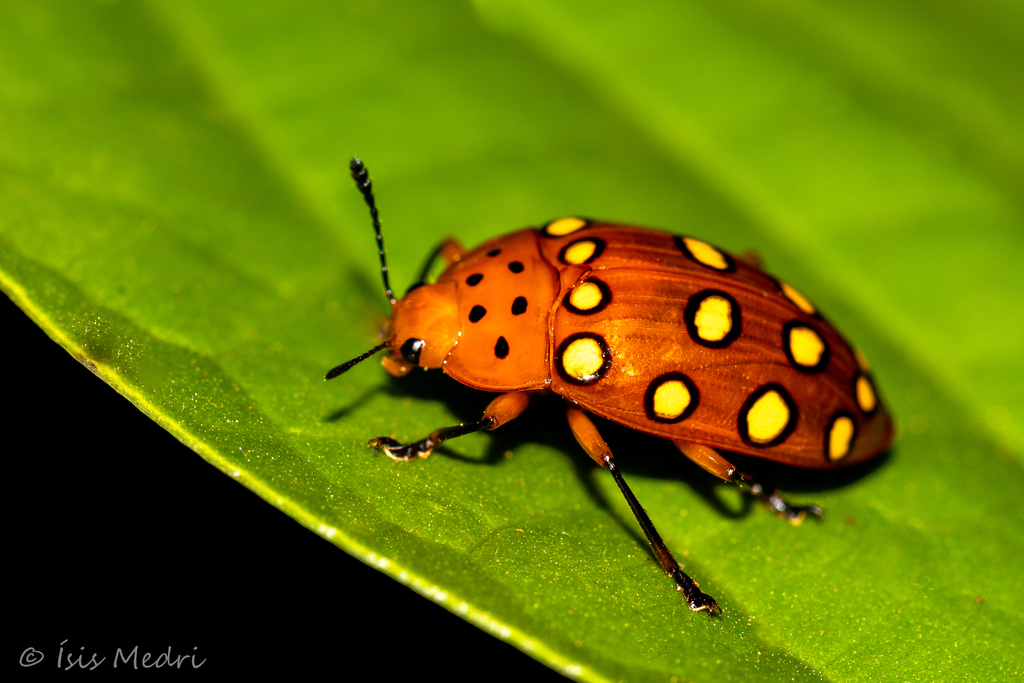
Iphiclus sedecimmaculatus
Iphiclus sedecimmaculatus is a Neotropical species of pleasing fungus beetle (family Erotylidae) described by Jean Buquet in 1840. Within its family, it belongs to subfamily Erotylinae.
This species occurs in the eastern foothills of the Andes, from Panama through Colombia, Peru and Brazil, to the lowlands of Paraguay.
From the article Iphiclus sedecimmaculatus on Wikipedia (CC BY-SA), quoted section by section
Description
I.sedecimmaculatus adults measure about 10-12 mm in length, and around 5.5 mm in width. Like most other members of subgenus Iphiclus (Iphiclus) they have a reddish-brownish pronotum, spotted black as in several of their closest relatives, unlike the all-black pronotum the somewhat more distantly related Erotylina. In this species, there are 6 pronotal spots, arranged in a crosswise ellipse with two spots at the outside and four in the center. The elytra have evenly-spaced weak lengthwise stripes and are also reddish-brown. They bear prominent yellowish-white eyespots, usually 16 in number and arranged in four crosswise rows of two spots per elytron. Two varieties have been named, Iphiclus sedecimmaculatus var. concentratus by George Crotch in 1876, and I.s. var. discedens by Paul Kuhnt in 1910. The concentratus variety are small individuals with more deeply impressed elytra stripes and small wingspots which have a rather white center. Kuhnt's discedens has only the wingspots of the first row are distinct; the spots in the other three rows are enlarged sideways to form coherent wavy bars, with the thin black border running all around.
What it does
In the (possibly paraphyletic) genus, I.sedecimmaculatus is placed in the nominate subgenus Iphiclus (Iphiclus), which is possibly more closely related to genus Erotylina than to other lineages traditionally placed in Iphiclus. Buquet's type specimen, now in the MNHN collection, was from "Colombia" – at that time the Republic of New Granada, which was much larger than the present-day Colombian state. Many early 19th-century authors used "Colombia" for roughly the same area as today's country, and "Nova Granada" (or similar) for indeterminable localities in the historical country, but it is not clear how Buquet (who was more of a trader in specimens than a describer of species) did it. George Crotch had an I.sedecimmaculatus in his collection which he initially believed to be Buquet's type and labeled it accordingly, but this label was then struck out and the specimen identified as having been acquired from Louis Reiche. Crotch's type specimen of I.s. var. concentratus, attributed to Henry Bates, is still in the Crotch collection at the UMZC; it is supposedly from "Colombia" too, but Bates' specimens are usually from the vicinity of Tefé in western Brazil – more than 500 km from the Colombian border today, but only about 150 km in Bates' time. Kuhnt's type of I.s. var. …
Wikipedia: “Systematics and ecology”
Listen
Looking for field recordings…
Where it lives
Recorded sightings
—
geo-referenced records in GBIF, from museums, herbaria and field observers.
Drag the globe to turn it. Dots are where records exist, not a range map; darker means more records.
In the stacks
Searching the stacks…
Every page naming Iphiclus sedecimmaculatus in the Biodiversity Heritage Library →
This page is assembled live from iNaturalist, GBIF, Wikipedia, the Source Library and the Internet Archive. It is not yet part of the hand-edited codex. iNaturalist taxon 520743.