- Plants
- ›Vascular Plants
- ›flowering plants
- ›Dicots
- ›saxifrages, stonecrops, and allies
- ›peony family
- ›Paeonia
- ›Paeonia
- ›Corallinae
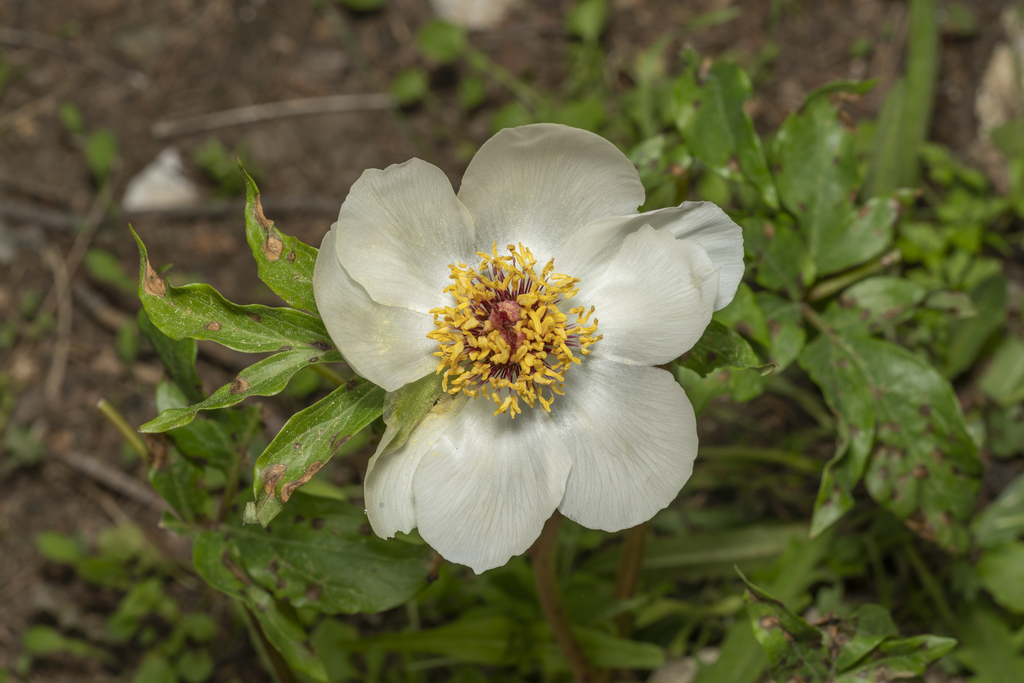
Clusius' Peony
Paeonia clusii
Paeonia clusii is a relatively low (25–50 cm) species of herbaceous peony with scented, white or pink flowers of up to 12 cm in diameter. In the wild, the species can only be found on the islands of Crete and Karpathos (subsp. clusii), and Rhodes (subsp. rhodia). It has pinkish-purple stem up to 30 cm long and glaucous dissected leaves. P. clusii blooms in mid-spring.
From the article Paeonia clusii on Wikipedia (CC BY-SA), quoted section by section
Description
Paeonia clusii is a perennial, herbaceous plant of 25–50 cm high. Both diploid (2n=10) and tetraploid (2n=20) specimens have been found.
Root, stems and leaves. The main roots are slightly tuberous, up to 2.5 cm wide, with thinner carrot-shaped side roots. The stems are mostly tinged purple, with several (up to nine) scales at their base. Leaves are split into three sets of leaflets, themselves further divided into twenty three to forty eight, 2.5–4.5 cm wide, ovate to lanceolate (subspecies rhodia) or to ninety five lanceolate to linear, 0.5–3.3 cm wide, segments (in the typical subspecies). The leaf is mostly hairless, but sometimes the lower surface carries a few hairs.
Flower, fruit and seed. The flowers are set individually at the tip of the stems, and are subtended by one or two bracts that look like small segmented leaves. There are three or four rounded sepals, green but purple around the margin, and with a rounded tip. Within are seven white or pink petals of 4–5 cm long and 2.5–4 cm wide. The many stamens consist of purple filaments topped by yellow anthers. The disk that encircle the carpels is 0.5–1 mm high and covered in soft hair. Two to four (or rarely only one) red carpels are covered in soft, white, 2–2.5 mm long hairs and topped by an almost seated flattened, recurving, red stigma 1.5–2 mm wide. …
What it does
The typical subspecies grows in maquis on limestone between 200–1900 m elevation. Subspecies rhodia occurs as undergrowth of pines at an elevation of 350–850 m.
Wikipedia: “Ecology”
How it is grown
Rhodes' peony likes well-drained, loamy soil or compost. It's hardy in the UK, but because it starts growing in late winter the leaves may be damaged by frosts. As can be expected from a plant from the Mediterranean, they suffer from wet soil.
Wikipedia: “Cultivation”
In human culture
Paeonia clusii was named in honor of the Dutch botanist Carolus Clusius, who was the first to write about a white flowered peony from Crete, already in 1601.
Wikipedia: “Etymology”
Where it lives
Recorded sightings
—
geo-referenced records in GBIF, from museums, herbaria and field observers.
Drag the globe to turn it. Dots are where records exist, not a range map; darker means more records.
In the stacks
Searching the stacks…
Every page naming Paeonia clusii in the Biodiversity Heritage Library →
This page is assembled live from iNaturalist, GBIF, Wikipedia, the Source Library and the Internet Archive. It is not yet part of the hand-edited codex. iNaturalist taxon 520916.