- Plants
- ›Vascular Plants
- ›flowering plants
- ›Dicots
- ›saxifrages, stonecrops, and allies
- ›peony family
- ›Paeonia
- ›Paeonia
- ›Corallinae
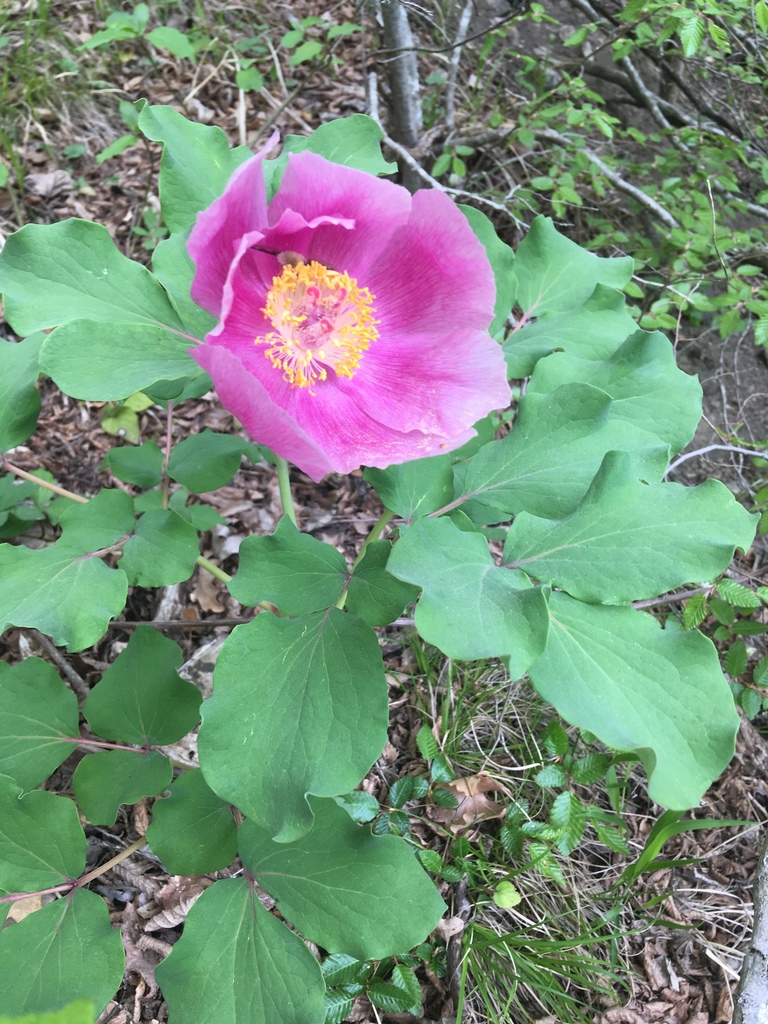
Crimean peony
Paeonia daurica
Paeonia daurica is a perennial herbaceous plant belonging to the peony family. It has slender carrot-shaped roots, leaves mostly consisting of nine leaflets, with one flower per stem. The flower is subtended by none to two leafy bracts, and has two or three sepals, five to eight petals, and many stamens. The subspecies vary in the colour of the petals (white, light yellow, pink, red), the size and shape of the leaflets, and the hairiness of the leaflets and the carpels. Paeonia daurica can be found from the Balkans to Iran, and the Crimea to Lebanon, with the centre of its distribution in the Caucasus. It is also cultivated as an ornamental.
From the article Paeonia daurica on Wikipedia (CC BY-SA), quoted section by section
Description
Paeonia daurica is a perennial herbaceous photosynthesising plant, emerging in spring and retreating underground in the autumn. It has slender carrot-shaped roots which are directed downwards. The leaves are alternately set along the stems and have an outline of 5–111⁄2 × 8–17 cm. The lower leaves are usually composed of three sets of three entire or sometimes bifid leaflets, and occasionally there is third order division, resulting in a maximum of nineteen leaflets. The shape of the leaflets is wide to narrowly oval, with the largest width at midlength or towards the tip. The base of the leaflets is more or less wedge-shaped or sometimes rounded, the margin is entire and sometimes wavy, and the tip is rounded or has a smaller or larger sharp tip. The upper surface of the leaf is hairless, while the undersides are hairless or sparsely to densely covered in felty hairs. The hermaphrodite flowers are set individually at the end of the stems and are subtended by none to two leafy bracts. The flower itself consists of two or three green sepals, five to eight petals, that may be white, pale yellow, yellow, yellow with a red blotch at the base or with a reddish margin, pink, red, or purple-red, and many stamens consisting of pale, yellow, pink or purple filaments topped by anthers that contain yellow pollen. …
Range & habitat
Paeonia daurica can be found scattered in the Balkans (Romania, Bulgaria, Serbia, Croatia, Bosnia, Montenegro, Albania, Macedonia, northern Greece), the Crimea, the Caucasus (Dagestan and Krasnodar Krai in Russia, Georgia, Azerbaijan), Kaçkar Mountains (Turkey), the Alborz Mountains (northern Iran), Talysh Mountains (west of Guilan province, South of Caspian sea), and in Lebanon. The typical P. daurica subsp. daurica is widespread, but is not sympatric with the other subspecies, and does not occur in the Velebit, Caucasus and Alborz mountains. P. daurica subsp. coriifolia occurs at elevations below 1000 m in the west and north-west of the Caucasus and it is found in deciduous forests dominated by oak, beech, elm, maple and ash or in mixed forests of fir, oak and beech, growing on a wide range of limestone, sandstone and volcanic rocks. P. daurica subsp. mlokosewitschii is only known from eastern Georgia, north-western Azerbaijan and adjacent Russia, where it grows in deciduous oak, beech, elm, maple and chestnut forests. P. daurica subsp. wittmanniana is found in north-western Georgia and the upper reaches of the Mzymta River in adjacent Russia where it grows in both deciduous forests and subalpine and alpine meadows between 1000 and 2300 m, only on limestone. P. daurica subsp. …
Wikipedia: “Distribution”
What it does
With its hairless leaves, P. daurica, does not seem to be adapted to a typical Mediterranean climate, but to rather more humid circumstances in summer. The population on Mount Orjen grows in forest consisting of silver fir, European beech, Turkish hazel, the maple species Acer pseudoplatanus and A. intermedium, and ash, and is further accompanied by widespread species such as European spindle, mountain cherry, drooping bittercress, Turk's cap lily, but also with endemics such as the Orjen iris.
Wikipedia: “Ecology”
How it is grown
Several subspecies of P. daurica are on offer as seed or plants (daurica, coriifolia, tomentosa, macrophylla, mlokosewitschii and wittmanniana) and are collected by specialist gardeners. These are said to be hardy in western Europe and suitable for normal garden conditions, the lowland taxa with preference for more or less shady circumstances. Paeonia daurica subsp. mlokosewitschii has won the Royal Horticultural Society's Award of Garden Merit. As this subspecies' name is somewhat difficult to pronounce in English, it is often affectionately referred to as 'Molly-the-Witch'. P. daurica is a red book species (VU) in Ukraine and is cultivated in the Crimean reservations of Yalta, Karadag and Cape Martyan. In the Crimean Tatar language it's called patlaq çanaq, meaning 'broken cup', referring to the shape of the petals that remind an elegant cup that was broken with the pieces still held in place.
== References ==
Wikipedia: “Cultivation”
In human culture
Paeonia daurica was first described by Henry Cranke Andrews in the seventh volume of his Botanist's Repository published in 1807. A yellow flowered Paeonia species from Abkhazia was collected by C.M. Worontzoff, and described in 1846 by John Lindley, who named it P. wittmanniana Lindl.. In 1848 Christian von Steven described another taxon with yellow petals under the same specific name P. wittmanniana Steven. It had been collected at Atskhu, Meskheti Province, in Georgia. Pierre Edmond Boissier made descriptions of three taxa in this complex in 1869: P. corallina and P. corallina var. triternata, and P. wittmanniana Steven. Franz Josef Ruprecht in 1869, distinguished P. triternata f. coriifolia. In 1892 Ernst Huth distinguished between P. corallina var. typica with entire leaflets and red petals, and P. wittmanniana with lobed leaflets and yellow petals. Russian botanist Nikolai Michailowitsch Albow was the first to think that a difference only in petal colour does not merit distinguishing species, and he reduced P. wittmanniana to P. corallina var. wittmanniana, under which he described a new form, f. macrophylla. Aleksandr Aleksandrovich Lomakin recognized four species in this group in 1897: P. corallina, P. mlokosewitschii, P. macrophylla, P. wittmanniana, and introduced P. wittmanniana var. tomentosa. …
Wikipedia: “Taxonomic history”
Where it lives
Recorded sightings
—
geo-referenced records in GBIF, from museums, herbaria and field observers.
Drag the globe to turn it. Dots are where records exist, not a range map; darker means more records.
In the stacks
Searching the stacks…
Every page naming Paeonia daurica in the Biodiversity Heritage Library →
This page is assembled live from iNaturalist, GBIF, Wikipedia, the Source Library and the Internet Archive. It is not yet part of the hand-edited codex. iNaturalist taxon 520919.