- Animals
- ›Arthropods
- ›Hexapods
- ›Insects
- ›Winged and Once-winged Insects
- ›Ants, Bees, Wasps, and Sawflies
- ›Narrow-waisted Wasps, Ants, and Bees
- ›Ants, Bees, and Stinging Wasps
- ›Bees and Apoid Wasps
- ›Bees
- ›Honey Bees, Bumble Bees, and Allies
- ›Carpenter Bees
- ›Large Carpenter Bees
- ›Xylocopa
- ›Lestis
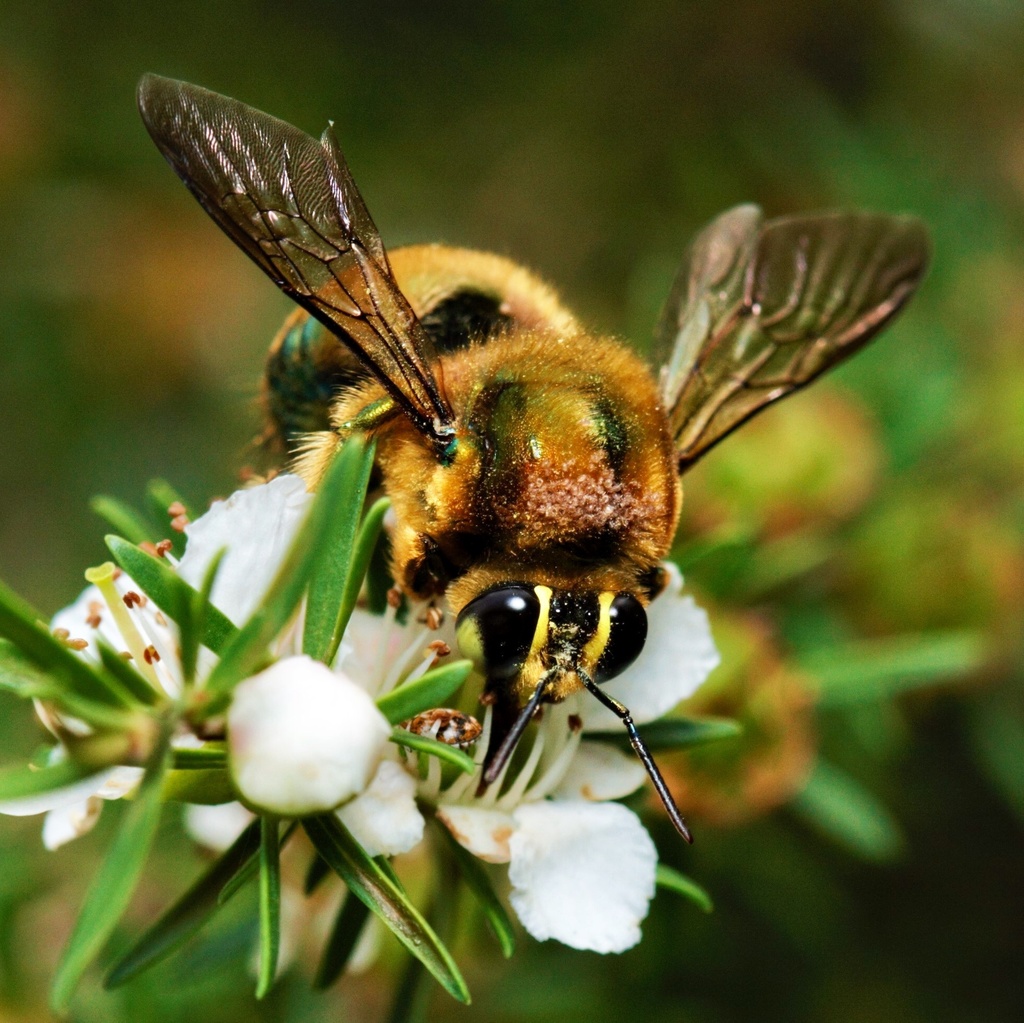
Golden-green Carpenter Bee
Xylocopa aerata
Xylocopa aerata, the golden-green carpenter bee or green carpenter bee, is one of two species of carpenter bee found only in the conservation areas around Sydney, and in the Great Dividing Range in New South Wales in Australia. Its only other habitat as of 2020 is on Kangaroo Island in South Australia. The species is especially vulnerable to fire, and much of its habitat was burnt during the 2019–20 Australian bushfire season.
The bee gets its common name by its habit of burrowing into wood. It is not a social species and does not produce honey, but it is an important pollinator for several species of Australian native plants.
From the article Xylocopa aerata on Wikipedia (CC BY-SA), quoted section by section
Description
It was originally described by F. Smith in 1851 as Lestis aeratus. Its specific epithet is the Latin adjective aerata, meaning "bronzed". As its name implies, the golden-green carpenter bee is a metallic green in colour, although it may appear purplish or bluish from some angles. A large stocky bee (at nearly 2 cm (0.79 in), one of the largest native bees in southern Australia), it is often heard by its loud low-pitched buzzing while flying between flowers. The male has yellow face markings. The bee does have a sting which is potentially painful, although no stings have been recorded.
Range & habitat
The natural distribution was southeastern New South Wales from Sydney southwards (where it overlaps with X. bombylans), and into Victoria and southeastern South Australia. However, the green carpenter bee went extinct on mainland South Australia in 1906 and in Victoria in 1938. Apart from conservation areas around Sydney, and in the Great Dividing Range, it exists only on the western half of Kangaroo Island in SA. They can be seen from spring to autumn, commonly feeding at pea flowers of the family Fabaceae, such as Gompholobium species, including Gompholobium latifolium in spring, and Pultenaea tuberculata in autumn. Flowers of Leucopogon and Leptospermum are also visited.
Wikipedia: “Distribution and habitat”
What it does
The golden-green carpenter bee nests by hollowing out stalks of grasstrees (Xanthorrhoea), or soft wood such as Banksia, Casuarina, Melaleuca and Leptospermum. The female excavates a tunnel with her jaws and picks up and dumps the wood shavings outside. The hollow can reach 30 cm (12 in) long by 1.1-1.4 cm diameter. Larger pieces of wood may allow for multiple tunnels. Several female bees may use a nest, one breeding and the others guarding. A bee defends the 0.7-1.0 cm wide entrance by blocking it with its abdomen (compare Allodapula). Both male and female bees may overwinter within the tunnels. The tunnels are partitioned into several cells, where the mother bee lays an egg in each accompanied by provisions of nectar and pollen.
Wikipedia: “Behaviour”
Listen
Looking for field recordings…
Where it lives
Recorded sightings
—
geo-referenced records in GBIF, from museums, herbaria and field observers.
Drag the globe to turn it. Dots are where records exist, not a range map; darker means more records.
In the stacks
Searching the stacks…
Every page naming Xylocopa aerata in the Biodiversity Heritage Library →
This page is assembled live from iNaturalist, GBIF, Wikipedia, the Source Library and the Internet Archive. It is not yet part of the hand-edited codex. iNaturalist taxon 522827.