- Animals
- ›Arthropods
- ›Crustaceans
- ›Typical Crustaceans
- ›Malacostracans
- ›Decapods, Isopods, and allies
- ›Decapods and Krill
- ›Decapods
- ›Crabs, Lobsters, Shrimps, and Allies
- ›True Crabs
- ›Eubrachyuran Crabs
- ›Thoracotrematan Crabs
- ›Ghost, Fiddler, Sand Bubbler Crabs and Allies
- ›Ghost and Fiddler Crabs
- ›Ghost Crabs
- ›Ocypode
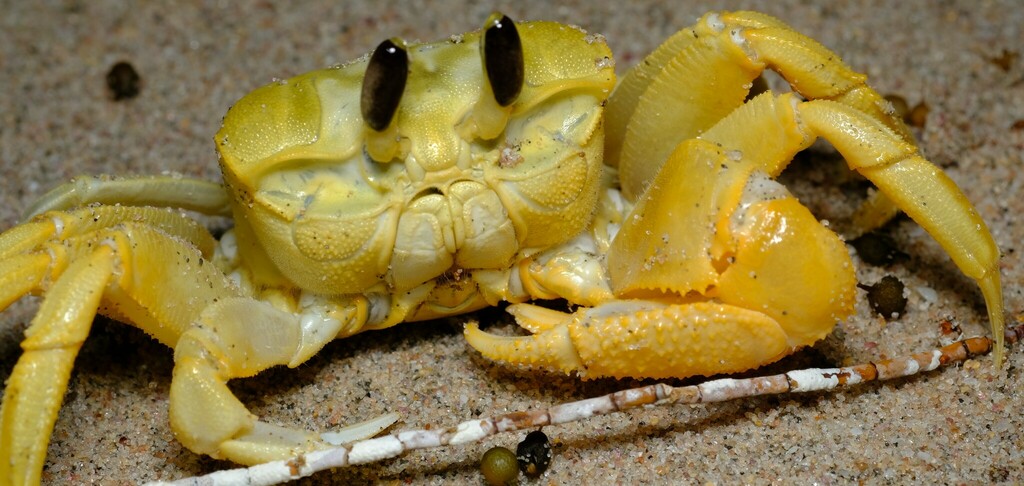
Golden Ghost Crab
Ocypode convexa
Ocypode convexa, commonly known as the golden ghost crab, or alternatively the western ghost crab or yellow ghost crab, is a species of ghost crabs endemic to the coast of Western Australia, from Broome to Perth. They are relatively large ghost crabs, with a carapace growing up to 45 mm (1.8 in) long and 52 mm (2.0 in) wide. They are easily recognisable by their golden yellow colouration. Like other ghost crabs they have box-like bodies with unequally sized claws. They also have large eyestalks with the cornea occupying most of the bottom part.
Golden ghost crabs are common inhabitants of open sandy beaches, living in burrows in the intertidal and supratidal zones. They are predominantly nocturnal and semi-terrestrial. They are a generalist species, feeding on carrion and debris, as well as preying on small animals. Along with the red fox (Vulpes vulpes), they are significant as one of the main predators of eggs and hatchlings of Western Australian sea turtles, particularly the Endangered loggerhead sea turtle (Caretta caretta) which has one of the largest rookeries in the region.
From the article Golden ghost crab on Wikipedia (CC BY-SA), quoted section by section
Description
Golden ghost crabs are relatively large and robust ghost crabs with strong legs and claws. Their carapace is deep and box-like in shape, and can grow to a length of up to 45 mm (1.8 in) and a width of 52 mm (2.0 in). They are easily identifiable by their colouration. As their common name implies, the overall colour of golden ghost crabs is usually creamy white to a rich golden yellow with faint brown markings.
Like other ghost crabs, the eyestalks of golden ghost crabs are large and swollen, with the cornea occupying the lower surface. Their tips do not extend into a spike (style) making them easy to distinguish from the similarly sized horned ghost crab (Ocypode ceratophthalma) which also occurs in Western Australia. The upper margins of the eye orbits curve around the bases of the eyestalks, then gently curve again towards the sides of the carapace. The outer edges of the upper margins of the eye orbits are triangular in shape and distinctly pointing forward. The lower margins of the eye orbits have deep notches on the center and on the sides. The carapace is wider than it is long, being broadest at the width between the outer edges of the eye orbits. The upper surface is covered densely with small bumps (tubercles) that gradually become sparser towards the anterolateral regions. …
Range & habitat
Golden ghost crabs are endemic to the coast of Western Australia, from Broome to Perth. They are one of five ghost crab species found in the Western Australian coast, the others being Ocypode ceratophthalma, Ocypode cordimanus, Ocypode fabricii, and Ocypode pallidula. Among these, Ocypode fabricii is also endemic to Australia (from Darwin to Shark Bay). Golden ghost crabs can easily be distinguished from all other species by their large size, their golden yellow colouration, and the rough tuberculation on their claws. The only similarly sized species in the region is the horned ghost crab, which are also easily distinguishable as they are the only ghost crab in Australia exhibiting spikes (exophthalmy) on the tips of their eyestalks. Younger individuals may be identified through the examination of their stridulating ridges and the shape of their gonopods.
Wikipedia: “Distribution”
What it does
Like other ghost crabs, golden ghost crabs are predominantly nocturnal, though they may sometimes emerge during the day. They are semi-terrestrial and breathe oxygen from the air through moistened gills. They must periodically wet their gills with seawater, usually by taking water from moist sand or by running into the surf and letting the waves wash over them. However, in 1962, the Australian zoologist William Ride reported golden ghost crabs foraging inland as far as 500 m (1,600 ft) away from the sea following heavy rains. This indicates that they are able to tolerate freshwater, and can still breathe by taking in moisture through wet vegetation. Golden ghost crabs must return to the sea to release their eggs. They hatch into marine planktonic larvae. Golden ghost crabs live in deep burrows in the intertidal and supratidal zones of open sandy beaches. Some burrows may be found as much as 12 to 20 m (39 to 66 ft) away from the high water mark and in the dune zone, but they are densest in the intertidal zone (71%). The burrows are vertically constructed, with the bottom commonly situated south of the entrance. It is believed that this is to prevent sunlight from shining into the burrow during the day.
They are swift runners, darting away to their burrows at the slightest sign of danger. …
Wikipedia: “Ecology and behaviour”
In human culture
While the specific name is derived from Latin convexus ("vaulted" or "domed"). The latter is a direct translation of Quoy and Gaimard's "French name" of the species, Ocypode bombé, referring to the dome-like shape of the carapace. They are commonly known as the "golden ghost crab". They are also sometimes referred to as the "western ghost crab", or the "yellow ghost crab".
Wikipedia: “Etymology”
Where it lives
Recorded sightings
—
geo-referenced records in GBIF, from museums, herbaria and field observers.
Drag the globe to turn it. Dots are where records exist, not a range map; darker means more records.
In the stacks
Searching the stacks…
Every page naming Ocypode convexa in the Biodiversity Heritage Library →
This page is assembled live from iNaturalist, GBIF, Wikipedia, the Source Library and the Internet Archive. It is not yet part of the hand-edited codex. iNaturalist taxon 522847.