- Plants
- ›Vascular Plants
- ›flowering plants
- ›monocots
- ›lilies, supplejacks, and allies
- ›lily family
- ›true lily subfamily
- ›true lilies and allies
- ›Lilium
- ›Leucolirion
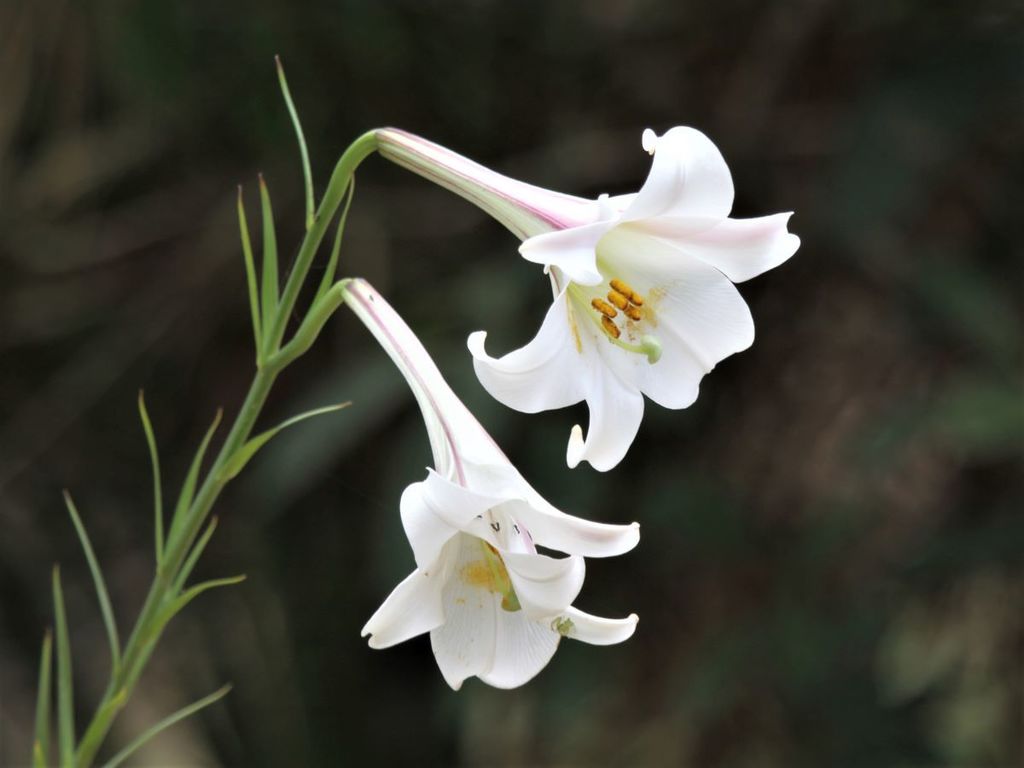
Formosa lily
Lilium formosanum
Lilium formosanum, also known as the Formosa lily or Taiwanese lily (simplified Chinese: 台湾百合; traditional Chinese: 台灣百合; pinyin: Táiwān bǎihé), is a plant species in the lily family, endemic to Taiwan. It is closely related to the Easter lily found in the Ryukyu Islands of Japan, eastern and northern Taiwan. Both species are cultivated for their showy, trumpet-shaped flowers. Lilium formosanum has become naturalized in scattered locations in Africa, Australia, and the Americas.
From the article Lilium formosanum on Wikipedia (CC BY-SA), quoted section by section
Description
Lilium formosanum reaches a height of 120 to 150 cm. The bulbs are small, rounded and reach a diameter of around 2 to 4 cm. They consist of white to yellowish lanceolate scales. The stem is smooth to papillose and sometimes tinged with purple. The leaves are linear or narrow and lanceolate, 2.5 to 15 cm long and 4 to 13 mm wide. They are freely distributed around the stem. The plant blooms from June to December with one to five fragrant, funnel-shaped flowers in an umbel. The hermaphrodite flowers are threefold. The six identically shaped flower bracts are broadly spatulate and 11.5 to 14.5 cm long. The basic color of the flowers is pure white, the outside is purple. Each flower contains three carpels and six stamens. The anthers are about 10 mm long, the pollen is yellow, the filaments are very long, about 10 cm. The nectaries are green and papillose on both sides. The seeds ripen in slender 7 cm to 9 cm long seed capsules and germinate immediately above the soil surface.
In human culture
This flower is favoured among the Rukai people who call this flower bariangalay, the Rukai often wear them in headdresses during special occasions or ceremonies.
Wikipedia: “In indigenous culture”
Where it lives
Recorded sightings
—
geo-referenced records in GBIF, from museums, herbaria and field observers.
Drag the globe to turn it. Dots are where records exist, not a range map; darker means more records.
In the stacks
Searching the stacks…
Every page naming Lilium formosanum in the Biodiversity Heritage Library →
This page is assembled live from iNaturalist, GBIF, Wikipedia, the Source Library and the Internet Archive. It is not yet part of the hand-edited codex. iNaturalist taxon 52360.