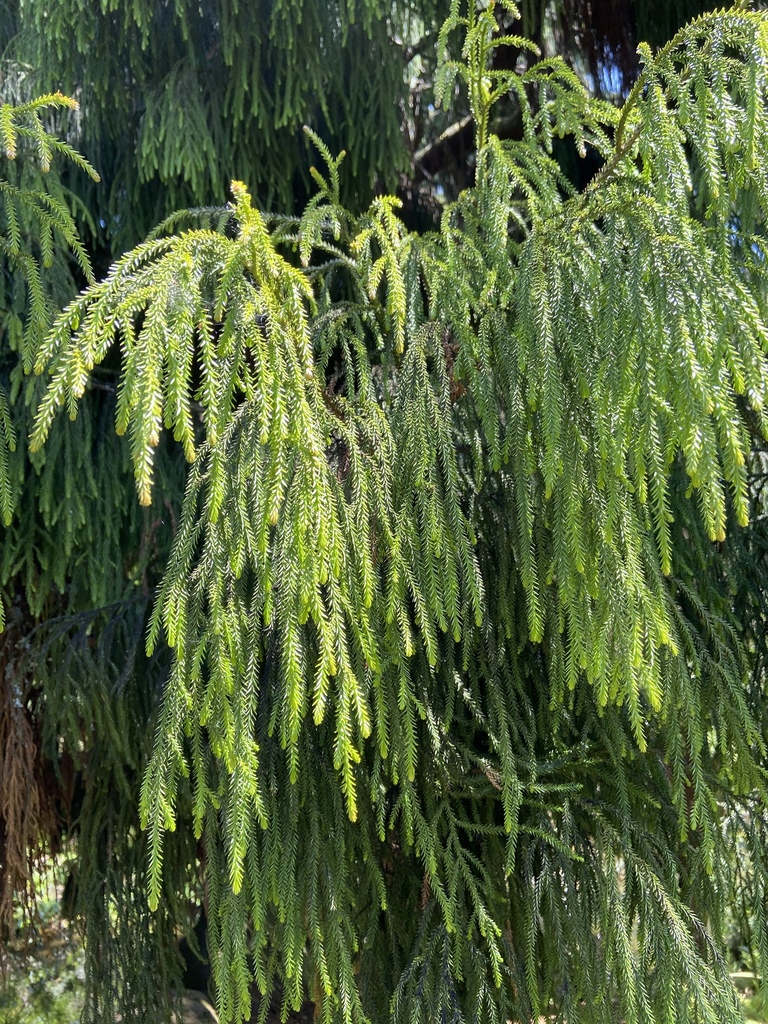
rimu
Dacrydium cupressinum
Dacrydium cupressinum, commonly known as rimu, is a species of conifer in the family Podocarpaceae, native to New Zealand. The tree usually reaches 35 metres (100 feet) in height, but may reach up to 60 metres (200 feet) and can have a stout trunk up to 2 m (6 ft 7 in) in diameter. It is dioecious, meaning individual trees are either male or female. Rimu is the country's most common native conifer, its range covers the North, South, and Stewart Islands. Rimu has an estimated lifespan of 600–800 years, although it may live as long as 1,200 years.
The name D. cupressinum was first published invalidly in 1786 by Daniel Solander and Georg Forster. However the species was first given a valid description in 1806 by Aylmer Lambert. The second part of the scientific name, cupressinum, was given because of the tree's similarity with cypress species. Rimu's fruits are consumed by various birds such as bellbirds, kererū, and the tūī. Rimu's fruits also provide an important source of food and vitamins for the native flightless parrot, the critically endangered kākāpō, which will only mate during years of heavy fruiting. Many different plants grow on the tree's trunk and branches, using it for support, which are called epiphytes and hemi-epiphytes. Rimu also plays host to numerous insect species.
From the article Dacrydium cupressinum on Wikipedia (CC BY-SA), quoted section by section
Description
Dacrydium cupressinum (rimu) is a species of dioecious (either male or female) evergreen conifer in the family Podocarpaceae, and usually reaches 35 metres (115 feet) in height, but may reach up to 60 m (200 ft) tall, and can have a stout trunk up to 1.5–2 m (4 ft 11 in – 6 ft 7 in) in diameter. The trunk is usually cylindrical and smooth. D. cupressinum grows in an erect (occasionally forked), and usually a monopodial manner, meaning it grows from the main stem. When reaching its maximum height, it is typically unbranched for 20 m (70 ft) of its height. The tree exhibits a pyramid-like shape in the early growth stages, and the crown of mature trees evolves into a domed shape, with the main branches spreading outwards or ascending. Its bark is grey to dark-brown in colour, shedding in large, elongated, thick flakes. When the outer layers of bark flake off, a distinctive wavy pattern of parallel raised ridges is visible on the new bark beneath. These lines of ridges have been described as resembling the contour lines on a topographic map. Areas of bark between the ridges have small pointed projections with porous tissue that allow air to penetrate the bark, providing oxygen to the cells of the tree beneath the bark. The wood is typically a dark-red colour, gradually becoming a yellow-brown colour after exposure to sunlight. D. …
Range & habitat
Dacrydium cupressinum is endemic to New Zealand, and is the country's most common native conifer. Its range covers the North Island, South Island, and Stewart Island. In the South Island, it is uncommon or absent in parts of the eastern side of the island. On the Banks Peninsula, it is almost entirely extinct, with its absence being attributed to deforestations instead of environmental changes, such as moisture deficits in summer. D. cupressinum was previously common around the Banks Peninsula town of Little River. In the South Island, D. cupressinum's range predominantly covers the west side of the island, and it is largely not present in: Canterbury, Marlborough, Otago, and more generally, the inland South Island. Dacrydium cupressinum was likely naturally not present in only a few specific areas of the North Island prior to colonisation, which included: the eastern parts of Tongariro National Park, Kaingaroa Forest, and the southern parts of Hawke's Bay. On the eastern side of the South Island, the tree's presence is scattered, particularly in the areas in between Blenheim and Waikouaiti. The species does occur in small populations in the Ashley Forest, the Hunters Hills, the Kaikōura Ranges, and a few other localities.
Habitat. Dacrydium cupressinum typically inhabits lowland to montane forests, and is occasionally found near subalpine scrubland. …
Wikipedia: “Distribution”
What it does
Dacrydium cupressinum's seeds are dispersed by gravity and by fruit-eating animals (frugivores). These seeds are well-adapted to be dispersed by birds; primary dispersers of the seeds include bellbirds, kererū, and the tūī. Brown creepers, fantails, grey warblers, riflemen, silvereyes, and tomtits have been observed in association with the tree. Other birds, such as white-eyes and house sparrows, feed on the tree's receptacles (fleshy fruit-like structures). The tree is known to be browsed by deer and possums, which browse the seedlings and consume the foliage and branchlets, respectively. Excrements of the wētā are frequently found in seed traps, which could indicate that wētā consume the seeds of the tree. The seeds have been recorded being destroyed by chaffinches, mice, rats, and wētā. Dacrydium cupressinum's fruits are an important food and vitamin resource for the native flightless parrot, the kākāpō, which feeds on the fruits. The fruits are high in calcium and vitamins, and the kākāpō may have adapted to survive prolonged periods of limited access to these resources. The kākāpō will only mate during years of heavy fruiting. Several species of insects have been recorded as feeding on the stems and leaves, including: stick insects, weevils, Pyrgotis species, and looper caterpillars, from Pseudocoremia fenerata. Other wood-boring insects on D. …
Wikipedia: “Ecology”
In human culture
The name D. cupressinum was first published invalidly in 1786 by the European naturalist Georg Forster, using a description by Daniel Solander, in a publication entitled, De Plantis Esculentis Insularum Oceani Australis Commentatio Botanica. The British botanist Aylmer Lambert provided the first valid description of the species in his 1806 work, A Description of the Genus Pinus. The name, Thalamia cupressina, comes from a later 1826 description of D. cupressinum where Kurt Sprengel attempted to place the taxon, D. cupressinum into the genus, Thalamia. His placement has not been accepted by other plant taxonomists, and hence the name given by Sprengel becomes a homotypic synonym. In 1855, French botanist Élie-Abel Carrière described the species Dacrydium cupressiforme, in his work Traité Général des Conifères. What he thought to be a new species is now recognised as being Dacrydium cupressinum and hence is a heterotypic synonym of the species described earlier in 1806.
Wikipedia: “History”
Where it lives
Recorded sightings
—
geo-referenced records in GBIF, from museums, herbaria and field observers.
Drag the globe to turn it. Dots are where records exist, not a range map; darker means more records.
In the old herbals & bestiaries

Commentaries on the Six Books of Dioscorides on Medical Matter
Pietro Andrea Mattioli · 1563 · p.665

François Bouchard — Recueil de cent-trente-trois oiseaux des plus belles especes (1775)
François Bouchard · 1775 · p.113

Notable Commentaries on the History of Plants
Leonhart Fuchs · 1542 · p.549

History of Plants in Four Books
Valerius Cordus · 1561 · p.324

Marcelli Malpighii ... Anatome Plantarum
Malpighi, Marcello · 1675 · p.163

Ortus sanitatis
1491 · p.618

Ortus sanitatis
1491 · p.213

Living Images of Plants
Otto Brunfels · 1532 · p.107

History of Rare Plants Observed in Pannonia
Carolus Clusius · 1583 · p.349

The Natural History of Carolina, Florida and the Bahama Islands, Vol. 1
Mark Catesby · 1777 · p.41

Commentaries on the Six Books of Dioscorides on Medical Matter
Pietro Andrea Mattioli · 1563 · p.664

History of Rare Plants Observed in Pannonia
Carolus Clusius · 1583 · p.351
In the stacks
Searching the stacks…
Every page naming Dacrydium cupressinum in the Biodiversity Heritage Library →
This page is assembled live from iNaturalist, GBIF, Wikipedia, the Source Library and the Internet Archive. It is not yet part of the hand-edited codex. iNaturalist taxon 52382.