- Plants
- ›Vascular Plants
- ›flowering plants
- ›Dicots
- ›proteas, lotuses, planes, and allies
- ›Protea family
- ›Paired Proteas
- ›Banksieae
- ›Banksiinae
- ›Banksia
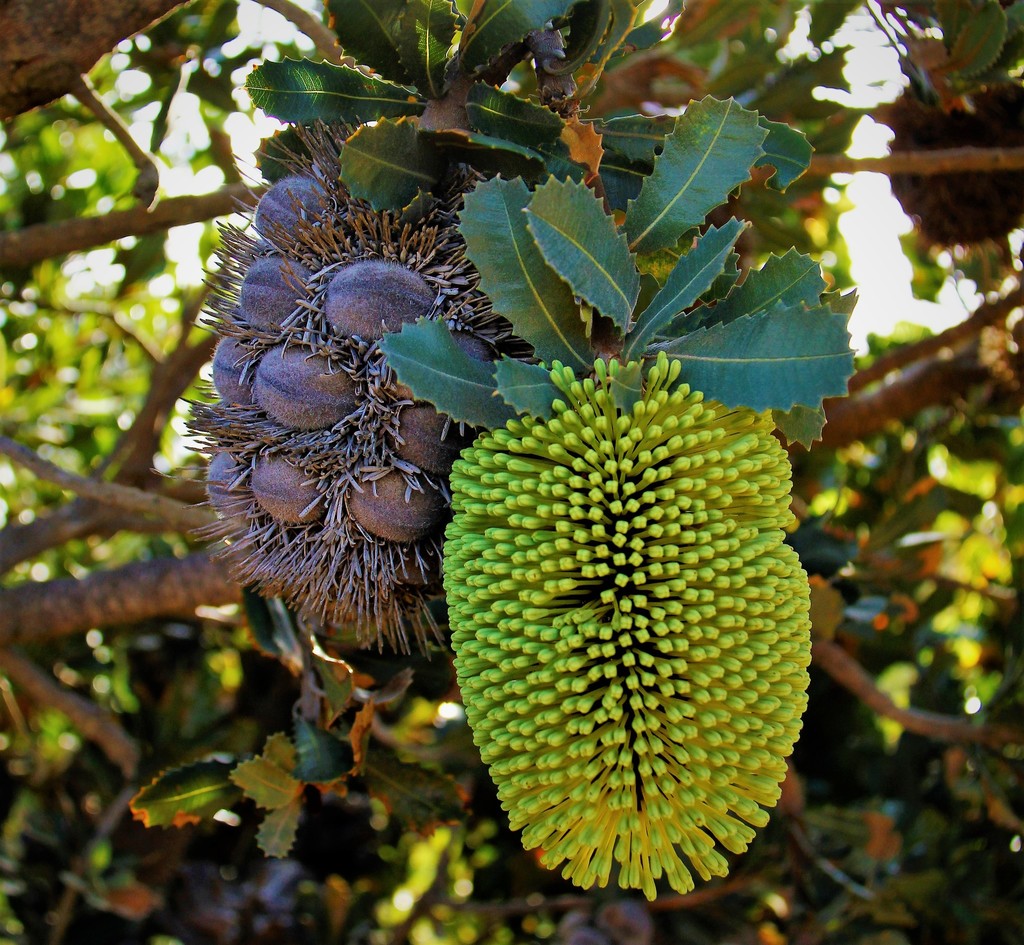
Yellow Lantern Banksia
Banksia lemanniana
Banksia lemanniana, the yellow lantern banksia or Lemann's banksia, is a species of flowering plant in the family Proteaceae, native to Western Australia. It generally grows as an open woody shrub or small tree to 5 m (16 ft) high, with stiff serrated leaves and unusual hanging inflorescences. Flowering occurs over summer, the greenish buds developing into oval flower spikes before turning grey and developing the characteristic large woody follicles. It occurs within and just east of the Fitzgerald River National Park on the southern coast of the state. B. lemanniana is killed by bushfire and regenerates from seed.
Described by Swiss botanist Carl Meissner in 1856, Banksia lemanniana was named in honour of English botanist Charles Morgan Lemann. It is one of three or four related species all with pendent inflorescences, which is an unusual feature of banksias. No subspecies are recognised. Banksia lemanniana is classified as Not Threatened under the Wildlife Conservation Act of Western Australia. Unlike many Western Australian banksias, it appears to have some resistance to dieback from the soil-borne water mould Phytophthora cinnamomi, and is one of the easier Western Australian species to grow in cultivation.
From the article Banksia lemanniana on Wikipedia (CC BY-SA), quoted section by section
Description
Banksia lemanniana grows as an open shrub or, less commonly, a small tree to 5 m (16 ft) in height, with a spreading habit. The trunk has thin grey bark and can reach a diameter of 15 cm (5.9 in). Lower-growing plants that reach 1.6 m (5.2 ft) have been reported from coastal areas of Fitzgerald River National Park. The new growth is finely hairy and predominantly seen in summer, before losing its hair and becoming glabrous (smooth) over two years. The stiff leaves are narrowly wedge-shaped or more oval (cuneate to obovate) and measure 3–9 cm (1.2–3.5 in) in length by 1.2–3 cm (0.47–1.18 in) wide. The leaf margins are serrated, with many teeth measuring 0.1 to 0.3 cm each. Flowering typically occurs between October and January. Unlike those of most other banksias, the cylindrical inflorescences hang down from branchlets and measure 5–11 cm (2–4 in) in length and 8–10 cm (3.1–3.9 in) in diameter. They are green-yellow in colour and smell of honey, dripping large amounts of nectar. The buds are a rich chocolate brown in colour until the yellow flowers push through. The inflorescences turn grey as they age, and the old flowers remain as up to 20 large woody follicles develop. …
Range & habitat
Banksia lemanniana is found near the southern coast of Western Australia, most of its population protected within Fitzgerald River National Park. Outside the park, it reaches the Ravensthorpe Range to the northeast and the rabbit-proof fence to the east, as well as isolated populations westwards as far as Pallinup estuary. The annual rainfall is 500–600 mm (20–24 in). It is found on the tops and slopes of hills as well as flatter areas on rocky or lateritic soil, as well as sand, in mallee scrubland or heath. Banksia lemanniana is relatively secure as much of its range lies within a National Park, and it is not a species collected for the cut flower industry. It is hence classified as Not Threatened under the Wildlife Conservation Act of Western Australia.
Wikipedia: “Distribution and habitat”
What it does
A variety of pollinators have been recorded visiting the flower spikes, including New Holland honeyeater (Phylidonyris novaehollandiae), red wattlebird (Anthochaera carunculata), native and European honey bees, wasps and ants. The flower spikes drip nectar onto the ground or lower leaves, suggesting pollination by nonflying mammals, which are attracted to the scent. Being upside down may facilitate this process. Banksia lemanniana is killed by bushfire and regenerates from seed. It is unclear how quickly seedlings take to reach flowering in the wild, but cultivated records suggest around five or six years. If fire occurs too frequently, plants are burned before reaching maturity or before they have produced sufficient seed to ensure regeneration of the population. This may cause a population decline or even local extinction. Too long a time between fires also causes population decline, as more plants die of natural attrition without releasing their seed, resulting in seed wastage. Banksia lemanniana has been shown to have a low to moderate susceptibility to dieback from the soil-borne water mould Phytophthora cinnamomi, unlike many Western Australian banksias. A study on cultivated plants in South Australia inoculated with P. cinnamomi and P. citricola found B. …
Wikipedia: “Ecology”
How it is grown
One of the easier Western species to grow, Banksia lemanniana has some horticultural potential in its attractive chocolate buds, green-yellow hanging flower spikes and large grey spikes with prominent follicles. It generally grows quite quickly, but nevertheless takes five to six years to flower from seed. It prefers a more alkaline rocky or sandy soil, with a nominal pH range from 6 to 7.5. It favours a sunny position and good drainage, and has been successfully cultivated in more humid climates on Australia's east coast. Seeds do not require any treatment, and take 27 to 43 days to germinate.
Wikipedia: “Cultivation”
Where it lives
Recorded sightings
—
geo-referenced records in GBIF, from museums, herbaria and field observers.
Drag the globe to turn it. Dots are where records exist, not a range map; darker means more records.
In the stacks
Searching the stacks…
Every page naming Banksia lemanniana in the Biodiversity Heritage Library →
This page is assembled live from iNaturalist, GBIF, Wikipedia, the Source Library and the Internet Archive. It is not yet part of the hand-edited codex. iNaturalist taxon 525124.