- Plants
- ›Vascular Plants
- ›flowering plants
- ›Dicots
- ›proteas, lotuses, planes, and allies
- ›Protea family
- ›Paired Proteas
- ›Banksieae
- ›Banksiinae
- ›Banksia
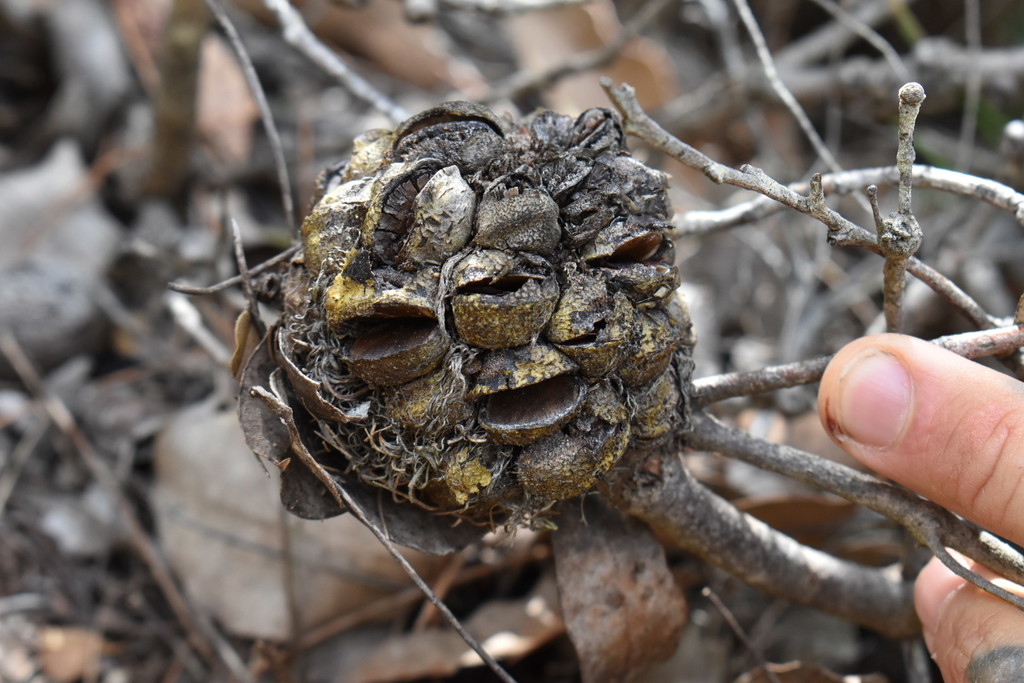
round-fruit banksia
Banksia sphaerocarpa
Banksia sphaerocarpa, commonly known as the fox banksia or round-fruit banksia, is a species of shrub or tree in the plant genus Banksia (family Proteaceae). It is generally encountered as a 1–2 m (3.3–6.6 ft) high shrub, and is usually smaller in the north of its range. This species has narrow green leaves, and brownish, orange or yellow round flower spikes which may be seen from January to July. It is widely distributed across the southwest of Western Australia, growing exclusively in sandy soils. It is usually the dominant plant in scrubland or low woodland. It is pollinated by, and is a food source for, birds, mammals, and insects.
First described in 1810 by botanist Robert Brown, B. sphaerocarpa has a complicated taxonomic history, and several taxa once classified as part of a broadly defined B. sphaerocarpa have since been named as species in their own right. At present, most authorities recognise five varieties; the largest variety, B. sphaerocarpa var. dolichostyla (ironcap banksia), is sometimes given species rank as B. dolichostyla. B. sphaerocarpa is classified as Not Threatened under the Wildlife Conservation Act of Western Australia, although two varieties have been placed on the Declared Rare and Priority Flora List—var. latifolia has been designated a Priority Two – Poorly Known taxon, and var. dolichostyla falls under Declared Rare Flora. None of the varieties are commonly seen in cultivation.
From the article Banksia sphaerocarpa on Wikipedia (CC BY-SA), quoted section by section
Description
Banksia sphaerocarpa is a variable species that differs in plant size, flower size and leaf size across its range. The variability is marked enough that five varieties are recognised. This species is generally a shrub 0.4–2 m (1.3–6.6 ft) tall. Plants are smaller in northern parts of the range, and grow larger in the southeast, with var. dolichostyla and rarely var. caesia reaching 4 m (13 ft) in height. All varieties bear a lignotuber, a swollen starchy root crown from which the plant resprouts after bushfire. The new stems are finely hairy but become smooth with maturity. The leaves are stiff, narrow and linear, and measure 2.5–10 cm (1.0–3.9 in) in length, on a petiole 2–3 mm (0.08–0.12 in) long. Leaves of most varieties are 1–1.5 mm (0.04–0.06 in) in width, and have a pointed tip, but var. latifolia has wider leaves, 2–2.5 mm (0.08–0.10 in), and a blunter tip. The foliage is green, or a more pale blue-grey in the case of caesia and dolichostyla.
The inflorescences are generally globular and measure 5 to 8 cm (2.0 to 3.1 in) in diameter, although larger forms, such as var. dolichostyla, are more oval in shape. Flowering from January to July, the blooms are yellow, orange or brownish in colour. They take five to eight weeks to develop from bud to the finish of flowering. Anthesis takes place over two weeks, as the individual flowers open in a wave across the inflorescence. …
Range & habitat
Banksia sphaerocarpa is distributed widely across southwestern Western Australia—from Eneabba in the north, south to the Whicher Range, Nannup, Albany and Jerramungup, and eastwards to the vicinity of Hyden. It is mainly found on sandy soils in flat or gently sloped areas in shrubland, mallee or open woodland.
Wikipedia: “Distribution and habitat”
What it does
Various animals, including mammals, birds, and insects such as bees, wasps, ants and beetles, have been recorded visiting Banksia sphaerocarpa inflorescences, including the colletid bee species Hylaeus sanguinipictus. Botanist Stephen Hopper found pollen of B. sphaerocarpa on New Holland honeyeaters (Phylidonyris novaehollandiae) and honey possums (Tarsipes rostratus) at Cheyne Beach in a field study published in 1980. Knowledge of the breeding system of B. sphaerocarpa comes from a 2009 study of genetic structure within and across fragmented plant populations, which made a case study of B. sphaerocarpa var. caesia populations in the vicinity of Dongolocking, where the landscape has been severely fragmented by land clearing. Very little self-pollination was observed. Most mating was between plants in the same population, but inter-population mating accounted for 15–33% of seed, a "very significant contribution... to overall reproductive dynamics". This figure was lowest in the smallest populations, which also exhibited lower rates of germination, smaller plants, and less genetic diversity than larger populations. One possible interpretation of this is that interpopulation mating confers a fitness advantage. There was also evidence of fine-scale genetic structure, with plants tending to be more closely related to nearby plants than to more distant plants. …
Wikipedia: “Ecology”
How it is grown
None of the varieties of Banksia sphaerocarpa are commonly seen in cultivation. They are difficult to grow in the wetter conditions of Australia's east coast. Trials with grafting have been very limited and results have been poor. Otherwise, they adapt well to gardens with good drainage, sandy soils and sunny aspects in drier and Mediterranean (winter moisture) climates, and are also frost tolerant. They are good bird-attracting plants, and flower when not much else is in flower. Seeds do not require any treatment prior to sowing, and take 20 to 48 days to germinate.
Wikipedia: “Cultivation”
Where it lives
Recorded sightings
—
geo-referenced records in GBIF, from museums, herbaria and field observers.
Drag the globe to turn it. Dots are where records exist, not a range map; darker means more records.
In the stacks
Searching the stacks…
Every page naming Banksia sphaerocarpa in the Biodiversity Heritage Library →
This page is assembled live from iNaturalist, GBIF, Wikipedia, the Source Library and the Internet Archive. It is not yet part of the hand-edited codex. iNaturalist taxon 525152.