- Fungi Including Lichens
- ›Basidiomycete Fungi
- ›Higher Basidiomycetes
- ›Mushrooms, Bracket Fungi, Puffballs, and Allies
- ›Thelephorales
- ›Boletopsidaceae
- ›Hydnellum
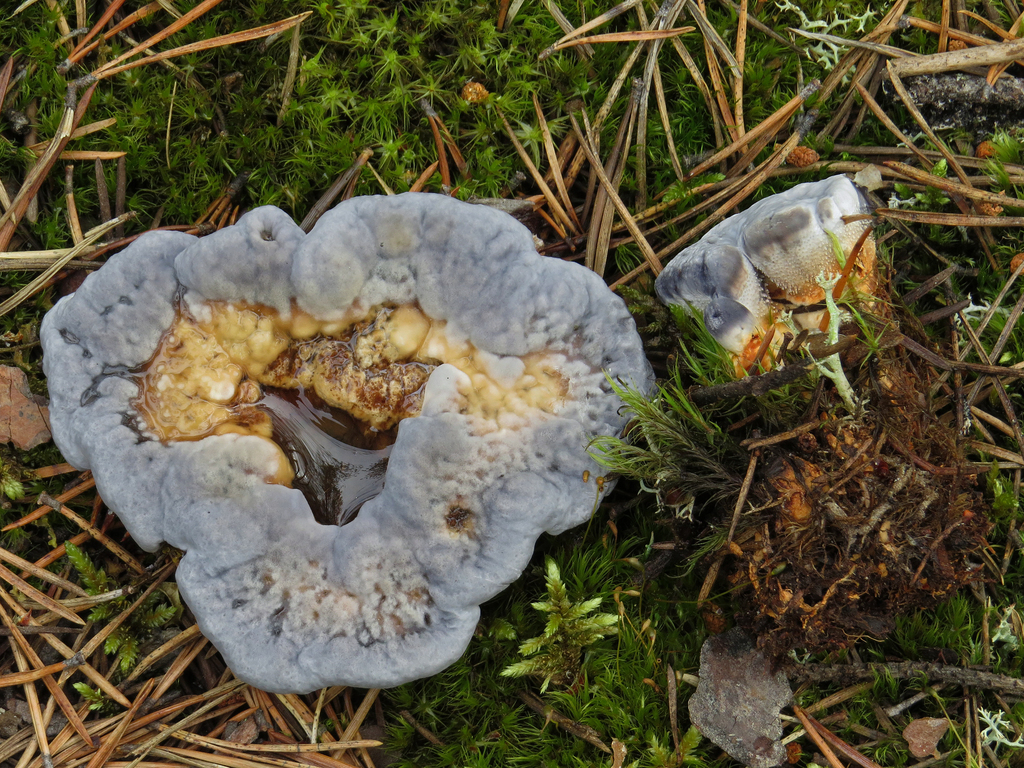
Blue Tooth
Hydnellum caeruleum
Hydnellum caeruleum, commonly known as the blue-gray hydnellum, blue-green hydnellum, blue spine, blue tooth, or bluish tooth, is an inedible fungus found in North America, Europe, and temperate areas of Asia.
The young caps have shades of blue, gray and brown, with light blue near the margin. The stem is orange to brown. The flesh is blue to black in the cap, and red to brownish in the stem. The blue hues tend to fade with age.
From the article Hydnellum caeruleum on Wikipedia (CC BY-SA), quoted section by section
Description
H. caeruleum belongs to a historic group of stipitate hydnoid fungi or 'stalked-tooth fungi' due to its morphological appearance with a cap, woody stipe, and distinct toothed hymenium. The fruiting body can be single or fuse with other bodies (called “confluence”) into gregarious or concrescent sporocarps. Due to this growth pattern, twigs and leaves can sometimes become engulfed into the flesh. The species has a whitish-blue cap, or pileus, which can be convex to planar in shape and is around 8 cm broad. The cap is tomentose, meaning that small dense hairs can make it feel velvety to the touch. The fungus is zonate, with concentric bands of color sometimes apparent on its cap, ranging from white, to grayish violet, to pastel blue zones. When bruised, flesh stains dark inky blue. Similarly, the inner flesh of the fungus appears blue when cut and dulls into a dark gray-blue when dry. Pale white or gray spines (3-6mm in length) cover the decurrent toothed hymenium on the stipe and underside of the cap. Older samples may have teeth that have turned brown to dark brown. Stipe is central and terete in shape, meaning that it is cylindrical and tapers in width. The base of the stipe is more bulbous and sometimes has an orange coloration. Climate effects can impact the coloration and defining characteristics of this fungus. During periods of high humidity, H. …
What it does
Hydnellum caeruleum is mycorrhizal and often found in the humus beneath conifer trees. H. caeruleum is an ectomycorrhizal fungus native to temperate regions of Asia, Europe, and North America. The species is commonly found in pine and spruce ecosystems due to its mycorrhizal relationships with coniferous trees. In these relationships, the fungus receives nutrients from the tree and in turn assists the plant in water and mineral uptake. Therefore, it is speculated that this fungus holds important impacts for the field of forestry. A study from 2012 suggests that stipitate hydnoid fungi such as H. caeruleum can remain in soils 1-4 years after their sporocarps are gone due to persistent below-ground mycelium. This persistence of vegetal mycelium was more important for the survival of the species than the production of sporocarps for sexual reproduction, suggesting that sporocarps may only form under specific advantageous conditions. A study on stipitate hydnoid fungi in Scottish coniferous forests, which focused on the conservation status and distribution of fungi in these habitats, discovered H. caeruleum making an interesting ectomycorrhizal association. H. caeruleum made an association with an heather shrub (Arctostaphylos uva-ursi) in a treeless site, indicating that the fungus may be able to switch hosts from coniferous trees to shrub species. …
Wikipedia: “Ecology”
Where it lives
Recorded sightings
—
geo-referenced records in GBIF, from museums, herbaria and field observers.
Drag the globe to turn it. Dots are where records exist, not a range map; darker means more records.
In the stacks
Searching the stacks…
Every page naming Hydnellum caeruleum in the Biodiversity Heritage Library →
This page is assembled live from iNaturalist, GBIF, Wikipedia, the Source Library and the Internet Archive. It is not yet part of the hand-edited codex. iNaturalist taxon 52525.