- Plants
- ›Vascular Plants
- ›flowering plants
- ›Dicots
- ›proteas, lotuses, planes, and allies
- ›Protea family
- ›Singlet Proteas
- ›Nutseed Proteoid Clade
- ›Adenanthinae
- ›Adenanthos
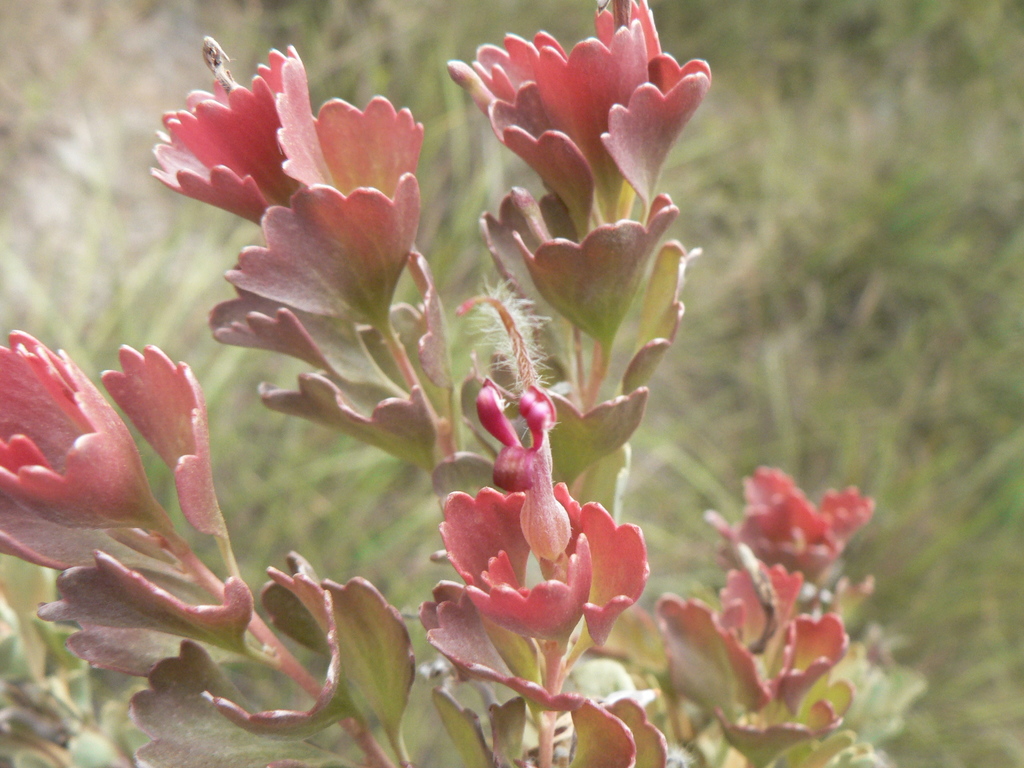
coastal jugflower
Adenanthos cuneatus
Adenanthos cuneatus, also known as coastal jugflower, flame bush, bridle bush and sweat bush, is a shrub of the family Proteaceae, native to the south coast of Western Australia. The French naturalist Jacques Labillardière originally described it in 1805. Within the genus Adenanthos, it lies in the section Adenanthos and is most closely related to A. stictus. A. cuneatus has hybridized with four other species of Adenanthos. Growing to 2 m (6 ft 7 in) high and wide, it is erect to prostrate in habit, with wedge-shaped lobed leaves covered in fine silvery hair. The single red flowers are insignificant, and appear all year, though especially in late spring. The reddish new growth occurs over the summer.
It is sensitive to Phytophthora cinnamomi dieback, hence requiring a sandy soil and good drainage to grow in cultivation, its natural habitat of sandy soils in heathland being an example. Its pollinators include bees, honey possum, silvereye and honeyeaters, particularly the western spinebill. A. cuneatus is grown in gardens in Australia and the western United States, and dwarf and prostrate forms are commercially available.
From the article Adenanthos cuneatus on Wikipedia (CC BY-SA), quoted section by section
Description
Adenanthos cuneatus grows as an erect, spreading or prostrate shrub to 2 m (6 ft 7 in) high and wide. It has a woody base, known as a lignotuber, from which it can resprout after bushfire. The wedge-shaped (cuneate) leaves are on short petioles, and are 2 cm (0.8 in) long and 1–1.5 cm (0.4–0.6 in) wide, with 3 to 5 (and occasionally up to 7) rounded 'teeth' or lobes at the ends. New growth is red and slightly translucent. It glows bright red against the light, especially when the sun is low in the sky. New growth is mainly seen in summer, and the leaves in general are covered with fine, silvery hair. Occurring throughout the year but more often from August to November, the insignificant single flowers are a dull red in colour and measure around 4 cm (1.6 in) long. The pollen is triangular in shape and measures 31–44 μm (0.0012–0.0017 in) in length, averaging around 34 μm (0.0013 in). The species is similar in many ways to its close relative A. stictus. The most obvious difference is in habit: the multi-stemmed, lignotuberous A. cuneatus rarely grows over 2 m (6 ft 7 in) in height, whereas A. stictus is a taller single-stemmed non-lignotuberous shrub that commonly reaches 5 m (16 ft 5 in) in height. Leaves are similar, but the lobes at the leaf apex are regular and crenate (rounded) in A. cuneatus, but irregular and dentate (toothed) in A. stictus. …
Range & habitat
The most widely distributed Adenanthos species of the south coast, A. cuneatus is common and locally abundant between King George Sound and Israelite Bay, along the coast and up to 40 km (25 mi) inland, with isolated populations extending west to Walpole and the Stirling Range, and as far east of Israelite Bay as Twilight Cove. This species is restricted to siliceous sandplain soils and will not grow in calcareous soils such as the limestone plains of the Nullarbor, or even siliceous dunes with limestone at little depth. This restriction explains the disjunctions east of Israelite Bay: the species occurs only in those few locations where the existence of cliff-top dunes of deep siliceous sand provide suitable habitat. Provided the soil is siliceous and fairly dry, A. cuneatus tolerates a range of edaphic conditions: it grows in both lateritic sand and sands of marine origin, and it tolerates pH levels ranging from 3.8 to 6.6. Consistent with these edaphic preferences, A. cuneatus is a frequent and characteristic member of the kwongan heathlands commonly found on the sandplains of Southwest Australia. The climate in its range is mediterranean, with annual rainfall from 275 to 1,000 mm (10.8 to 39.4 in).
Wikipedia: “Distribution and habitat”
What it does
Colletid bees of the genus Leioproctus visit Adenanthos cuneatus flowers. A 1978 field study conducted around Albany found the honey possum (Tarsipes rostratus) occasionally visited Adenanthos cuneatus, while the western spinebill much preferred the species to other flowers. A 1980 field study at Cheyne beach showed that the New Holland honeyeater and white-cheeked honeyeater pollinate it. A 1985–86 field study in the Fitzgerald River National Park found that the nectar-feeding honey possum occasionally eats it. The silvereye (Zosterops lateralis) feeds on nectar from the flowers, and has also been observed taking dew-drops from leaves early in the morning. Adenanthos cuneatus is known to be susceptible to Phytophthora cinnamomi dieback, but reports on the degree of susceptibility vary from low to high. A study of Banksia attenuata woodland 400 km (249 mi) southeast of Perth across 16 years, and following a wave of P. cinnamomi infestation, showed that A. cuneatus populations were not significantly reduced in diseased areas. Phosphite (used to combat dieback) has some toxic effects in A. cuneatus, with some necrosis of leaf tips, but the shrub uptakes little of the compound when compared with other shrubs. …
Wikipedia: “Ecology”
How it is grown
Adenanthos cuneatus was taken to Great Britain in 1824, and has been grown in cultivation in Australia and the western United States. Its attractive bronzed or reddish foliage is its main horticultural feature, along with its ability to attract birds to the garden. It requires a well-drained position to do well, but will grow in full sun or semi-shade, and tolerates both sand and gravelly soils. George Lullfitz, a Western Australian nurseryman, recommends growing it as a rambling ground cover in front of other shrubs, or in a rockery. The following cultivars exist:
A. "Coral Drift" is a compact form in cultivation since at least the 1990s. It is 50–70 cm (19.7–27.6 in) tall and 1–1.5 m (3.3–4.9 ft) wide. The grey foliage has pinkish purple new growth. A. "Coral Carpet" is a prostrate form which peaks at around 20 cm (7.9 in) high and spreads to 1.5 m (4.9 ft) across. The new foliage is a pinkish purple. A chance seedling from 'Coral Drift', it was originally developed by George Lullfitz of Lullfitz Nursery in Wanneroo. It became available to the public in 2005, and has been registered successfully under Plant Breeders' Rights.
Wikipedia: “Cultivation”
Where it lives
Recorded sightings
—
geo-referenced records in GBIF, from museums, herbaria and field observers.
Drag the globe to turn it. Dots are where records exist, not a range map; darker means more records.
In the stacks
Searching the stacks…
Every page naming Adenanthos cuneatus in the Biodiversity Heritage Library →
This page is assembled live from iNaturalist, GBIF, Wikipedia, the Source Library and the Internet Archive. It is not yet part of the hand-edited codex. iNaturalist taxon 525356.