- Plants
- ›Vascular Plants
- ›flowering plants
- ›Dicots
- ›pinks, cactuses, and allies
- ›Sundew Family
- ›Drosera
- ›Drosera
- ›Drosera
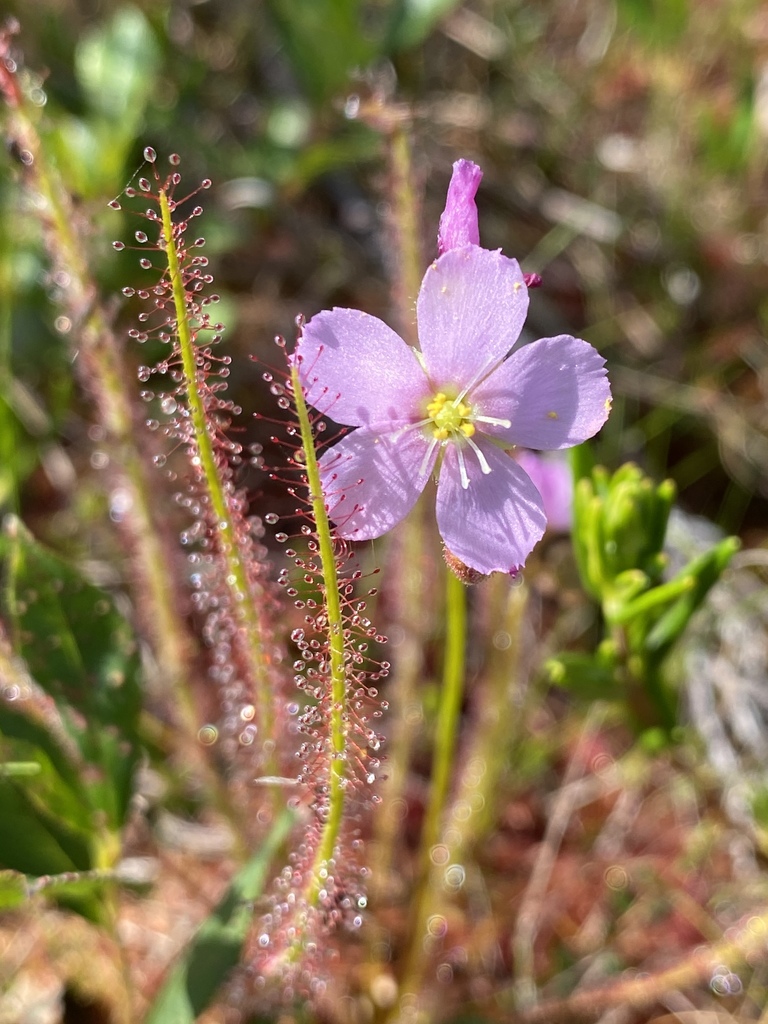
Thread-leaved Sundew
Drosera filiformis
Drosera filiformis, commonly known as the thread-leaved sundew, is a small, insectivorous, rosette-forming species of perennial herb. A species of sundew, it is unusual within its genus in that the long, erect, filiform (thread-like) leaves of this plant unroll in spirals – an arrangement similar to the circinate vernation seen in ferns.
From the article Drosera filiformis on Wikipedia (CC BY-SA), quoted section by section
Range & habitat
D. filiformis occurs naturally in both Canada and the United States; its natural range extends down the eastern seaboard of North America from south western Nova Scotia in the north down through New England to Florida in the south. Its disjunct distribution on the Atlantic Coast reflects the prehistoric land connection between Nova Scotia and Cape Cod, Massachusetts, which formed an ancient extension of the Atlantic Plain region that likely persisted well into the current interglacial period as an island chain.
Wikipedia: “Distribution and habitat”
How it is grown
D. filiformis is frequently cultivated, with a few registered cultivars, such as D. filiformis var. filiformis (also known as D. filiformis typical), D. filiformis × 'California Sunset' (a hybrid between D. filiformis var. filiformis.) All of these cultivars are grown with similar conditions as most other Drosera species: mineral-poor soil and distilled, reverse osmosis, or collected rain water. D. filiformis require a winter dormancy for long-term survival, forming hibernacula in the winter.
Wikipedia: “Cultivation”
Where it lives
Recorded sightings
—
geo-referenced records in GBIF, from museums, herbaria and field observers.
Drag the globe to turn it. Dots are where records exist, not a range map; darker means more records.
In the stacks
Searching the stacks…
Every page naming Drosera filiformis in the Biodiversity Heritage Library →
This page is assembled live from iNaturalist, GBIF, Wikipedia, the Source Library and the Internet Archive. It is not yet part of the hand-edited codex. iNaturalist taxon 52657.