Cape Saffron
Cassine peragua
Cassine peragua, also known as Cape saffron, bastard saffron and forest spoonwood, is a medium-sized tree with fragrant flowers, decorative fruits and a saffron-coloured trunk. It is indigenous to the Afro-montane forests of South Africa.
From the article Cassine peragua on Wikipedia (CC BY-SA), quoted section by section
Description
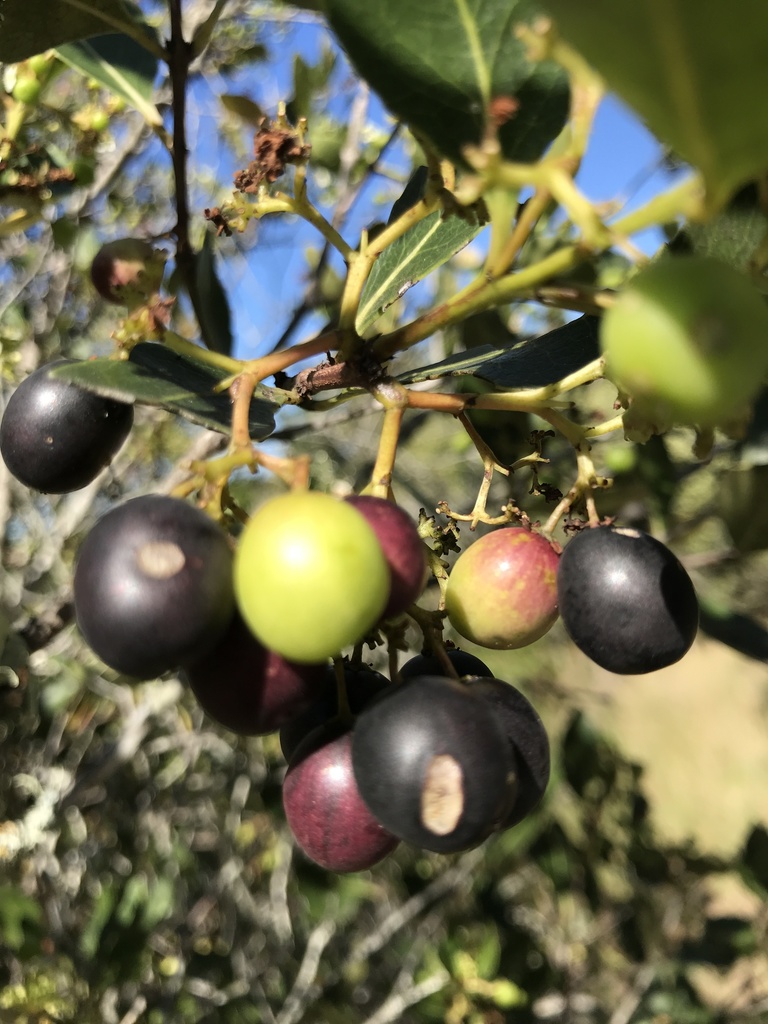
Cape saffron is an evergreen tree which is usually around 2 to 5 meters in height, but can sometimes grow to 15 meters in the right conditions. The tough, round, leathery leaves are usually dark green, but can be copper, orange or scarlet coloured depending on growth. The bunches of small, bisexual flowers have a strong, but pleasant fragrance, and the fruits are berries that appear as green and then gradually darken to purple and black. The trunk eventually assumes an orange saffron colour, as the grey bark flakes off exposing the orange under-layer.
Wikipedia: “Appearance”
Range & habitat
It is naturally distributed throughout the southern and eastern parts of South Africa, including Eswatini. Here it grows in a wide variety of habitats, from deep Afromontane forest to coastal dunes and rocky mountain slopes. In addition to the most common and widespread subspecies, there are two rare dwarfed subspecies (subsp. barbara & affinis) which occur in restricted pockets in the Western Cape. It is now cultivated as an ornamental garden tree throughout South Africa.
Wikipedia: “Natural distribution”
Where it lives
Recorded sightings
—
geo-referenced records in GBIF, from museums, herbaria and field observers.
Drag the globe to turn it. Dots are where records exist, not a range map; darker means more records.
In the stacks
Searching the stacks…
Every page naming Cassine peragua in the Biodiversity Heritage Library →
This page is assembled live from iNaturalist, GBIF, Wikipedia, the Source Library and the Internet Archive. It is not yet part of the hand-edited codex. iNaturalist taxon 527633.