- Animals
- ›Arthropods
- ›Hexapods
- ›Insects
- ›Winged and Once-winged Insects
- ›Ants, Bees, Wasps, and Sawflies
- ›Narrow-waisted Wasps, Ants, and Bees
- ›Ants, Bees, and Stinging Wasps
- ›Bees and Apoid Wasps
- ›Bees
- ›Honey Bees, Bumble Bees, and Allies
- ›Apine Bees
- ›Bombini
- ›Bombus
- ›Thoracobombus
- ›Bombus fervidus
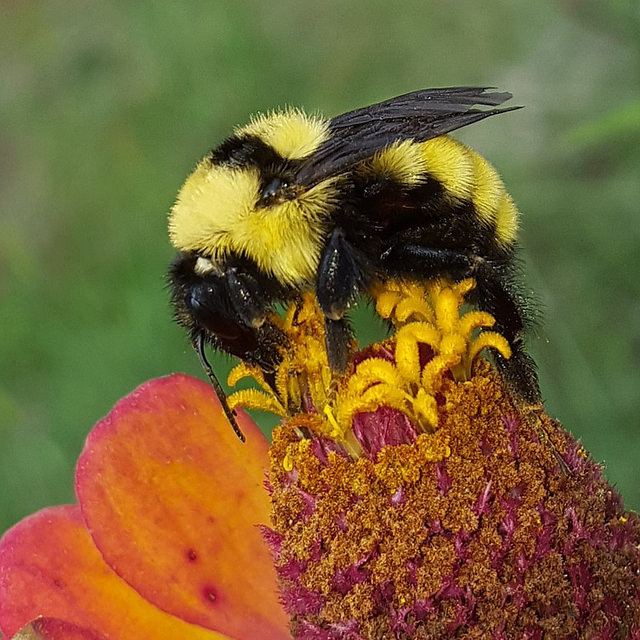
Golden Northern Bumble Bee
Bombus fervidus
Bombus fervidus, the golden northern bumble bee or yellow bumblebee, is a species of bumblebee native to North America. It has a yellow-colored abdomen and thorax. Its range includes the North American continent, excluding much of the southern United States, Alaska, and the northern parts of Canada. It is common in cities and farmland, with populations concentrated in the Northeastern part of the United States. It is similar in color and range to its sibling species, Bombus californicus, though sometimes also confused with the American bumblebee (Bombus pensylvanicus) or black and gold bumblebee (Bombus auricomus). It has complex behavioral traits, which includes a coordinated nest defense to ward off predators. B. fervidus is an important pollinator, so recent population decline is a particular concern.
From the article Bombus fervidus on Wikipedia (CC BY-SA), quoted section by section
Description
Bombus fervidus is on average 13–16 mm long However, there are slight differences in morphology between queens, workers, and drones (see table below). The first four abdominal tergites are yellow. The occiput and face are black, and have yellow pleurae extending to or nearly to the bases of the legs. A black band is present between the base of wings. The wings are dark to dark grey colored. The hairs are thick. B. fervidus is long-tongued and therefore specializes on flowers with long corollas. B. fervidus use long tongues to extract nectar and pollen from longer flowers. Males have slightly more yellow on their abdomen, and are difficult to distinguish from B. pensylvanicus and B. californicus. Males have a wingspan of 22 mm while female workers have a wingspan of 40 mm.
Wikipedia: “Description and identification”
Range & habitat
B. fervidus is native to Canada, Mexico and the continental United States, and individuals in its genetic lineage are more broadly distributed than previously suspected. The species prefers temperate savanna, grassland and tall grass biomes, and readily coexists with suburban or agricultural developments. It is common in grazing farmlands.
Nest. The nest of B. fervidus is a loose mass of soft, lightly entangled grass mixed with goose or other feces that are most likely carried in and arranged by the bees themselves. B. fervidus generally nest in grassy, open areas, which includes forests and along roadsides. Nests can be located both above and below ground, but the latter is more common. Nests are typically within 50 meters of a food source sufficient to feed the entire growing colony.
Wikipedia: “Distribution and habitat”
What it does
Bombus fervidus workers are able to feed both the queen and the developing brood by chewing/mixing pollen and saliva. In order to have enough of this food, B. fervidus spend a lot of time foraging for pollen and nectar, pollinating flowers in the process. Thus they have an important role in the ecosystem. When a new worker bumblebee emerges from its cocoon, it takes care of the queen and her eggs. Although the queen started the colony on her own, new workers will accommodate the growth of the colony by adding dead grass to the nest. If the population grows too big, newly emerged queens may arise that must leave the nest early or even be killed by other workers before they mate. Because males have a purely reproductive process in the nest, they will often leave the nest. They live independently until the fall, when they mate and then die.
Worker-queen conflict. Conflict can arise because, although workers never mate, they are able to lay unfertilized eggs, which develop into males (drones). Like other hymenoptera, this species is haplodiploid, with haploid males arising from unfertilized eggs and diploid females. …
Wikipedia: “Behavior”
Listen
Looking for field recordings…
Where it lives
Recorded sightings
—
geo-referenced records in GBIF, from museums, herbaria and field observers.
Drag the globe to turn it. Dots are where records exist, not a range map; darker means more records.
In the stacks
Searching the stacks…
Every page naming Bombus fervidus in the Biodiversity Heritage Library →
This page is assembled live from iNaturalist, GBIF, Wikipedia, the Source Library and the Internet Archive. It is not yet part of the hand-edited codex. iNaturalist taxon 52774.