- Plants
- ›Vascular Plants
- ›flowering plants
- ›Dicots
- ›Sunflowers, Bellflowers, Fanflowers, and Allies
- ›Sunflowers, Daisies, Asters, and Allies
- ›chicories, dandelions, and allies
- ›Lettuce, Chicory, Dandelion and Salsify Tribe
- ›Hyoseridinae
- ›Sonchus
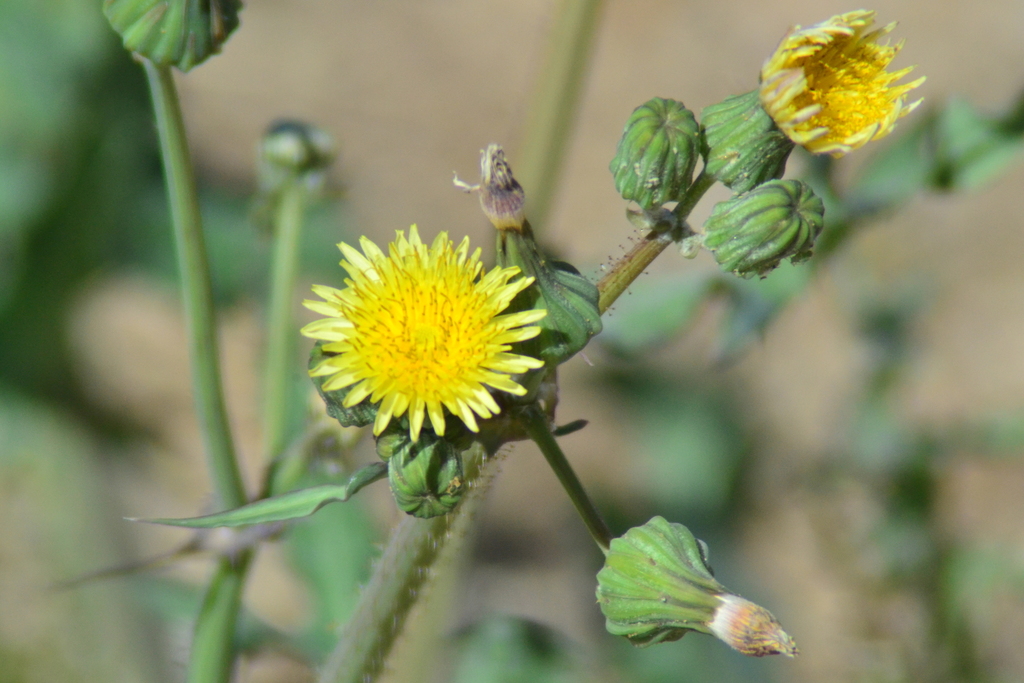
Common Sow-thistle
Sonchus oleraceus
Sonchus oleraceus is a species of flowering plant in the tribe Cichorieae of the family Asteraceae, native to Europe and Western Asia. It has many common names including common sowthistle, sow thistle, smooth sow thistle, annual sow thistle, puha (in New Zealand English, from Māori pūhā), hare's colwort, hare's thistle, milky tassel, milk thistle, and soft thistle.
From the article Sonchus oleraceus on Wikipedia (CC BY-SA), quoted section by section
Description
This annual plant has a hollow, upright stem up to 30 to 100 centimetres (12 to 39 in) high. It prefers full sun, and can tolerate most soil conditions. The flowers are hermaphroditic, and common pollinators include bees and flies. It spreads by seeds being carried by wind or water.
At the table
The leaves are eaten as salad greens or cooked like spinach. This is one of the species used in Chinese cuisine as kŭcài (苦菜; lit. bitter vegetable). The younger leaves are less bitter and better to eat raw. Steaming can remove the bitterness of older leaves. The younger roots are also edible and can suffice as a coffee substitute.
Nutrition. Nutritional analysis reveals 30–40 mg of vitamin C per 100 g of plant, 1.2% protein, 0.3% fat, 2.4% carbohydrate. Leaf dry matter analysis per 100 g (likely to vary with growing conditions) shows: 45 g carbohydrate, 28 g protein, 22 g ash, 5.9 g fibre, 4.5 g fat; in all, providing 265 calories. Minerals
Calcium: 1500 mg Phosphorus: 500 mg Iron: 45.6 mg Magnesium: 0 mg Sodium: 0 mg Potassium: 0 mg Zinc: 0 mg Vitamins
A: 35 mg Thiamine (B1): 1.5 mg Riboflavin (B2): 5 mg Niacin: 5 mg B6: 0 mg C: 60 mg
Herbalism. Sonchus oleraceus has a variety of uses in herbalism. It also has been ascribed medicinal qualities similar to dandelion and succory. When the plant was introduced to New Zealand, the Māori people found it similar to and as palatable as their native pūhā or S. kirkii (also known as raurōroa), thus also picked up S. oleraceus (since also named rauriki) for similar food and medical use. Native Americans had many uses for this plant. …
Wikipedia: “Uses”
In human culture
Its specific epithet oleraceus means "vegetable/herbal". The common name 'sow thistle' refers to its attractiveness to pigs, and the similarity of the leaf to younger thistle plants. The common name 'hare's thistle' refers to its purported beneficial effects on hare and rabbits.
Wikipedia: “Etymology”
Where it lives
Recorded sightings
—
geo-referenced records in GBIF, from museums, herbaria and field observers.
Drag the globe to turn it. Dots are where records exist, not a range map; darker means more records.
In the stacks
Searching the stacks…
Every page naming Sonchus oleraceus in the Biodiversity Heritage Library →
This page is assembled live from iNaturalist, GBIF, Wikipedia, the Source Library and the Internet Archive. It is not yet part of the hand-edited codex. iNaturalist taxon 53294.