- Plants
- ›Vascular Plants
- ›flowering plants
- ›Dicots
- ›Sunflowers, Bellflowers, Fanflowers, and Allies
- ›Sunflowers, Daisies, Asters, and Allies
- ›Asteroideae
- ›asters and allies
- ›Baccharidinae
- ›Baccharis
- ›Molina
- ›Corymbosae
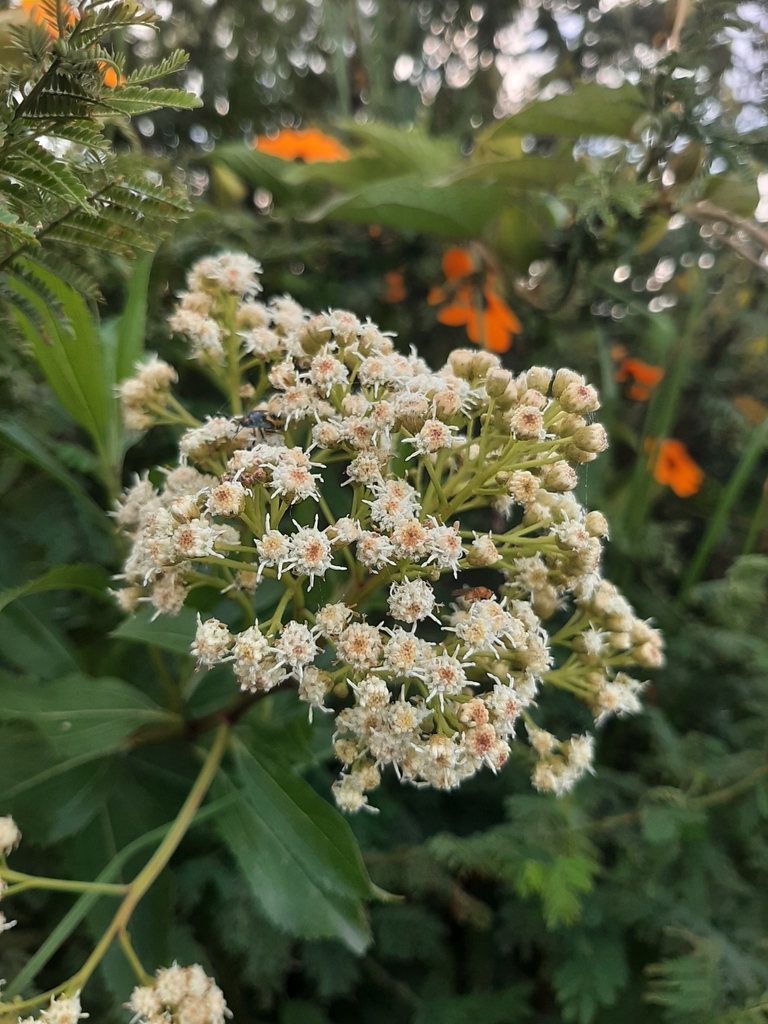
Chilca
Baccharis latifolia
Baccharis is a genus of perennials and shrubs in the aster family (Asteraceae). They are commonly known as baccharises but sometimes referred to as "brooms", because many members have small thin leaves resembling the true brooms. They are not at all related to these however, but belong to an entirely different lineage of eudicots. B. halimifolia is commonly known as "groundsel bush", however true groundsels are found in the genus Senecio.
Baccharis, with over 500 species, is one of the largest genera in the Asteraceae.
From the article Baccharis on Wikipedia (CC BY-SA), quoted section by section
What it does
Baccharis are used as food plants by the larvae of some Lepidoptera species, such as the swift moths Phymatopus californicus and P. hectoides. Those of the leaf-miner moths Bucculatrix dominatrix and B. seperabilis feed exclusively on bush baccharis (B. pilularis), B. ivella has been found on eastern baccharis, and B. variabilis is a polyphagous species which has been recorded on various Baccharis. The Coleophora case-bearers C. linosyridella and C. viscidiflorella are polyphagous species whose larvae have been recorded on the Bush Baccharis as well as other plants. Caterpillars of the owlet moth Schinia ocularis feed exclusively on broom baccharis (B. sarothroides). Baccharis conferta, native to Mexico, was chosen to serve as nurse plants to protect from frost and drought newly planted tree seedlings of Abies religiosa in the world's first assisted migration experiment that coupled upslope planting of the fir tree in anticipation of climate change forcing overwintering Monarch butterflies to seek higher elevations in central Mexico.
Wikipedia: “Ecology”
At the table
Several species of Baccharis are of interest for cultivation, as the dense but flexible stem structure makes for a good windbreak. Plants of this genus are rich in terpenes, and some are used in native or folk medicine. One that has been specifically described from Chilean and Argentinean Baccharis is viscidone. Baccharis flowers are rich in nectar, and several species are good honey plants. Particularly B. dracunculifolia is highly esteemed by beekeepers.
Wikipedia: “Uses”
Where it lives
Recorded sightings
—
geo-referenced records in GBIF, from museums, herbaria and field observers.
Drag the globe to turn it. Dots are where records exist, not a range map; darker means more records.
In the stacks
Searching the stacks…
Every page naming Baccharis latifolia in the Biodiversity Heritage Library →
This page is assembled live from iNaturalist, GBIF, Wikipedia, the Source Library and the Internet Archive. It is not yet part of the hand-edited codex. iNaturalist taxon 534316.