- Animals
- ›Arthropods
- ›Crustaceans
- ›Typical Crustaceans
- ›Malacostracans
- ›Decapods, Isopods, and allies
- ›Decapods and Krill
- ›Decapods
- ›Crabs, Lobsters, Shrimps, and Allies
- ›Anomurans
- ›Squat Lobsters and Porcelain Crabs
- ›Porcelain Crabs
- ›Petrolisthes
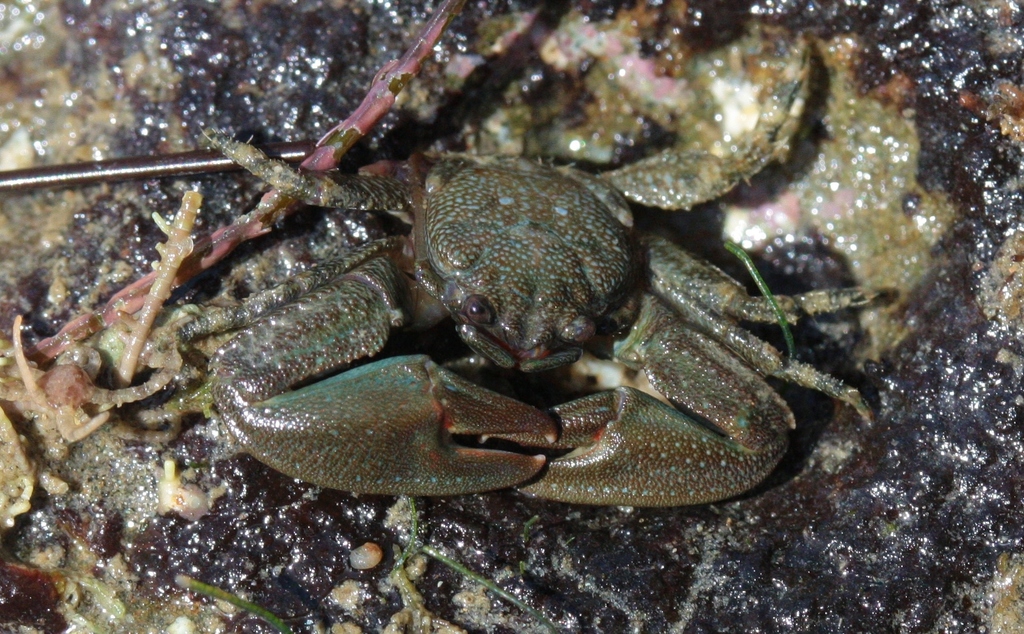
Cabrillo Porcelain Crab
Petrolisthes cabrilloi
Petrolisthes cabrilloi, also known as the Cabrillo porcelain crab, is a species of porcelain crab. Native to the Pacific coast of North America, it was first described to science by Steve Glassell in 1945 from crabs collected in Anaheim Landing, California. Its range is believed to be from Morro Bay to Baja California. It is more common than its close cousin Petrolisthes cinctipes in waters south of Point Conception.
From the article Petrolisthes cabrilloi on Wikipedia (CC BY-SA), quoted section by section
Description
The Cabrillo porcelain crab is a smooth porcelain crab with a dull orange carapace that is marked by small spots. These spots have some pubescence in them, with the carapace noticeably hairier in juveniles. The chelipeds, commonly called pincers or claws, are large, about three times the width of the carapace. Each cheliped is flattened and has a carpus ("wrist") that is about twice as long than it is wide, without strong tubercles or teeth adorning it. P. cabrilloi is the most similar in appearance to P. cinctipes, and is often found under the same rocks, but only P. cabrilloi has pubescent, setose ambulatory legs, a carpus length twice that of the width, and juvenile carapace pubescence. P. cabrilloi has the longest cheliped tufts of any Petrolisthes species in California. While Petrolisthes species are primarily filter feeders, these tufts can be used to capture food particles while scraping it from environmental surfaces. P. cabrilloi likewise differs from other Petrolisthes species by its higher tolerance for sand and turbid water, but is also often found with other Petrolisthes species in the rocky intertidal zone.
== References ==
Where it lives
Recorded sightings
—
geo-referenced records in GBIF, from museums, herbaria and field observers.
Drag the globe to turn it. Dots are where records exist, not a range map; darker means more records.
In the stacks
Searching the stacks…
Every page naming Petrolisthes cabrilloi in the Biodiversity Heritage Library →
This page is assembled live from iNaturalist, GBIF, Wikipedia, the Source Library and the Internet Archive. It is not yet part of the hand-edited codex. iNaturalist taxon 53626.