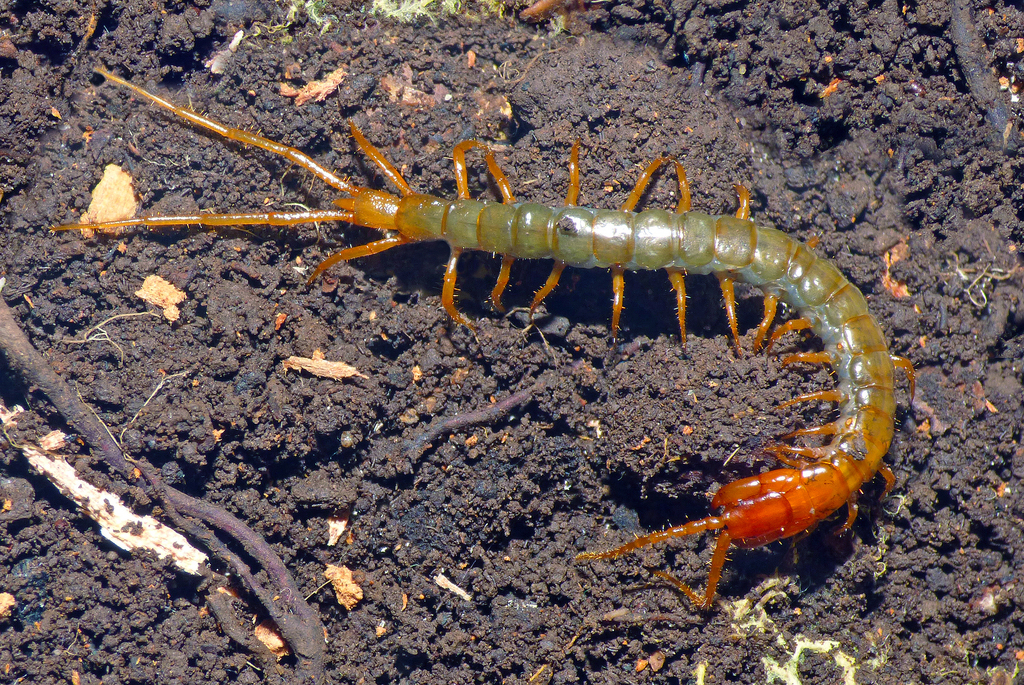
Craterostigmus tasmanianus
Craterostigmus tasmanianus, also known as the Tasmanian remarkable centipede, is a species of Tasmanian centipede endemic and widespread on the island.
From the article Craterostigmus tasmanianus on Wikipedia (CC BY-SA), quoted section by section
Description
Craterostigmus tasmanianus is a small, greenish or yellowish-brown centipede, growing up to 50 millimetres (2.0 in) in length. It has a long reddish-brown head with a single ocellus on either side of the cephalic plate (head shield), and dark reddish-brown forcipules extending visibly forward past the plate. It cannot be distinguished from Craterostigmus crabilli on a basis of colour. The antennae taper, are divided into 17 or 18 articles (antennomeres), are recorded as about one quarter the length of the head, and are hirsute, especially closer to the tips. The species is generally slow-moving. Adults have 15 pairs of legs and 21 tergites.
Range & habitat
Craterostigmus tasmanianus is widespread across Tasmania (and especially common in the west), as well as other nearby islands, but not on the mainland. It is found in a variety and elevations, ranging from sea-level to highland (up to 1300 m), but is restricted to woodland habitats, both dry and wet. In drier areas, it is restricted microhabitats such as leaf litter, piled rocks rotting logs, and deep humus. The record for average density is one specimen per 12 m2, from a 1992 hand-collecting expedition (in Nothofagus forest).
Wikipedia: “Distribution, habitat and ecology”
What it does
The brood chambers of C. tasmanianus are usually cavities in damp rotting logs or excavations in the soil. The breeding season runs from November to February, and brooding occurs between September and April. Like members of the Scolopendromorph and Geophilmorph orders, the mother coils around the eggs and early instars to guard them. Hatchlings emerge from the eggs with 12 pairs of legs, then gain three final ones in their first moult. They then disperse in winter into the leaf litter. Mothers have been recorded to lay anywhere between 44 and 77 eggs at a time.
Wikipedia: “Reproduction and development”
Where it lives
Recorded sightings
—
geo-referenced records in GBIF, from museums, herbaria and field observers.
Drag the globe to turn it. Dots are where records exist, not a range map; darker means more records.
In the stacks
Searching the stacks…
Every page naming Craterostigmus tasmanianus in the Biodiversity Heritage Library →
This page is assembled live from iNaturalist, GBIF, Wikipedia, the Source Library and the Internet Archive. It is not yet part of the hand-edited codex. iNaturalist taxon 536955.