- Animals
- ›Arthropods
- ›Crustaceans
- ›Typical Crustaceans
- ›Malacostracans
- ›Decapods, Isopods, and allies
- ›Decapods and Krill
- ›Decapods
- ›Crabs, Lobsters, Shrimps, and Allies
- ›Crayfishes and Lobsters
- ›Northern Hemisphere Crayfishes
- ›Astacid Crayfishes
- ›Pacifastacus
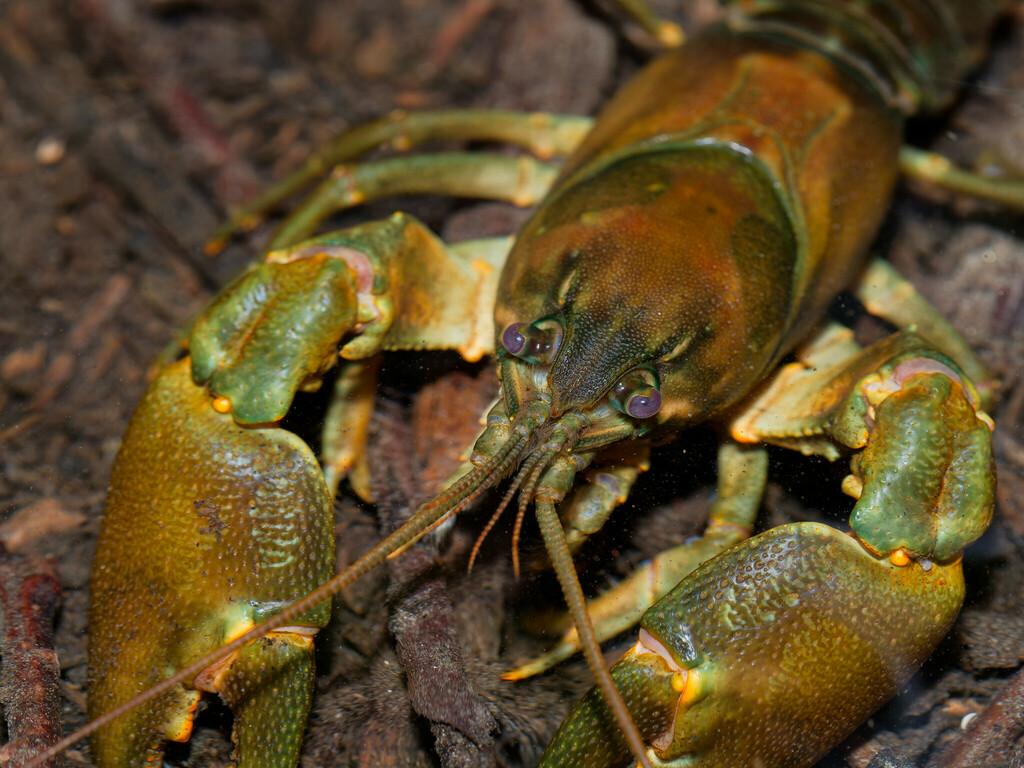
Signal Crayfish
Pacifastacus leniusculus
Pacifastacus leniusculus, commonly known as the signal crayfish, is a species of freshwater crayfish in the family Astacidae, native to western North America. They are thought to have originated from the Columbia River Basin.
Physically, they are characterized by a smooth carapace and a distinctive white to pale blue-green patch at the base of the claw joint. Reminiscent of the white flags that signalmen used for directing trains, this light patch is responsible for the species' common name. Due to its heightened aggression and opportunistic polytrophic diet,P. leniusculus has become an established invasive species found across North America, Europe, and Japan, displacing many of the regions’ native species.
From the article Signal crayfish on Wikipedia (CC BY-SA), quoted section by section
Description
Members of this species are typically 6–9 cm (2.4–3.5 in) long, although sizes up to 16–20 cm (6–8 in) are possible. They typically weigh 60 g and 110 g at carapace lengths of 50 mm and 70 mm, respectively. Their dorsal surface is typically brown, but can range from bright red to blue. A distinctive white to pale blue-green patch is present near the claw hinge. The surface of the carapace and claws are smooth. P. leniusculus can often be confused with the noble crayfish (Astacus astacus), but lacks a row of spines on the shoulders of the carapace to distinguish them.
Range & habitat
P. leniusculus is thought to be endemic to the Columbia River Basin in North America, which includes the Canadian province of British Columbia and U.S. states Washington, Oregon, and Idaho. However, substantial cryptic diversity exists, with morphology-based taxonomy and molecular evidence suggesting that three groups are highly distinctive from P. leniusculus in discrete geographic regions: the Chehalis River glacial refugium, central Oregon and the Okanagan Plateau. First introduced to the San Lorenzo River watershed in California in 1912, P. leniusculus has since spread through the state. The only native crayfish remaining in California (aside from Pacifastacus leniusculus klamathensis, a subspecies of P. leniusculus believed to be native to the Klamath River in Northern California) is the Shasta crayfish, of Shasta County, California (Pacifastacus fortis). Efforts are being made to create a barrier to signal crayfish invasion in this region. Within North America, it has also been introduced to Nevada, and the populations in Utah may be the result of introductions. It has also been found in Alaska, specifically Kodiak Island, in the Buskin River and Buskin Lake. It is listed as a species of least concern on the IUCN Red List. P. leniusculus was first introduced to Europe in 1960 and have spread across the continent since, both intentionally and not. …
Wikipedia: “Geographic range”
What it does
P. leniusculus are primarily nocturnal, conducting most of their activity at night. In a 12:12 light-dark cycle, an average of 72% of their activity occurred during dark hours. Research has shown that they have a circadian rhythm with distinct chronotypes, consistent and repeatable activity patterns, during early and middle night. Late-night behavior is far more variable and unpredictable. This is hypothesized to be driven by predator avoidance as a potential evolutionary strategy. P. leniusculus display heighten aggressive behaviors compared to other freshwater crayfish. In interactions with the invasive spiny cheek crayfish (Faxionus limosus), P. leniusculus established dominance consistently. P. leniusculus had a greater tendency to engage and maintain high-intensity fight. F. limosus conversely retreated at a lower fight intensity. These behavioral trends in P. leniusculus may in part explain their success as an invasive species. P. leniusculus exhibits great individual variation in risk-taking behavior. Except in a directly food-motivated context, individuals were not found to display any repeatability or consistency in risk-taking. Consequently, boldness within individual P. leniusculus is likely a context-dependent rather than a stable or distinct personality trait. …
Wikipedia: “Behavior”
In human culture
P. leniusculus follows a similar breeding and lifecycle to most temperate crayfish in the family Astacidae. Their mating period occurs in the fall, spanning from September to October. Females will carry their clutch of eggs through the winter until the temperature warms and they can hatch, typically in March to April. Upon hatching, the juveniles undergo three stages of development, passing through two molting stages before leaving their mother. Populations of P. leniusculus in cooler climates may hatch later, as their growth is temperature-dependent. As such, individuals in cooler climates may mature more slowly.
Wikipedia: “Life history”
Where it lives
Recorded sightings
—
geo-referenced records in GBIF, from museums, herbaria and field observers.
Drag the globe to turn it. Dots are where records exist, not a range map; darker means more records.
In the stacks
Searching the stacks…
Every page naming Pacifastacus leniusculus in the Biodiversity Heritage Library →
This page is assembled live from iNaturalist, GBIF, Wikipedia, the Source Library and the Internet Archive. It is not yet part of the hand-edited codex. iNaturalist taxon 53708.