- Plants
- ›Vascular Plants
- ›flowering plants
- ›Dicots
- ›Mints, Plantains, Olives, and Allies
- ›bignonia family
- ›Tabebuia
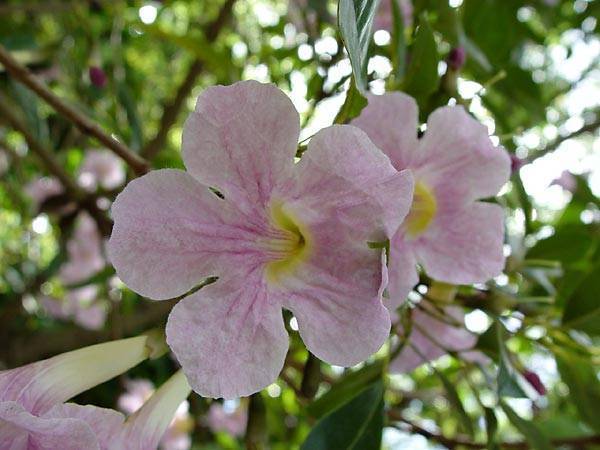
Pink Trumpet-tree
Tabebuia heterophylla
Tabebuia heterophylla is a species of Tabebuia native to the Caribbean islands of South America and to the Swan Islands of Honduras, and is also cultivated. It is also known as pink manjack, pink trumpet tree, white cedar, and whitewood.
From the article Tabebuia heterophylla on Wikipedia (CC BY-SA), quoted section by section
Description
Tabebuia heterophylla grows up to 20 to 30 feet tall. Leaves are opposite and palmately compound with five or fewer leaflets. T. heterophylla is considered brevi decidius. Flowers are showy pink, tubular and five lobed (2 to 3 inches long). The flowering time is spring and summer. Its fruit is a seedpod, it splits along 2 lines to shed the numerous thin light brown seeds (1/2 to 1 inch long with 2 white wings).
Flower anatomy. The flowers of Tabebuia heterophylla are in an inflorescence of the umbellate type. It is a perfect and complete flower with radial (actinomorphic) symmetry, and the whorls of the corrolla and the calyx are connately joined. The ovary is superior with an axile placentation, two locules and two carpels.
Range & habitat
The tree is native to the Caribbean, notably Puerto Rico and the Lesser Antilles. It is particularly common throughout Puerto Rico except in the higher elevations of the Sierra de Luquillo and the Cordillera Central. It can be found in high concentrations in the Sierra de Cayey and a protected area there, La Robleda, has recently become famous for its blooms which happen for a few weeks every year.
Wikipedia: “Distribution and habitat”
Where it lives
Recorded sightings
—
geo-referenced records in GBIF, from museums, herbaria and field observers.
Drag the globe to turn it. Dots are where records exist, not a range map; darker means more records.
In the stacks
Searching the stacks…
Every page naming Tabebuia heterophylla in the Biodiversity Heritage Library →
This page is assembled live from iNaturalist, GBIF, Wikipedia, the Source Library and the Internet Archive. It is not yet part of the hand-edited codex. iNaturalist taxon 53722.