- Plants
- ›Vascular Plants
- ›flowering plants
- ›Dicots
- ›staff-vines and allies
- ›staff-vine family
- ›Loeseneriella
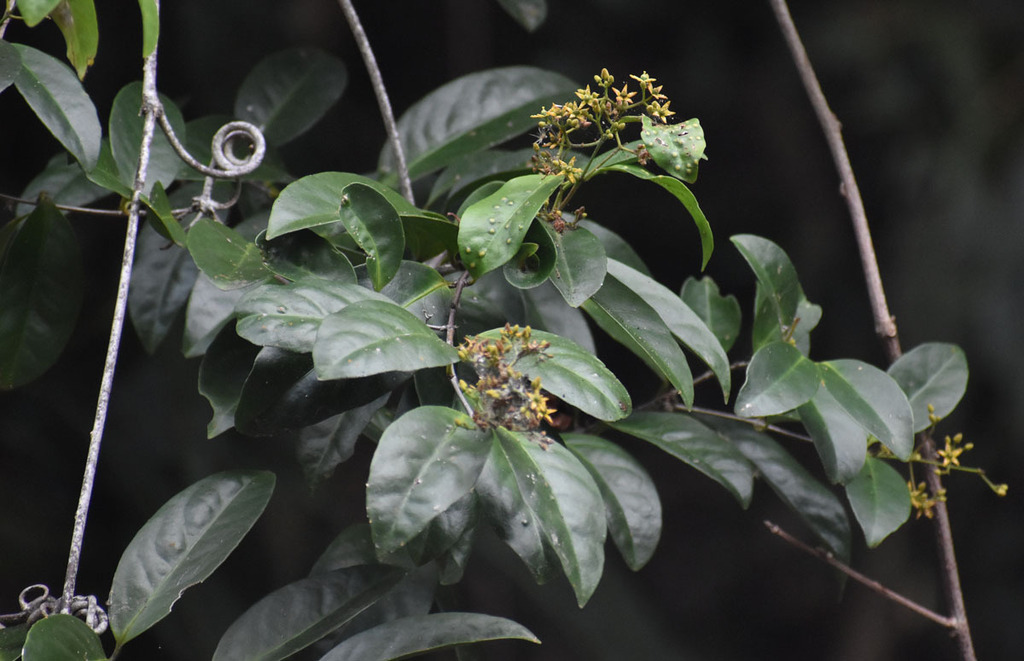
knotvine
Loeseneriella barbata
Loeseneriella barbata, commonly known as knot vine, is a climbing plant in the family Celastraceae found in New South Wales and Queensland, Australia. It was first described in 1859 and its tendrils form distinctive "knots" around its supports.
From the article Loeseneriella barbata on Wikipedia (CC BY-SA), quoted section by section
Description
Loeseneriella barbata is a woody vine with a stem diameter up to 4 cm (1.6 in), whose tendrils often form knot-like coils around supports. The leaves are quite stiff and arranged in opposite pairs. They are elliptic, ovate or lanceolate and measure up to 12 cm (4.7 in) long and 6 cm (2.4 in) wide. Flowers are produced in branched cymes and are about 10 mm (0.39 in) wide with 5 or 6 yellow petals. The fruit is a capsule about 5 cm (2.0 in) long and 3 cm (1.2 in) wide containing a number of winged seeds about 3 cm (1.2 in) long.
Range & habitat
The knot vine occurs in two widely separated populations in eastern parts of Queensland and northeastern New South Wales. The northern population is found from the top of Cape York Peninsula south to about Ayr. The southern population begins at Rockhampton, about 530 km (330 mi) south of Ayr, and continues into the far northern corner of New South Wales to about Grafton.
Wikipedia: “Distribution and habitat”
Where it lives
Recorded sightings
—
geo-referenced records in GBIF, from museums, herbaria and field observers.
Drag the globe to turn it. Dots are where records exist, not a range map; darker means more records.
In the stacks
Searching the stacks…
Every page naming Loeseneriella barbata in the Biodiversity Heritage Library →
This page is assembled live from iNaturalist, GBIF, Wikipedia, the Source Library and the Internet Archive. It is not yet part of the hand-edited codex. iNaturalist taxon 538083.