- Fungi Including Lichens
- ›Basidiomycete Fungi
- ›Higher Basidiomycetes
- ›Mushrooms, Bracket Fungi, Puffballs, and Allies
- ›Agaricomycetidae
- ›Common Gilled Mushrooms and Allies
- ›Pluteineae
- ›amanita mushrooms and allies
- ›Amaniteae
- ›Amanita
- ›Amanita
- ›Caesareae
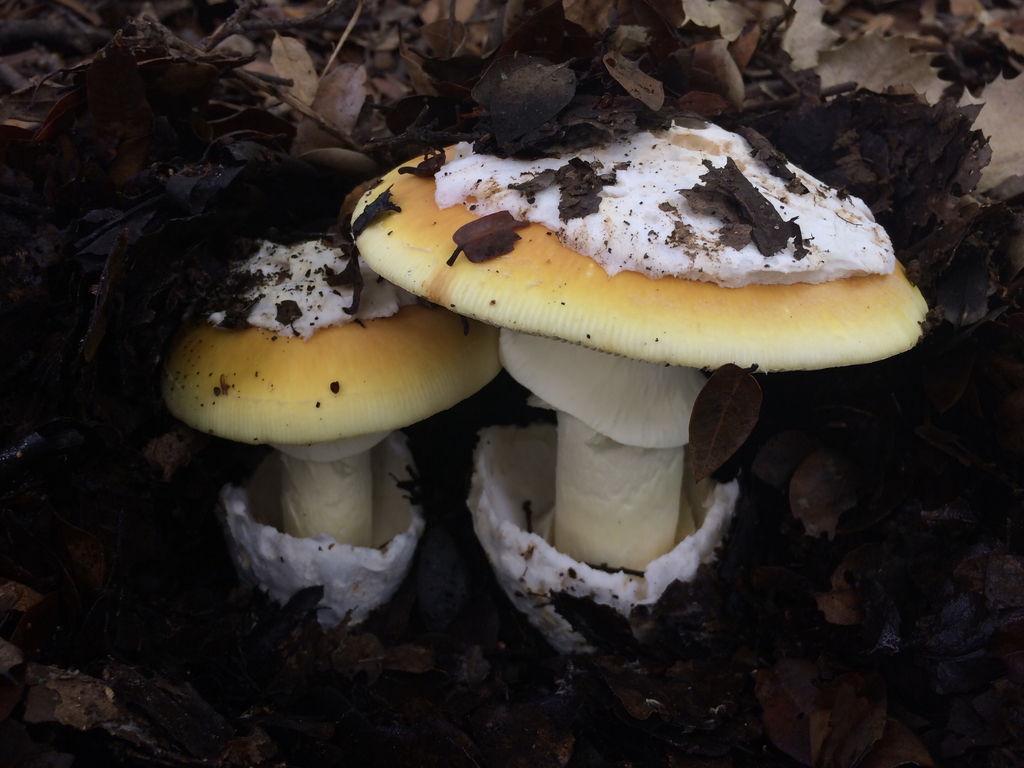
Coccora
Amanita calyptroderma
Amanita calyptroderma also known as coccora, coccoli or the Pacific amanita, is a white-spored mushroom that fruits naturally in the Sierra Nevada and coastal forests of the western United States during the fall, winter and spring.
From the article Amanita calyptroderma on Wikipedia (CC BY-SA), quoted section by section
Description
This mushroom's cap is about 10–25 centimetres (4–10 inches) in diameter, usually orange-brown in color (but sometimes white), and partially covered by a thick white patch of universal veil. It has white, close gills. Its cream-colored stalk is about 10–20 cm in length and 2–4 cm (3⁄4–1+1⁄2 in) in width, adorned with a partial veil. It has a partially hollow stem (filled with a stringy white pith), and a large, sacklike volva at the base of the stalk. The spores of this species, which are white, do not change color when placed in a solution of Melzer's reagent, and thus are termed inamyloid. This characteristic in combination with the skirt-like annulus and absence of a bulb at the base of the stalk place this mushroom in the section Caesareae.
Similar species. The deadly poisonous A. phalloides is similar in appearance. Amanita vernicoccora is a closely related edible species, which fruits in hilly or mountainous areas from late winter to spring. Otherwise similar in appearance, its cap is yellow. A. caesarea is also related and edible.
Range & habitat
This mushroom occurs in conifer forests, forming mycorrhizae with madrone (Arbutus menziesii) in the southern part of its range (Central California northwards to Washington). However, in the northern part of its range (Washington to southern Canada), its preferred host is Douglas-fir (Pseudotsuga menziesii).
Wikipedia: “Distribution and habitat”
At the table
Experienced mushroom hunters regard this mushroom as a good edible species, but caution must be exercised when collecting A. calyptroderma for the table, since it can be confused with other species in the genus. Amanita contains some of the deadliest mushrooms in the world, most notably A. phalloides and A. ocreata.
Wikipedia: “Edibility”
Where it lives
Recorded sightings
—
geo-referenced records in GBIF, from museums, herbaria and field observers.
Drag the globe to turn it. Dots are where records exist, not a range map; darker means more records.
In the stacks
Searching the stacks…
Every page naming Amanita calyptroderma in the Biodiversity Heritage Library →
This page is assembled live from iNaturalist, GBIF, Wikipedia, the Source Library and the Internet Archive. It is not yet part of the hand-edited codex. iNaturalist taxon 53884.