- Animals
- ›Arthropods
- ›Hexapods
- ›Insects
- ›Winged and Once-winged Insects
- ›Ants, Bees, Wasps, and Sawflies
- ›Narrow-waisted Wasps, Ants, and Bees
- ›Ants, Bees, and Stinging Wasps
- ›Bees and Apoid Wasps
- ›Bees
- ›Honey Bees, Bumble Bees, and Allies
- ›Apine Bees
- ›Bombini
- ›Bombus
- ›Pyrobombus
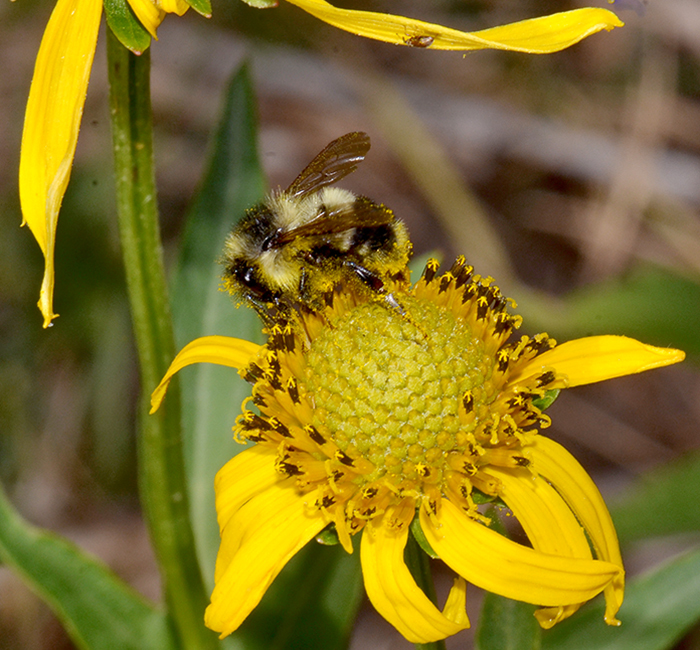
Cockerell's Bumble Bee
Bombus cockerelli
Bombus cockerelli, Cockerell's bumblebee, is a yellow and black bumblebee known only from fewer than 30 specimens, collected at a few high-altitude (over 6,500 ft or 2,000 m) localities in the White Mountains of New Mexico, all within an area of less than 300 square miles (780 km2), giving it the smallest range of any of the ~250 species of bumblebees in the world.
From the article Bombus cockerelli on Wikipedia (CC BY-SA), quoted section by section
Description
Bombus cockerelli is a typical bumblebee in appearance, with queens 15–20 mm (0.6–0.8 in) long, and distinctly smaller workers. The queens and workers are black on the head, with a few pale yellow hairs. The anterior and posterior thorax and the two basal and two terminal abdominal segments are yellow, while abdominal segments 3 and 4 are black. Males are unknown. Another species of bumblebee, Bombus balteatus, known to occur at high altitudes in Colorado, is similar to B. cockerelli, but B. cockerelli has a shorter head, numerous intermixed black hairs on the anterior thorax, and the abdominal apex is yellow rather than rust-tinted.
In human culture
The bee was first described in 1913, based on six specimens collected near the Rio Ruidoso in New Mexico. Between 1956 and 2011, not even one was seen. For a time, this bee was believed to be just a subspecies and not a full species. However, given access to fresh specimens whose genetic material can be analyzed, it is expected that it will now be possible to determine whether it is a true species.
Wikipedia: “History”
Listen
Looking for field recordings…
Where it lives
Recorded sightings
—
geo-referenced records in GBIF, from museums, herbaria and field observers.
Drag the globe to turn it. Dots are where records exist, not a range map; darker means more records.
In the stacks
Searching the stacks…
Every page naming Bombus cockerelli in the Biodiversity Heritage Library →
This page is assembled live from iNaturalist, GBIF, Wikipedia, the Source Library and the Internet Archive. It is not yet part of the hand-edited codex. iNaturalist taxon 538901.