- Animals
- ›Arthropods
- ›Hexapods
- ›Insects
- ›Winged and Once-winged Insects
- ›Beetles
- ›Water, Rove, Scarab, Long-horned, Leaf, and Snout Beetles
- ›Cucujiform Beetles
- ›Darkling Beetles and Allies
- ›Darkling Beetles
- ›Tenebrioninae
- ›Alphitobiini
- ›Alphitobius
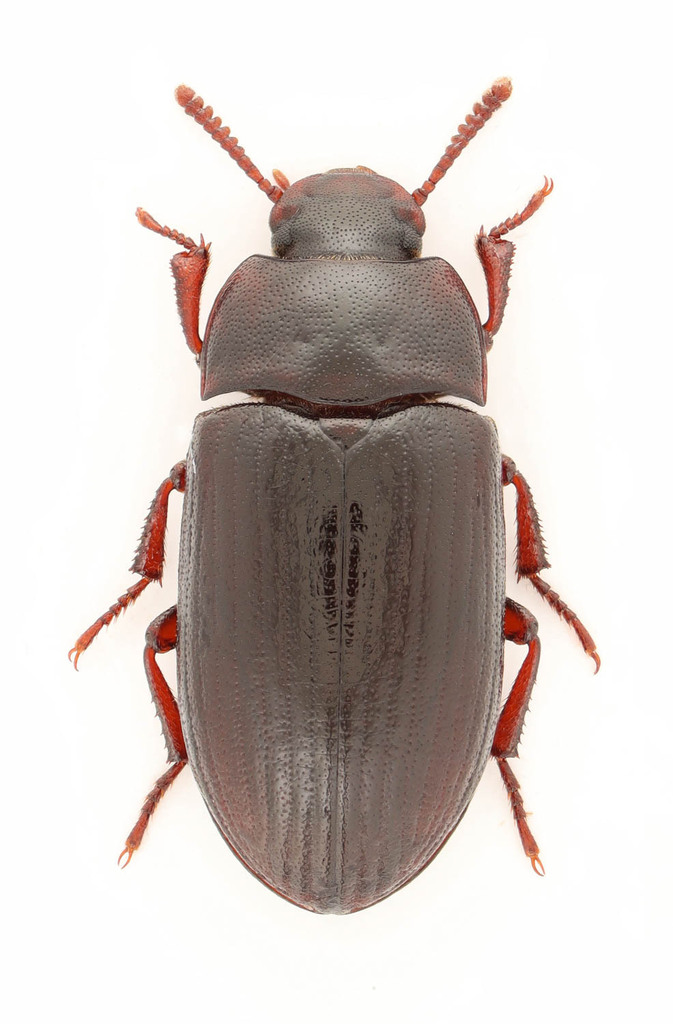
Lesser Mealworm
Alphitobius diaperinus
Alphitobius diaperinus is a species of beetle in the family Tenebrionidae, the darkling beetles. It is known commonly as the lesser mealworm and the litter beetle. It has a cosmopolitan distribution, occurring nearly worldwide. It is known widely as a pest insect of stored food grain products such as flour, and of poultry-rearing facilities and it is a vector of many kinds of animal pathogens. In larval form, it is an approved novel food in the European Union, and also used as animal feed.
From the article Alphitobius diaperinus on Wikipedia (CC BY-SA), quoted section by section
Description
The adult lesser mealworm beetle is roughly 6 mm long and widely oval in shape. It is shiny black or brown with reddish brown elytra, the color variable among individuals and changing with age. Much of the body surface is dotted with puncture-like impressions. The antennae are paler at the tips and are covered in tiny, yellowish hairs. The elytra have shallow longitudinal grooves. The eggs are narrow, whitish or tan, and about 1.5 mm long. The larvae somewhat resemble other mealworms, such as the common mealworm (Tenebrio molitor), but are smaller, measuring up to 11 mm long at the final subadult stage. They are tapering and segmented, with three pairs of legs toward the front end, and whitish when newly emerged from the egg and darken to a yellow-brown. They become pale when preparing to molt between instar stages six to 11 instars occur.
Range & habitat
This species has long been known throughout the world as a common pest, so its origins are uncertain, but it may have originated in Sub-Saharan Africa. It moved into Europe long ago, and was likely introduced to North America from there.
Wikipedia: “Distribution”
At the table
The larvae are edible insects and also farmed for human consumption by specialized European insect farms, mostly in the Netherlands and Belgium. The larvae are either sold freeze-dried for consumption, or processed into food such as burger patties, pasta, or snack bars. As food, the larvae are commonly marketed under the term buffalo worms, a name that is also used for the larvae of Alphitobius laevigatus which can lead to confusion. The species can be detected using the PCR method. On 4 July 2022, EFSA published an opinion confirming the safety of frozen and freeze-dried larvae of Alphitobius diaperinus for human consumption. Approval as novel food in the European Union followed on 6 January 2023 with the EU commission's publication of Implementing Regulation 2023/58 authorising the placing on the market of the frozen, paste, dried and powder forms of Alphitobius diaperinus larvae.
Wikipedia: “As food”
Listen
Looking for field recordings…
Where it lives
Recorded sightings
—
geo-referenced records in GBIF, from museums, herbaria and field observers.
Drag the globe to turn it. Dots are where records exist, not a range map; darker means more records.
In the stacks
Searching the stacks…
Every page naming Alphitobius diaperinus in the Biodiversity Heritage Library →
This page is assembled live from iNaturalist, GBIF, Wikipedia, the Source Library and the Internet Archive. It is not yet part of the hand-edited codex. iNaturalist taxon 53926.