- Fungi Including Lichens
- ›Basidiomycete Fungi
- ›Higher Basidiomycetes
- ›Mushrooms, Bracket Fungi, Puffballs, and Allies
- ›Phallomycetidae
- ›Gomphales
- ›Gomphaceae
- ›Gomphus
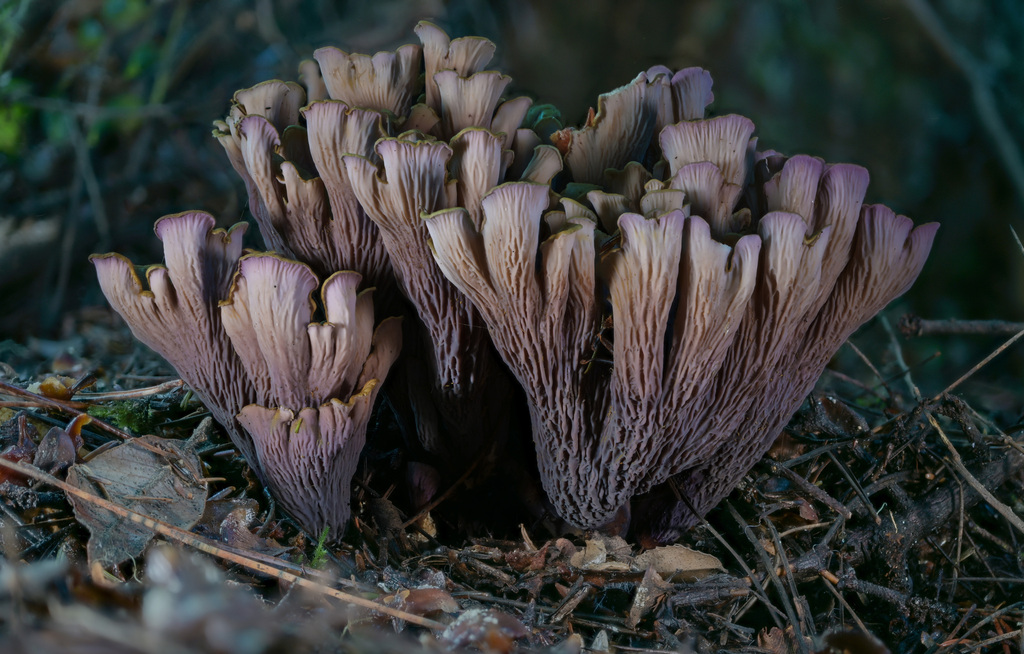
pig's ears
Gomphus clavatus
Gomphus clavatus, commonly known as pig's ears or the violet chanterelle, is an edible species of fungus in the genus Gomphus. Described by Jacob Christian Schäffer in 1774, G. clavatus has had several name changes and many alternative scientific names, having been classified in the genus Cantharellus (also called chanterelles), though it is not closely related to them. The fruit body is vase- or fan-shaped with wavy edges to its rim, and grows up to 15–16 cm (6–6+1⁄4 in) wide and 17 cm (6+3⁄4 in) tall. The upper surface or cap is orangish-brown to lilac, while the lower spore-bearing surface, the hymenium, is covered in wrinkles and ridges rather than gills or pores, and is a distinctive purple color.
Typically found in coniferous forests in Eurasia and North America, G. clavatus is mycorrhizal and associated with various conifers, particularly spruces and firs. It is more common at elevations of greater than 2,000 ft (600 m), in moist, shady areas with plenty of leaf litter. Although widespread, G. clavatus has become rare in many parts of Europe and extinct in the British Isles. It has been placed on the national Red Lists of threatened fungi in 17 different European countries and is one of 33 species proposed for international conservation under the Bern Convention.
From the article Gomphus clavatus on Wikipedia (CC BY-SA), quoted section by section
Description
The basidiocarps, or fruit bodies, of immature Gomphus clavatus are club-shaped and have one cap, but later spread out and have a so-called merismatoid appearance—several vase-shaped caps rising from a common stem. The fruit body is up to 20 cm (8 in) tall and 15 cm (6 in) wide; it is fan-shaped with wavy edges. The upper surfaces of the fruit bodies are covered with brown hyphae (microscopic filaments) that form small, distinct patches towards the margin, but combine to form a continuous felt-like fine-haired area, or tomentum, over the center of the cap. The color of the upper cap surface is orange-brown to violet, but fades to a lighter brown with age. The cap margins of older mushrooms can be quite ragged. The lower spore-bearing surface—the hymenium—is wrinkled, often with folds and pits, and violet to brown in color. The solid stem, which is continuous with the cap, is 0.8–3 cm (3⁄8–1+1⁄8 in) wide, 1–10 cm (1⁄2–4 in) tall, and covered with fine hairs that become coarser (hispid) towards the base. It is often compound, with several fruit bodies arising from the basal portion. Fruit bodies may bruise reddish-brown where handled. The flesh can be whitish-pink to lilac or cinnamon-buff. Thick under the center of the cap, it thins out towards the margins. It can be crunchy, though it is softer than that of the chanterelle. The taste and odor are mild. …
Range & habitat
Growing on the ground, Gomphus clavatus mushrooms appear singly, in clusters or clumps, or even occasionally fairy rings. The species is typically found in coniferous forests, and with a preference for moist, shady areas with deep leaf litter, or rotten wood debris on the ground. It is equally common in older or younger stands of trees. Fruit bodies are easily missed because their colors blend with those of the forest floor. It is more common at elevations of greater than 2,000 ft (600 m). Gomphus clavatus has been reported as forming symbiotic (mycorrhizal) associations with a variety of trees: Abies alba, Abies cephalonica, Abies firma, Abies nephrolepis, Abies religiosa, Picea species, Pinus densiflora, Pseudotsuga menziesii, and Tsuga heterophylla. It is also reported with beech (Fagus sylvatica) in Europe. In Asia, Gomphus clavatus has been reported from China, Japan, Korea, Malaysia, Nepal, and Pakistan. European countries where the fungus has been reported include Austria, the Czech Republic, France, Germany, Greece, Italy, Lithuania, Poland, Romania, Russia, Sweden, Switzerland, and Turkey. In North America, the fungus has been found across Canada, Mexico, and the United States (October–December on the West Coast and July–October elsewhere), being abundant in the Pacific Northwest.
Wikipedia: “Habitat and distribution”
At the table
Gomphus clavatus is edible; it is rated as choice by some, while others find it tasteless or experience gastric upsets. It has an earthy flavor and meaty texture that has been regarded as suiting red meat dishes. Like many edible fungi, consumption may cause gastrointestinal distress in susceptible individuals. The flesh becomes bitter with age, and older specimens may be infested with insects. Insect infestation is unlikely if the weather is cool. G. clavatus has been used for cooking for some time; Fries included it in his 1867 book Sveriges ätliga och giftiga svampar (Edible and Poisonous Mushrooms in Sweden). It is highly regarded by the Zapotec people of Ixtlán de Juárez in Oaxaca, Mexico, and the Sherpa people in the vicinity of Sagarmatha National Park in Nepal. Extracts prepared from G. clavatus fruit bodies have a high antioxidant activity, and a high concentration of phenolic and flavonoid compounds. Phenolic compounds identified from the fungus include protocatechuic acid, gallic acid, gentisic acid, vanillic acid, syringic acid, cinnamic acid, caffeic acid, ferulic acid, and tannic acid. In a chemical analysis of collections from the south Aegean Region of Turkey, the fungus was shown to have bioaccumulated the toxic metal cadmium to levels exceeding the maximum intake recommended by the European Union Scientific Committee on Food.
== References ==
Wikipedia: “Edibility”
Where it lives
Recorded sightings
—
geo-referenced records in GBIF, from museums, herbaria and field observers.
Drag the globe to turn it. Dots are where records exist, not a range map; darker means more records.
In the old herbals & bestiaries

In the stacks
Searching the stacks…
Every page naming Gomphus clavatus in the Biodiversity Heritage Library →
This page is assembled live from iNaturalist, GBIF, Wikipedia, the Source Library and the Internet Archive. It is not yet part of the hand-edited codex. iNaturalist taxon 54121.